Humpback whales - the gentle giants
pp. 60-61 · Read in the full issue
MAUI is one of the most beautiful islands in the world. Rainbows in every valley, brilliant green cane fields sprout ing out of the red earth, Haleakala crater rising high above the clouds. On the windward side, a bountiful growth of flowers, vines and ferns seems to spring out of the earth and the scent of plumeria and ginger fills the air. And each winter, on the leeward side of Maui, hundreds of humpback whales make their phenom enal reappearance in the calm warm waters off Lahaina.
Fellowship arrived in Maui on a warm blue Hawaiian day after a smooth and lazy sail from Molokai and anchored in the roadstead off Lahaina. Lahaina used to be a major whaling port but today the whaling ships and the old seadogs who sailed them have disappeared. Instead, it has become a whale-watching tourist mecca. Like everyone else, we hoped to catch sight of a whale or two lazing off the Lahaina waterfront.
We often got up at dawn and found the world breathless, not a ripple on the water, not a movement in the air. On a morning such as this, as we were quietly sipping our coffee on deck, somebody bellowed, k ‘Thar she blows!” Off to starboard and less than 50 feet away, three humpback whales were lazily swimming through the anchorage in front of the old Mala Wharf. They passed between Fellowship and another boat at
anchor in only 40 feet of clear water.
Foster donned his mask and fins and got a peek at the whales underwater. I was
momentarily mesmerized poetically
awestruck and grabbed a view from the deck instead. I couldn’t believe it!
I supposed I should have been scared to death humpbacks are much larger than Fellowship’s 33 feet, averaging 40 to 46 feet in length and weighing up to 40 tons. And they are much stronger than our fibreglass hull a mere flick of their tail on the water produces a slap that can be heard at once on the shores of Maui, Molokai and Lanai. But they are grace ful animals with an other-worldly voice and a strange appeal. They are the gentle giants.
Humpback whales are migratory ani mals, spending their summers in the high latitudes (Alaska, New Zealand and Antarctica) where there are generous food supplies. In the winter, they cruise to warmer waters nearer the equator to mate and breed. The females choose the breeding ground and in the North Pacific they winter in Mexico and Hawaii. In the South Pacific they often head for Tonga. Fellowship has followed a similar pattern, choosing the warmth and calm ness of tropical waters in winter, and shifting poleward in the summer to avoid hurricane season. Perhaps our affinity for these mammal springs from this like mindedness. During our travels, we have sighted humpbacks in Alaska and Ha waii, Tonga and New Zealand.
Day saling out of Lahaina in the winter is exciting. Each time we had a different experience with the humpback
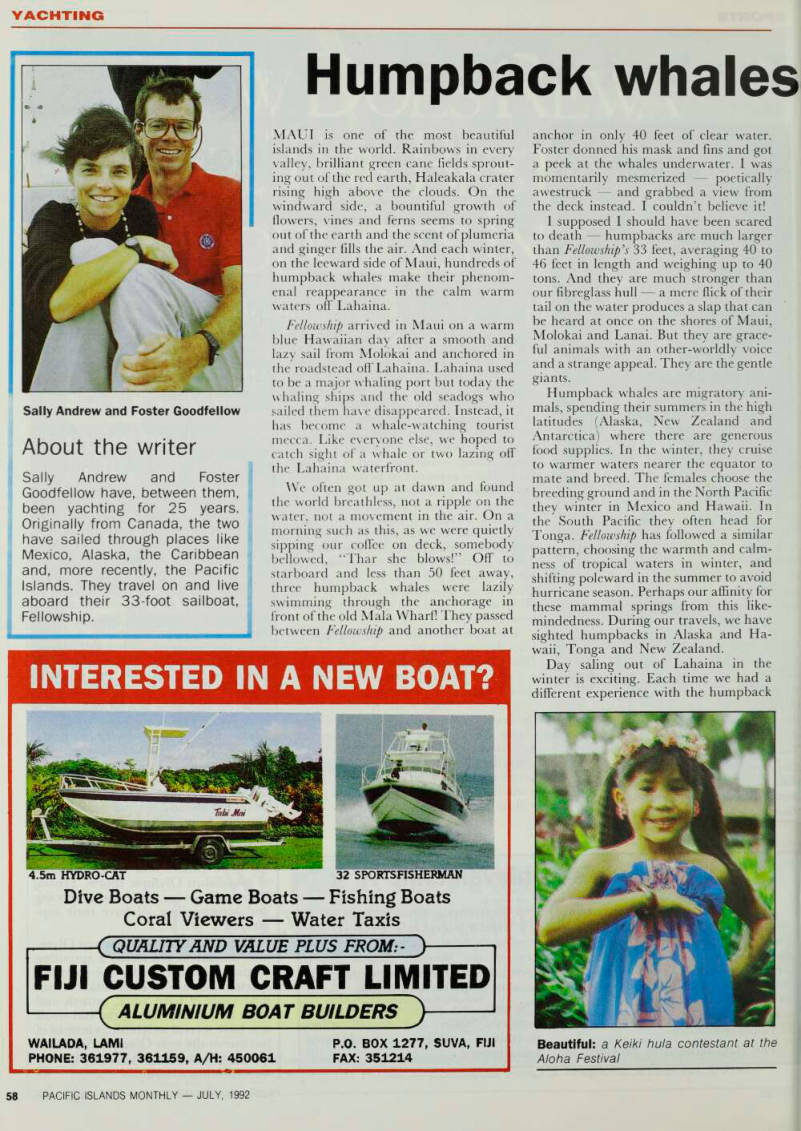
Beautiful: a Keiki hula contestant at the Aloha Festival
whales. One day we sailed Lanai-ward and saw several male humpbacks
breaching, slapping their flippers on the
water and generally having a good time.
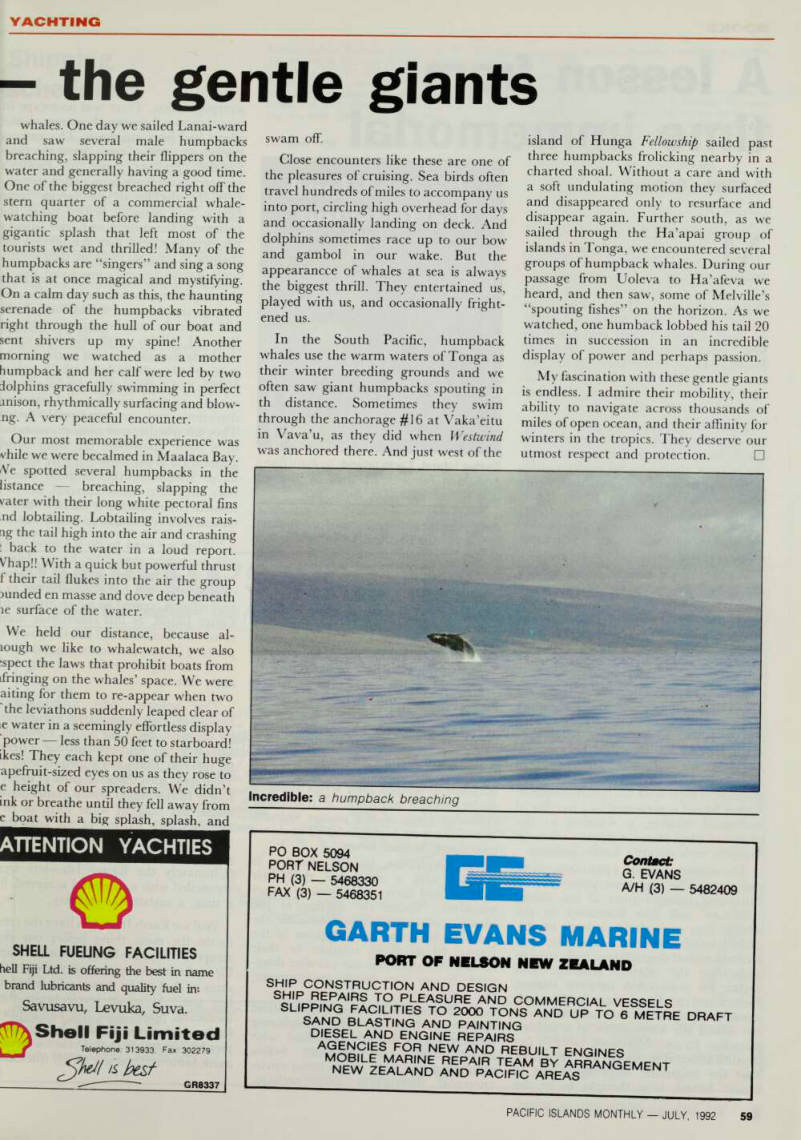
One of the biggest breached right off the stern quarter of a commercial whale watching boat before landing with a gigantic splash that left most of the tourists wet and thrilled! Many of the humpbacks are “singers” and sing a song that is at once magical and mystifying.
On a calm day such as this, the haunting serenade of the humpbacks vibrated right through the hull of our boat and sent shivers up my spine! Another morning we watched as a mother humpback and her calf were led by two
dolphins gracefully swimming in perfect
anison, rhythmically surfacing and blowi
ng. A very peaceful encounter.
Our most memorable experience was vhile we were becalmed in Maalaea Bay.
A/e spotted several humpbacks in the
listance breaching, slapping the
vater with their long white pectoral fins nd lobtailing. Lobtailing involves rais ng the tail high into the air and crashing : back to the water in a loud report.
Vhap!! With a quick but powerful thrust f their tail flukes into the air the group mnded en masse and dove deep beneath ic surface of the water.
We held our distance, because al lough we like to whalewatch, we also ;spect the laws that prohibit boats from fringing on the whales’ space. We were aiting for them to re-appear when two the leviathons suddenly leaped clear of e water in a seemingly effortless display power less than 50 feet to starboard! ikes! They each kept one of their huge apefruit-sized eyes on us as they rose to e height of our spreaders. We didn’t ink or breathe until they fell away from e boat with a big splash, splash, and
swam off.
Close encounters like these are one of the pleasures of cruising. Sea birds often trave i hundreds of miles to accompany us into port, circling high overhead for days and occasiona iiy ] andin „ on deck And dolphins sometimes race up to our bow and gambol in our wa ' ke But , hc appearancce of whales at sea is a , r™ , . , 7 \ th h ‘ entert * m ?? “ S ’ us US ’ 3 occaslonal ly f "ght- 1° the South Pacific, humpback whales use the warm waters of Tonga as their winter breeding grounds and we often saw giant humpbacks spouting in th distance. Sometimes they swim through the anchorage #l6 at Vaka’eitu * n ava u ’ as d ' d when Westwmd was anc^ored there. And just west of the
island of Hunga Fellowship sailed past three hum pbacks frolicking nearby in a charted shoal. Without a care and with a soft undula ting motion they surfaced and dlsa PP eared onl V to resurface and disappear again. Further south, as we $ T d f hr ° Ugh the Ha ’ a P ai grou P of islands m Tonga we encountered several of humpback whales During our passage Irom Uoleva to Ha afeva we heard, and then saw, some of Melville’s “spouting fishes” on the horizon. As we watched, one humback lobbed his tail 20 times in succession in an incredible display of power and perhaps passion, My fascination with these gentle giants j s endless. I admire their mobility their ability to navigate across thousands of miles of open ocean, and their affinity for winters in the tropics. They deserve our utmost respect and protection. □
Incredible: a humpback breaching