PNG politics
pp. 13-15 · Read in the full issue
Resource development - the dividing line in PNG politics
By Frank Kolma
ECONOMIC independence will be the central issue of Papua New Guinea’s fourth Parliament, just elected. At the time of writing the make-up of that Parliament is subject to a national general election.
With proceeds from mineral and petroleum developments, the chief means of funding government activity, the resource sector has become a target for differing political party policies.
Prime Minister Rabbie Namaliu’s Pangu Pati has had a run of bad public opinion very close to the election.
Namaliu’s own achievements of the last four years in trying to assure foreign multi-national joint ventures were tor pedoed by party’s founder and Foreign Affairs Minister, Sir Michael Somare, when he declared that he would person ally influence the party after the elections to renegotiate all agreements. Somare said he would get more Papua New Guinea interests in the developments.
Prominent companies and Namaliu himself tried to make light of the suggestion, declaring that it was made in the heat of the moment on the campaign trail. Somare’s seniority, however, forced over K 220 million to be wiped off the shares of most PNG-based resource developers on the Australian stock exchange.
Opposition leader Pias Wingti grabbed the chance to put his own views on the matter.
Said Wingti: “We intend to put a ban on logs and certain things that are leaving the country in raw form. We want to see an oil refinery, a gold refinery, a copper smelter in the country.
“As a policy that is what we want to do. It will definitely be a priority.”
Earlier, again at the insistence of Somare, Cabinet agreed to set up a local National Oil and Gas company to carry out local processing of mineral and oil.
Namaliu announced that he had struck an agreement with a Japanese firm to forward sell K6OO million worth of Kutubu oil. He quickly recoiled at the reaction from the business community and the idea has not been heard of since.
Debate on on-shore processing of gold and oil has flared from time to time and a consultant couple with very close links to Cabinet ministers revealed they had
plans to raise money to build a K6OO million gold refinery and plans for a similar project in gold. Controversy on the links with senior ministers shelved that idea.
In this light, the June elections were critical.
As they were lined up for the elections, the government coalition parties of Pangu, People’s Action Party, League for National Advancement and one half of the National Party were declaring that they were committed to each other. The
Opposition parties, comprising the
People’s Democratic Movement, People’s Progress Party, United Party and the other half of National Party were equally committed to each other.
Opposition leader, Paias Wingti, said, however: “In politics, we have no permanent enemies.”
If the current Prime Minister were to lead the government again, it would have meant a continuing of current policies relating to mineral and pet roleum development, but with Somare as a persistent thorn in his side.
Should Opposition leader, Paias Wingti lead his coalition into govern ment, there is likely to be a drastic shift in policy.
It is an election that has fallen short of many expectations. It was thought, for instance, that 16 years after Indepen dence, this election would see a maturing of PNG politics.
University of PNG lecturer in politics Nao Badu states that so such develop ment has taken place.
Badu said: “There are no clear ideological differences between the par ties. All parties can be classified near the centre.
“All want the market economy, but under national control. They want state control of welfare services.
“This is not necessarily bad. Papua New Guinea has peacefully passed that critical 15 years of independence which have seen nations of Africa go down the road to dictatorships and revolutions.
We are still a thriving democracy. That is something to be proud of.”
But it is bad when the aspirations of the people supercede those of the leaders.
Over 2000 policemen, 200 soldiers and 19,000 electoral officers are ready with over 100 tonnes of ballot papers and election equipment.
Twelve political parties are jostling to be in government on July 4. With no party clearly ahead of the others, the fourth Parliament looks set to be another coalition government.
Predictions on what party leads that coalition is pure guess-work at this stage, although it can be narrowed down to the Pangu Pati of current Prime Minister Namaliu and the Opposition People’s Democratic Movement led by Paias Wingti.
Campaigning has been boring re cently, with candidates from every camp offering the same roads, bridges, hos pitals and schools. Only the issue of resource development has seen clear divisions in policies.
With more educated candidates and a public outcry for Constitutional reforms and stable government it was thought this election would see the maturing of PNG politics. It has not.
Democracy, PNG style is tribal. Free choice is the tribal leaders' will.
Since Independence on September 16, 1975, when the Australian flag was peacefully lowered, this South Pacific nation has taken the Westminster parlia mentary system of government and grafted on it its own special brand.
With so many candidates running for power and a first past the post electoral system it is most likely the candidate with the biggest number of tribesmen support ing him will win.
Election is loud and open. The principle of secret ballot remains that principle only. Tribal leaders discuss openly and decide who their people should vote for.
Wendu Mek, a woman from the Southern Highlands province who de cided to follow her own counsel last election wound up in hospital and, when discharged from the hospital, she found she was without a husband, as well.
She warned fellow women in this election: “Somehow they have spies who will find out who you vote for. I did not like the person the village decided to vote for so I voted a different person.
“I thought it was secret, but when I returned my husband broke my hand.
Later he threw my clothes out of the house. He said I brought shame to his name because he had guaranteed the village that his family would vote the man they had decided on.”
Other villages see election as an opportune time to make money. “We are a market good,” a leader in Chimbu province of the populous highlands region, “whoever wants our vote can buy it.”
In one province election has taken on a totally different turn.
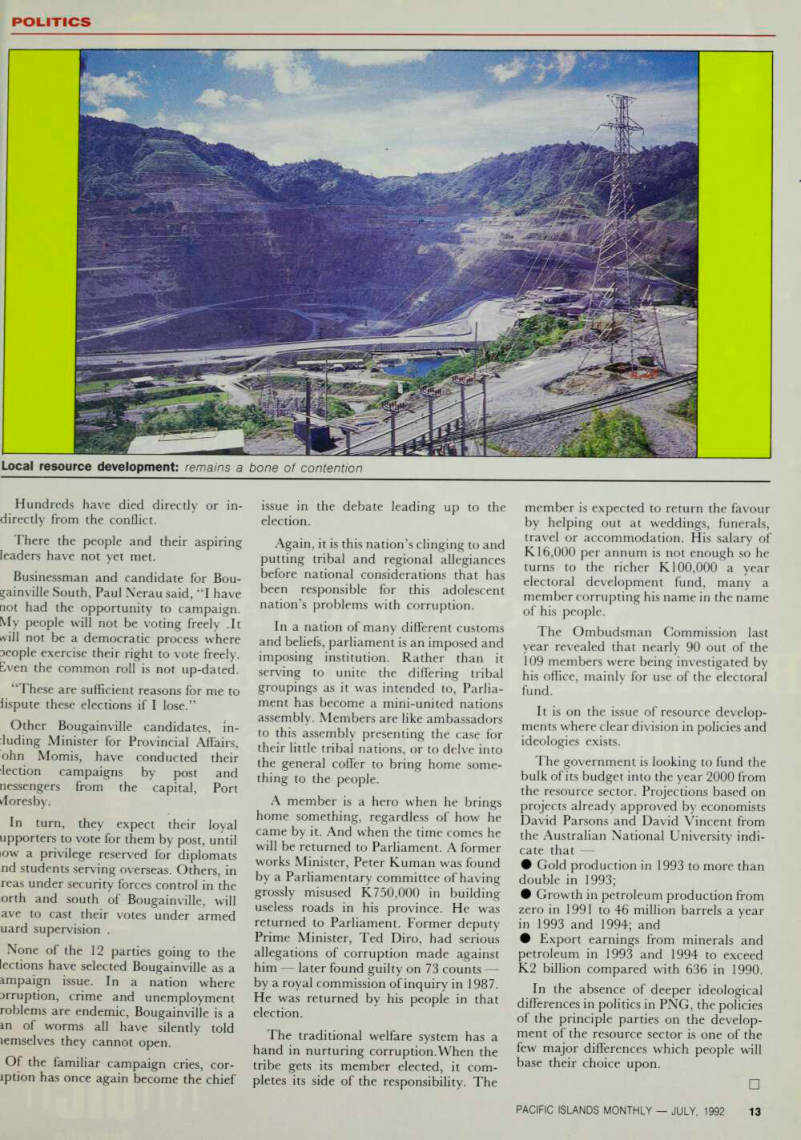
A three-year secessionist uprising on Bougainville has forced a halt to govern ment services to the island and closed down one of the world’s largest open cut
mines, Bougainville Copper.
Hundreds have died directly or in directly from the conflict.
There the people and their aspiring leaders have not yet met.
Businessman and candidate for Bou gainville South, Paul Nerau said, “I have not had the opportunity to campaign.
My people will not be voting freely .It will not be a democratic process where people exercise their right to vote freely.
Even the common roll is not up-dated.
“These are sufficient reasons for me to lispute these elections if I lose.”
Other Bougainville candidates, m :luding Minister for Provincial Affairs, ohn Momis, have conducted their lection campaigns by post and nessengers from the capital, Port
Moresby.
In turn, they expect their loyal upporters to vote for them by post, until iow a privilege reserved for diplomats nd students serving overseas. Others, in reas under security forces control in the orth and south of Bougainville, will ave to cast their votes under armed uard supervision .
None of the 12 parties going to the lections have selected Bougainville as a ampaign issue. In a nation where Drruption, crime and unemployment roblems are endemic, Bougainville is a m of worms all have silently told icmselves they cannot open.
Of the familiar campaign cries, cor iption has once again become the chief
issue in the debate leading up to the election.
Again, it is this nation’s clinging to and
putting tribal and regional allegiances
f r ■ , -j l , before national considerations that has e^. n res ponsi e or tis a o escent natlon s problems with corruption.
I n a nation of many different customs and beliefs, parliament is an imposed and
imposing institution. Rather" than it
serving to unite the differing tribal groupings as it was intended to, Parliament has become a mini-united nations assembly. Members are like ambassadors to this assemb , presenting the case for their Uttle triba n H ations (Q ddve into the genera i co fy er to bring home something to the people. .
A member is a hero when he brings hom \ somet A hl “g> regardless of how he ° by lL Am ? wh J: n f he time c A °™ es he wl " be returned to Parliament. A former Minister, Peter Kuman was found b y a committee of having g , y misused K 750,000 m building Use e “ j'° ads r . m ,. hIS pr °, VlnCe He was returned to Parliament. Former deputy Prime Minister, Ted Diro, had serious allegations of corruption made against him later found guilty on 73 counts — by a ro y ai commission ermquiry in 1987.
He was returned by his people m that electl ° n - Tbe tradit ‘onal welfare system has a hand in nurturing corruption. When the tribe gets its member elected, it completes its side of the responsibility. The
member is expected to return the favour by helping out at weddings, funerals, ' r^ e l° r accommodation. His salary of , Kl6 ’ 00 ,° P e J ann “ m IS "°‘ e "°o gH S ° turns to the ncher K 100,000 a year electora , deve l o pment fund, many a member corrupting his name in the name of his peop i e r Xh e Ombudsman Commission last vear revealed that ou7 of the
K^wt^Tn^inldglmdt
his office, mainly for use of the electoral fund, T .. r . , It is on the issue of resource develop where clear division m polices and
ideologies exists.
The government is looking to fund the bulk of its budget into the year 2000 from the resource sector. Projections based on projects already approved by economists David Parsons and David Vincent from the Australian National University indi cate that - • Gold production in 1993 to more than double in 1993; • Growth in petroleum production from zero in 1991 to 46 million barrels a y ear in 1993 and 1994; and • Export earnings from minerals and petroleum in 1993 and 1994 to exceed K 2 billion compared with 636 in 1990.
In the absence Q f deeper ideological differences in politics in PNG, the policies of the Principle parties on the develop ment of the resource sector is one of the * ew ma J or differences which people will base their choice upon, □
Local resource development: remains a bone of contention