Keeping politicans
pp. 9-12 · Read in the full issue
money-honest
Disclosure laws can make a difference
By David North
HOW do you keep elected poli ticians money-honest? That’s a problem throughout the Pacific and much of the world. While*there’s no cure-all for greed, the U.S. islands approach this problem with a collection of techniques including a series of spotlights pointed at the inidivdual politician’s public and private finances.
As a result, we know that: • Congressman Ben Blaz (R Guam) pays $390 per month to Maids To Order, a cleaning service which takes care of his office on the island. We also know that these maids don’t do rugs his office paid someone else for carpet
cleaning.
• Speaking of home island offices, Congressman Eni F. H. Faleomavaega (D American Samoa) must grit his teeth every time the office rent is paid; he has to make out a monthly check for $BOO to the Treasurer of American Samoa, Ace Tago the very man who ran against him for Congress two years ago.
Faleomavaega rents space from the American Samoa Government (ASG), and pays about a fifth as much rent as Blaz, who represents a more affluent island. • Joseph Tighe, director of one of the Guam’s public agencies, says he has assets of $3OOO and liabilities of $96,000, despite an annual income of $93,817.48. • Then there is Tighe’s colleague, Giovanni Sgambelluri, another Guam official, who has a slightly lower income but assets of $2,244,000 and liabilities of $106,000. Maybe their financial stand ings reflect their lines of work; Tighe does educational television and Sgambelluri is the Director of the Territorial Bureau of Budget and Management Research. • Further, both Faleomavaega and Blaz have mobile phones in their cars but the former pays $22.47 a month for his, while Blaz’s pays only $2O a month.
All of these tidbits come from the official records of the U.S. Congress, and from the Territory of Guam; anyone wanting this information can secure it by visiting the office in question, or, in the
case of the Guam official’s financial statements, by reading them in the Pacific Daily News.
Journalists can, and do, have fun with this kind of financial trivia, but the underlying theme is a serious one.
Carefully drawn financial dissclosure legislation, even if indifferently enforced, can make a major difference in the way politicians behave; these “sunshine laws,” are a major part of the efforts in the U.S. islands to keep politicians money honest.
These disclosure laws bring results.
The rental arrangements noted above, for example, remind me of the former Congressman from Indiana who had to report that government funds were being used to rent his front porch, as a district office. He was laughed and voted out of office and other Congressman avoided renting space in buildings that they owned.
More significantly, forcing Congress men to report on lecture fees, the norm was $2OOO, paid to them while speaking to interest groups, has virtually ended that practice. The interest groups were not intrigued by what the Congressmen would say to them, what they were buying, it is generallyy believed, was access to the Congressman before and after the little speech.
The “sunshine laws,” however, do not stand alone, they are part of a larger U.S. system of checks and balances, all designed to keep politicians money honest. There are four principal elements in this larger system; two or more levels of government eyeing each other; three quite separate and quite independent branches of each of these levels of government (executive, legislative and judicial); an independent auditing au thority, and an independent and often assertive press. When legislators adopt “sunshine laws” within this system they not only limit their ability to gouge the taxpayers, should they feel so inclined, but they set a precedent for years or decades to come. It is politically awk ward to undo “sunshine” arrangements, though Peter Tali Coleman, Governor of American Samoa, has moved in that direction.
The controversial of these elements'is that of the layers of government; U.S. flag islands con tinue to seek money from Washington, but do not want strings tied to that money, or to have federal auditors pay attention to how it is spent. And it was federal prosecutors who, in recent years, ended the political career of Congress man Fofo Sunia (D American Samoa), who plea bargained a charge of stealing Congressional funds, and of Governor Ricky Bordallo (D Guam) who killed himself rather than go to prison for misusing public funds.
While both Sunia and Bordallo were Democrates prosecuted by the Reagan Administration, it is not only Democrats who get in trouble with the feds.
Currently both the Commonwealth of the Northern Mariana Islands (CNMI) and the ASG (both with Republican Governors) are fighting with federal auditors.
Strictly speaking, the CNMI issue is more of a policy issue than an investi gation of individual malfeasance. The Inspector General of the Mainland Department of Interior, wants to exam ine the way CNMI collects income taxes.
The Governor, Larry Guerrero, argues that these are local funds, and that the feds have no right to look at them.
Without anyone saying so very loudly, the feds apparently suspect that the CNMI taxation system produces rela tively little revenue (hence the requests for federal funds), and that the system is tilted heavily against low income resi dents of the islands. CNMI's income tax
system has three elements: 1) starts with the graduated federal income tax system (though the money all stays on the island); 2) heavy refunds, 95 per cent for those with incomes under S 7 million, are then sent to the taxpayers; 3) and then another, island-oriented tax system is imposed on income, with a heavier burden on the lower income residents
than on well-to-do ones. The IG would like to look at this, and has been forced by the Governor to go into federal court, where the IG will probably win.
The auditors’ work in American Samoa is more sweeping than the efforts of the IG in CNMI. Encouraged by Faleomaveaga, and the House Interior
Committee, Washington’s independent
audit agency, the General Accounting Office (GAO) sent a team of inspectors to look at the books in Pago Pago. They also worked with a thick pile of critical reports assembled over the years by the IG’s office.
GAO found that: American Samoa’s deficit was large and rising rapidly, that it failed to collect taxes very well, and may have let some major politicians get away without paying taxes, that officials often spent money that had not been budgeted, that procurement regulations were regularly violated, and that there were conflicts of interest with ASG officials favoring their kinfolk when making ASG purchasing decisions. It also found that there was a long and persistent pattern of these problems.
The House of Representatives Interior and Insular Affairs Committee held a hearing on the subject.
Although the Fono and the Governor are often at odds with each other, the legislature did not rise to the opportunity to criticize the Governor. As a matter of fact, a close reading of the exchange between the House Committee and the Fono displayed the much larger cultural gap between Washington and Pago Pago, than it did any island-based division between the executive and the legislature.
The Committee’s questions were sharp, focussed precisely on the issues at hand (fiscal mismanage ment and corruption), and business-like to abrupt in tone. The Fono’s replies were fuzzy to non-responsive, often dealt with a broader context (like the island’s poverty), and were expressed with a soft grace. The Committee wrote, for ex ample: “The GAO has reported wide spread ignoring of procurement policies and conflicts of interest in contracting involving high-ranking officials. The Samoan administration doesn’t admit some of the procurement system’s fail ures. Do you agree with the administra tion? If not, what should be done?”
The Fono’s reply, over the signature of Tuana’itau F. Tuia, Speaker of the House of Representatives, started on an odd note: “I was surprised by the submission of additional questions since I was under the assumption duringg the course of the hearing, Mr. Chairman, that sufficient information was provided to address the audit findings. Neverthe less, the following pages contain the responses to the questions directed to me.”
Congressional committees have been asking additional questions, following hearings, since time immemorial; one wonders who was advising the Speaker.
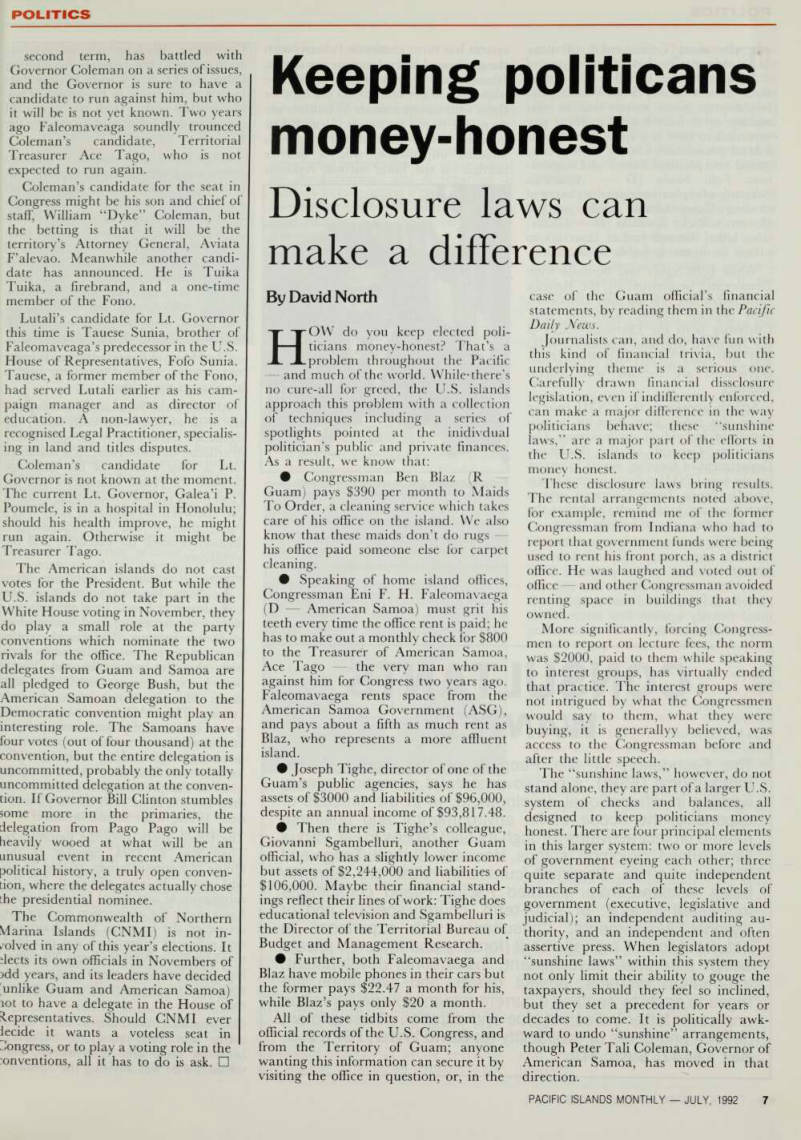
Falaeomavaega: must grit his teeth
As to the conflict-of-interest ques tion, the Speaker replied: “It should be noted that American Samoa is far removed from the main stream. Therefore, it does not have the luxury of having many contractors to choose from ... It wwould be unfair to prevent companies owned by some of the ranking officials from the bidding process based on their position.”
The GAO and Interior’s IG had focussed on a glaring instance of conflict of interest; the ASG’s Director of Com munications was charged with settingg the specifications of a purchase in such a way that the only way that the product in question, which related to mobile telephones, could be purchased in Am erican Samoa was to buy it from his family’s firm, which had an island-wide
sales monopoly.
On the even more fundamental ques tion of fiscal mismanagement, generally, the committee had written: “You say in your statement that ‘no measure of efficiency is ... going to relieve the territory ... of its financial woes.’ But
wouldn’t government integrity measures
help, given the apparent amount of nisspending in Samoa?”
In reply the Speaker while bowing in he direction of “stated rules and regu ations” (often laws passed by his own egislature), wrote of the islands “very ragile economic system. Misspending, as he GAO labeled it, emerged as a result )f not having sufficient funds to meet the leeds of the people of the territory.”
One of the underlying tensions be ween Washington and the islands re vives around government structures.
Vashington would be willing to pay less ttention to island finances if it were onvinced that the balance of powers rrangements separate and self
onfident executive, legislatie, judicial
nd auditory branches were alive and
well in the islands.
American Samoa has a governmental structure which is quite unlike the Mainland model. Samoa, unlike either Guam or CNMI, has no resident federal attorney, to prosecute lawbreakers. The ASG Attorney General, unlike most in the Mainland state governments (who are elected independently), is appointed by the Governor, and is regarded as unlikely to take action if laws are broken by another gubernatorial appointee in good standing with the Governor. The ASG auditor’s offie appears to Washing ton with the Governor. The ASG auditor’s office appears to Washington to have little independence, and the flabby response by the Fono to the GAO investigation has already been noted.
Although American Samoa is nominally organized on the Mainland model of an independently chosen legis lature, the de facto concentration of power in the executive’s hand is much like that in a parliamentary executive’s hand is much like that in a parliamen tary democracy, such as the one in nearby Western Samoa.
In fact, if it were not for the local press and Faleomavaega off in Washington
the various audits by the Interior Department and the GAO apparently would produce little change. The Samoa News , however, pays close attention to the audits done by other organizations, and raises a series of detailed fiscal honesty questions of its own on a regular basis.
Why was the former owner of the SPIA airline given given an insurance check by ASG after a former SPIA hanger was damaged in a hurricane, the News asked, when the hanger was owned by ASG at the time of the storm? Why did Governor Coleman end the long established practice of listing everyone who left the island on an airplane ticket
purchased by ASG? This time the News must have had a double motive for the question there was, of course, the matter of the public’s right to know how the public’s money was being spent, but there also was the denial of the best kind of news story, a list of names (and names make news) of the folks who managed to wangle an off-island trip at government expense.
It is the combination of the described ingredients which brings pressure for financial honesty to bear on the politicians. It includes the easy avail ability of the detailed records, a regular pattern of independent audits, indepen dent prosecutors and judges if the situation is bad enough, and the use of these records and audits by both political opponents and a nosey press. All of this helps produce an environment in which financial honesty become not only mor ally correct but the better part of valor, as well.
Returning to the financial filings in Washington and Guam, we find a number of items worth noting, for
example:
• The Lt. Governor of Guam (R), Frank Bias, and four of the nine Senators filing their returns on time, reported net worths in excess of one million dollars.
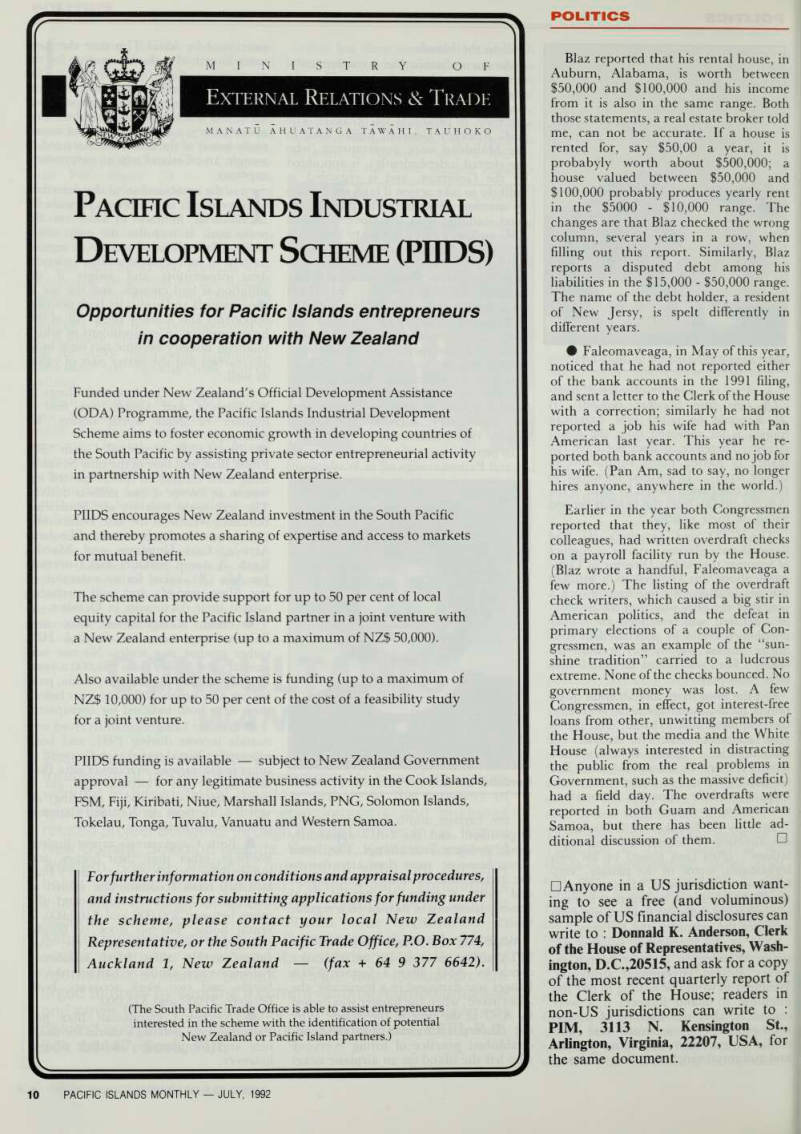
The well-to-do senators are Madeleine Bordallo, widow of the late Democratic Governor, and Senators Elizabeth Arriola, Carl Gutierrez and Martha Ruth. A dozen senators and Governor Joe Ada (R), asked for an extension of the filing period, and will probably submit their documents in October. • Both Congressmen Blaz and Faleomaveaga use, for Capitol Hill, rather modest pay scales. No one was paid at rates higher than $55,000 a year.
Faleomaveaga’s predecessor, Sunia, paid his top aide nearly $BO,OOO a year before they were both indicted for corruption. • Neither Congressman received any outside income during 1991, and both reported minimal travel at the expense of other organizations; in terms of gifts, Blaz had none, and Faleomaveaga got a peace-pipe, a quilt and a painting, all worth $lB5, from the National Congress of American Indians. • Both Congressmen report limited holdings, other than their homes, and automobiles (which do not count.) Blaz had two bank accounts, one valued at between $lOOO and $15,000 and the other between $50,000 and $lOO,OOO, a rental house, but no stock or bonds. (Congress, to blur things a bit, uses ranges rather than hard numbers.) Faleomaveaga, similarly, had no stock or bonds, and two bank accounts, both between $lOOO and $15,000. • Neither Congressman Blaz nor Faleomaveaga gets high marks for neat ness and completeness in their filings, however.
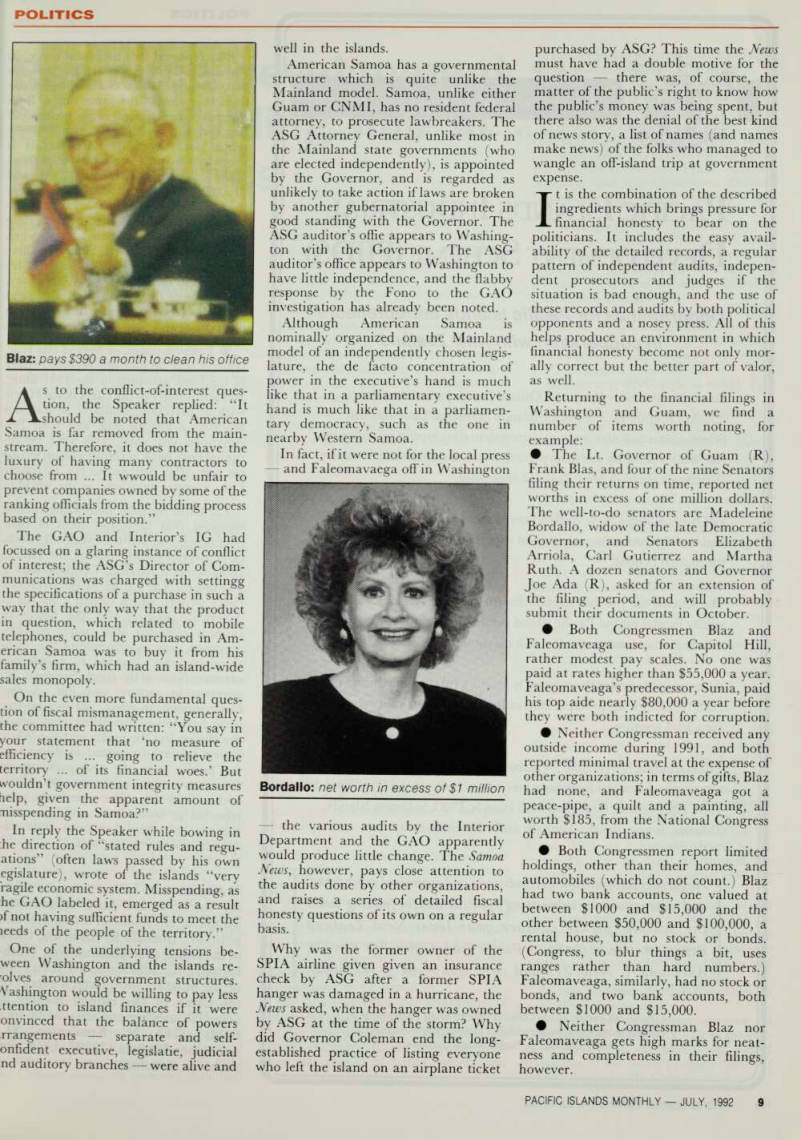
Blaz: pays $390 a month to clean his office
Bordallo: net worth in excess of $1 million
Blaz reported that his rental house, in Auburn, Alabama, is worth between $50,000 and $lOO,OOO and his income from it is also in the same range. Both those statements, a real estate broker told me, can not be accurate. If a house is rented for, say $50,00 a year, it is probabyly worth about $500,000; a house valued between $50,000 and $lOO,OOO probably produces yearly rent in the $5OOO - $lO,OOO range. The changes are that Blaz checked the wrong column, several years in a row, when filling out this report. Similarly, Blaz reports a disputed debt among his liabilities in the $15,000 - $50,000 range.
The name of the debt holder, a resident of New Jersy, is spelt differently in different years. • Faleomaveaga, in May of this year, noticed that he had not reported either of the bank accounts in the 1991 filing, and sent a letter to the Clerk of the House with a correction; similarly he had not reported a job his wife had with Pan American last year. This year he re ported both bank accounts and no job for his wife. (Pan Am, sad to say, no longer hires anyone, anywhere in the world.) Earlier in the year both Congressmen reported that they, like most of their colleagues, had written overdraft checks on a payroll facility run by the House. (Blaz wrote a handful, Faleomaveaga a few more.) The listing of the overdraft check writers, which caused a big stir in American politics, and the defeat in primary elections of a couple of Con gressmen, was an example of the “sun shine tradition” carried to a ludcrous extreme. None of the checks bounced. No government money was lost. A few Congressmen, in effect, got interest-free loans from other, unwitting members of the House, but the media and the White House (always interested in distracting the public from the real problems in Government, such as the massive deficit) had a field day. The overdrafts were reported in both Guam and American Samoa, but there has been little ad ditional discussion of them. □ □ Anyone in a US jurisdiction want ing to see a free (and voluminous) sample of US financial disclosures can write to : Donnald K. Anderson, Clerk of the House of Representatives, Wash ington, D.C.,20515, and ask for a copy of the most recent quarterly report of the Clerk of the House; readers in non-US jurisdictions can write to : PIM, 3113 N. Kensington St., Arlington, Virginia, 22207, USA, for the same document.