Settling disputes the Pacific way
p. 41 · Read in the full issue
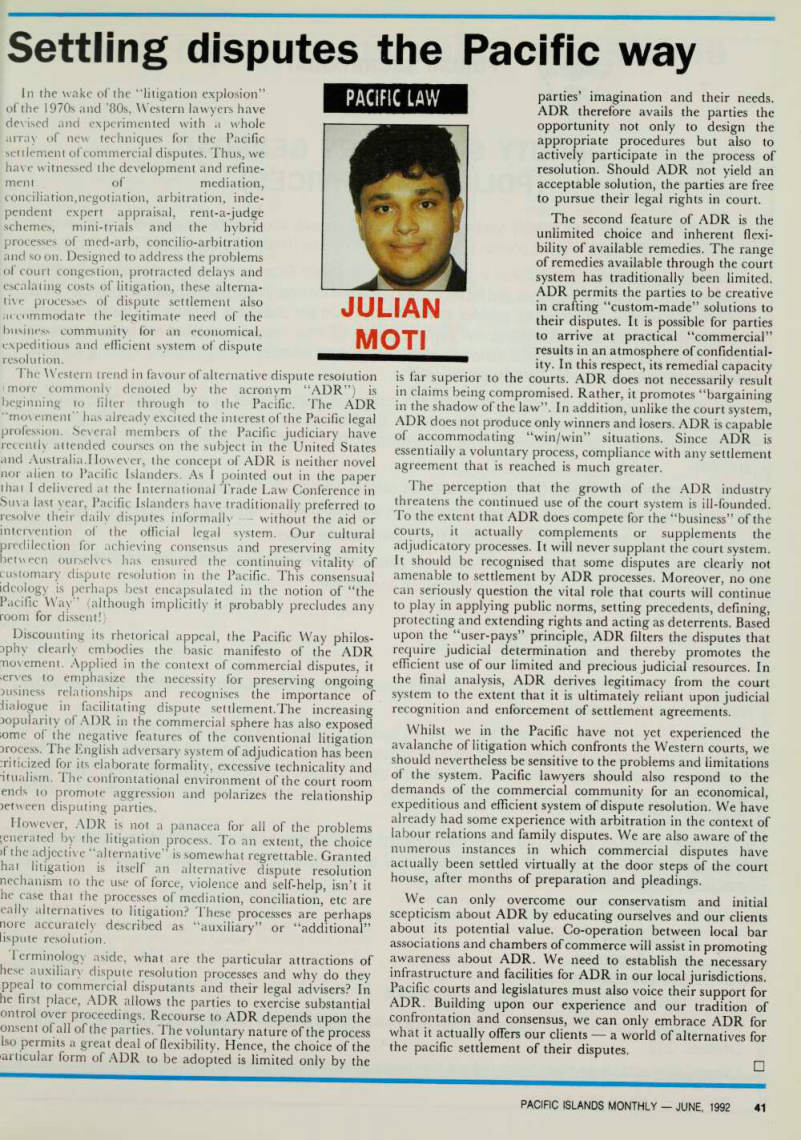
In the wake of the “litigation explosion” of the 1970 s and ’Bos, Western lawyers have devised and experimented with a whole array of new techniques for the Pacific settlement of commercial disputes. Thus, we have witnessed the development and refine ment of mediation, conciliation,negotiation, arbitration, inde pendent expert appraisal, rent-a-judge schemes, mini-trials and the hybrid processes of med-arb, concilio-arbitration and so on. Designed to address the problems of court congestion, protracted delays and escalating costs of litigation, these alterna tive processes of dispute settlement also accommodate the legitimate need of the business community for an economical, expeditious and efficient system of dispute resolution.
The Western trend in favour of alternative dispute resolution more commonly denoted by the acronym “ADR”) is beginning to filter through to the Pacific. The ADR “movement has already excited the interest of the Pacific legal profession. Several members of the Pacific judiciary have recently attended courses on the subject in the United States and Australia. However, the concept of ADR is neither novel nor alien to Pacific Islanders. As I pointed out in the paper that I delivered at the International Trade Law Conference in Suva last year, Pacific Islanders have traditionally preferred to resolve their daily disputes informally without the aid or intervention of the official legal system. Our cultural predilection for achieving consensus and preserving amity between ourselves has ensured the continuing vitality of customary dispute resolution in the Pacific. This consensual ideology is perhaps best encapsulated in the notion of “the Pacific Way (although implicitly ft probably precludes any room for dissent!) Discounting its rhetorical appeal, the Pacific Way philos ophy clearly embodies the basic manifesto of the ADR movement. Applied in the context of commercial disputes, it ;erves to emphasize the necessity for preserving ongoing ms in ess relationships and recognises the importance of dialogue in facilitating dispute settlement. The increasing Dopularity of ADR in the commercial sphere has also exposed 'Ome of the negative features of the conventional litigation process. The English adversary system of adjudication has been :ri ticized for its elaborate formality, excessive technicality and itualism. Ihe confrontational environment of the court room ends to promote aggression and polarizes the relationship
)etween disputing parties.
However, ADR is not a panacea for all of the problems generated by the litigation process. To an extent, the choice )f the adjective “alternative” is somewhat regrettable. Granted hat litigation is itself an alternative dispute resolution nechanism to the use of force, violence and self-help, isn’t it he case that the processes of mediation, conciliation, etc are eaily alternatives to litigation? Ihese processes are perhaps nore accurately described as “auxiliary” or “additional”
lispute resolution.
1 criminology aside, what are the particular attractions of hese auxiliary dispute resolution processes and why do they PPeal to commercial disputants and their legal advisers? In he first place, ADR allows the parties to exercise substantial ontrol over proceedings. Recourse to ADR depends upon the onsent of all of the parties. The voluntary nature of the process Iso permits a great deal of flexibility. Hence, the choice of the articular form of ADR to be adopted is limited only by the
Pacific Law
parties’ imagination and their needs.
ADR therefore avails the parties the opportunity not only to design the appropriate procedures but also to actively participate in the process of resolution. Should ADR not yield an acceptable solution, the parties are free to pursue their legal rights in court.
The second feature of ADR is the unlimited choice and inherent flexi bility of available remedies. The range of remedies available through the court system has traditionally been limited.
ADR permits the parties to be creative in crafting “custom-made” solutions to their disputes. It is possible for parties to arrive at practical “commercial” results in an atmosphere of confidential ity. In this respect, its remedial capacity
is far superior to the courts. ADR does not necessarily result in claims being compromised. Rather, it promotes “bargaining in the shadow of the law”. In addition, unlike the court system, ADR does not produce only winners and losers. ADR is capable of accommodating “win/win” situations. Since ADR is essentially a voluntary process, compliance with any settlement agreement that is reached is much greater.
The perception that the growth of the ADR industry threatens the continued use of the court system is ill-founded.
To the ex tent that ADR does compete for the “business” of the courts, it actually complements or supplements the adjudicatory processes. It will never supplant the court system.
It should be recognised that some disputes are clearly not amenable to settlement by ADR processes. Moreover, no one can seriously question the vital role that courts will continue to play in applying public norms, setting precedents, defining, protecting and extending rights and acting as deterrents. Based upon the “user-pays” principle, ADR filters the disputes that require judicial determination and thereby promotes the efficient use of our limited and precious judicial resources. In the final analysis, ADR derives legitimacy from the court system to the extent that it is ultimately reliant upon judicial recognition and enforcement of settlement agreements.
Whilst we in the Pacific have not yet experienced the avalanche of litigation which confronts the Western courts, we should nevertheless be sensitive to the problems and limitations of the system. Pacific lawyers should also respond to the demands of the commercial community for an economical, expeditious and efficient system of dispute resolution. We have already had some experience with arbitration in the context of labour relations and family disputes. We are also aware of the numerous instances in which commercial disputes have actually been settled virtually at the door steps of the court house, after months of preparation and pleadings.
We can only overcome our conservatism and initial scepticism about ADR by educating ourselves and our clients about its potential value. Co-operation between local bar associations and chambers of commerce will assist in promoting awareness about ADR. We need to establish the necessary infrastructure and facilities for ADR in our local jurisdictions.
Pacific courts and legislatures must also voice their support for ADR. Building upon our experience and our tradition of confrontation and consensus, we can only embrace ADR for what it actually offers our clients a world of alternatives for the pacific settlement of their disputes.