A Subsistence Alternative
p. 40 · Read in the full issue
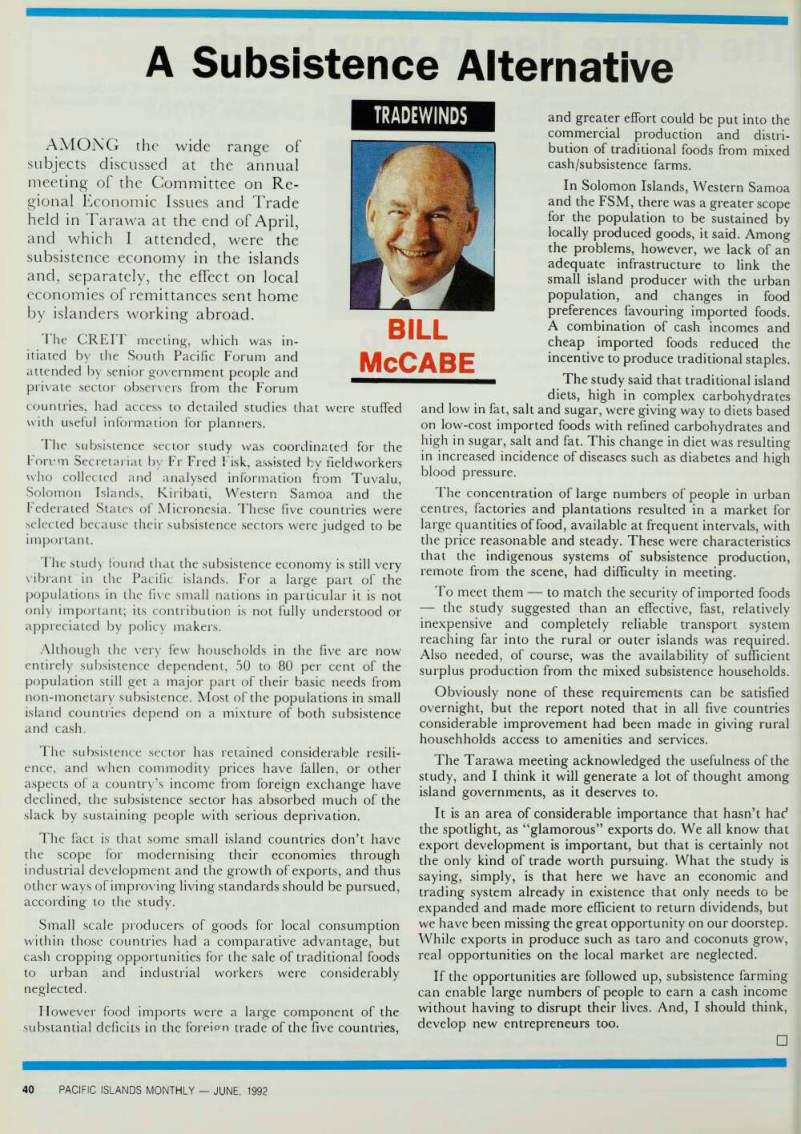
AMONG the wide range of subjects discussed at the annual meeting of the Committee on Re gional Economic Issues and Trade held in Tarawa at the end of April, and which 1 attended, were the subsistence economy in the islands and, separately, the effect on local economies of remittances sent home by islanders working abroad.
The CREIT meeting, which was in itiated by the South Pacific Forum and attended by senior government people and private sector observers from the Forum
countries, had access to detailed studies that were stuffed with useful information for planners.
The subsistence sector study was coordinated for the l orum Secretariat by Fr Fred Fisk, assisted by held workers who collected and analysed information from Tuvalu, Solomon Islands, Kiribati, Western Samoa and the Federated States of Micronesia. These five countries were selected because their subsistence sectors were judged to be
important.
The stud) found that the subsistence economy is still very vibrant in the Pacific islands. For a large part of the populations in the five small nations in particular it is not only important; its contribution is not fully understood or
appreciated by policy makers.
Although the very few households in the five are now entirely subsistence dependent, 50 to 80 per cent of the population still get a major part of their basic needs from non-monetary subsistence. Most of the populations in small island countries depend on a mixture of both subsistence and cash.
The subsistence sector has retained considerable resili ence, and when commodity prices have fallen, or other aspects of a country’s income from foreign exchange have declined, the subsistence sector has absorbed much of the slack by sustaining people with serious deprivation.
The fact is that some small island countries don’t have the scope for modernising their economies through industrial development and the growth of exports, and thus other ways of improving living standards should be pursued,
according to the study.
Small scale producers of goods for local consumption within those countries had a comparative advantage, but cash cropping opportunities for the sale of traditional foods to urban and industrial workers were considerably neglected.
However food imports were a large component of the substantial deficits in the foreip-n trade of the five countries,
Tradewinds
and greater effort could be put into the commercial production and distri bution of traditional foods from mixed cash/subsistence farms.
In Solomon Islands, Western Samoa and the FSM, there was a greater scope for the population to be sustained by locally produced goods, it said. Among the problems, however, we lack of an adequate infrastructure to link the small island producer with the urban population, and changes in food
preferences favouring imported foods.
A combination of cash incomes and cheap imported foods reduced the incentive to produce traditional staples.
The study said that traditional island diets, high in complex carbohydrates
and low in fat, salt and sugar, were giving way to diets based on low-cost imported foods with refined carbohydrates and high in sugar, salt and fat. This change in diet was resulting in increased incidence of diseases such as diabetes and high blood pressure.
The concentration of large numbers of people in urban centres, factories and plantations resulted in a market for large quantities of food, available at frequent intervals, with the price reasonable and steady. These were characteristics that the indigenous systems of subsistence production, remote from the scene, had difficulty in meeting.
To meet them to match the security of imported foods the study suggested than an effective, fast, relatively inexpensive and completely reliable transport system reaching far into the rural or outer islands was required.
Also needed, of course, was the availability of sufficient surplus production from the mixed subsistence households.
Obviously none of these requirements can be satisfied overnight, but the report noted that in all five countries considerable improvement had been made in giving rural househholds access to amenities and services.
The Tarawa meeting acknowledged the usefulness of the study, and I think it will generate a lot of thought among island governments, as it deserves to.
It is an area of considerable importance that hasn’t had the spotlight, as “glamorous” exports do. We all know that export development is important, but that is certainly not the only kind of trade worth pursuing. What the study is saying, simply, is that here we have an economic and trading system already in existence that only needs to be expanded and made more efficient to return dividends, but we have been missing the great opportunity on our doorstep.
While exports in produce such as taro and coconuts grow, real opportunities on the local market are neglected.
If the opportunities are followed up, subsistence farming can enable large numbers of people to earn a cash income without having to disrupt their lives. And, I should think, develop new entrepreneurs too.