What is the Forum?
p. 32 · Read in the full issue
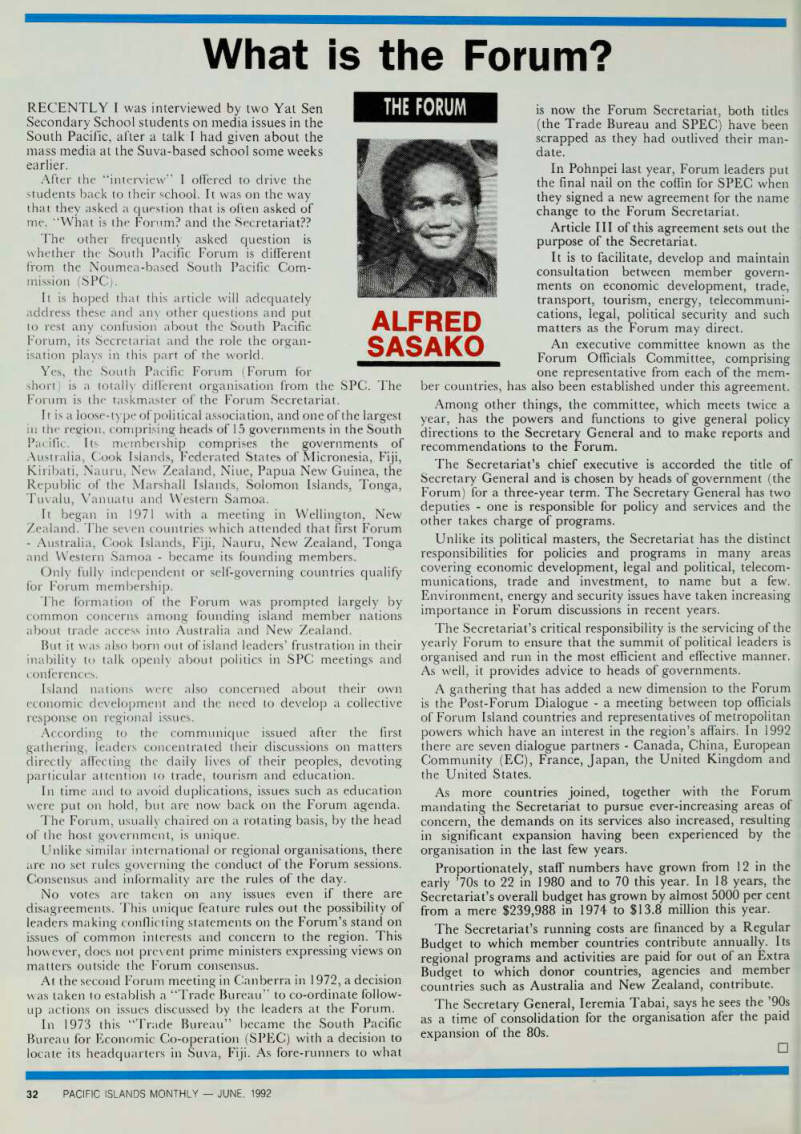
RECENTLY 1 was interviewed by two Yat Sen Secondary School students on media issues in the South Pacific, after a talk I had given about the mass media at the Suva-based school some weeks earlier.
After the “interview” I offered to drive the students back to their school. It was on the way that they asked a question that is often asked of me. “What is the Forum? and the Secretariat??
The other frequently asked question is w'hether the South Pacific Forum is different from the Noumea-based South Pacific Com
mission (SPC).
It is hoped that this article will adequately address these and any other questions and put to rest any confusion about the South Pacific Forum, its Secretariat and the role the organ isation plays in this part of the world.
Yes, the South Pacific Forum (Forum for
short) is a totally different organisation from the SPC. The Forum is the taskmaster of the Forum Secretariat.
It is a loose-type of political association, and one of the largest in the region, comprising heads of 15 governments in the South Pacific. Its membership comprises the governments of Australia, Cook Islands, Federated States of Micronesia, Fiji, Kiribati, Nauru, New Zealand, Niue, Papua New Guinea, the Republic of the Marshall Islands, Solomon Islands, Tonga, Tuvalu, Vanuatu and Western Samoa.
It began in 1971 with a meeting in Wellington, New Zealand. The seven countries which attended that first Forum - Australia, Cook Islands, Fiji, Nauru, New Zealand, Tonga and Western Samoa - became its founding members.
Only fully independent or self-governing countries qualify for Forum membership.
The formation of the Forum was prompted largely by common concerns among founding island member nations about trade access into Australia and New' Zealand.
But it was also born out of island leaders’ frustration in their inability to talk openly about politics in SPC meetings and conferences.
Island nations were also concerned about their own economic development and the need to develop a collective response on regional issues.
According to the communique issued after the first gathering, leaders concentrated their discussions on matters directly affecting the daily lives of their peoples, devoting particular attention to trade, tourism and education.
In time and to avoid duplications, issues such as education were put on hold, but are now' back on the Forum agenda.
The Forum, usually chaired on a rotating basis, by the head of the host government, is unique.
Unlike similar international or regional organisations, there are no set rules governing the conduct of the Forum sessions.
Consensus and informality are the rules of the day.
No votes are taken on any issues even if there are disagreements. This unique feature rules out the possibility of leaders making conflicting statements on the Forum’s stand on issues of common interests and concern to the region. This how ever, does not prevent prime ministers expressing views on matters outside the Forum consensus.
At the second Forum meeting in Canberra in 1972, a decision w as taken to establish a “Trade Bureau” to co-ordinate follow up actions on issues discussed by the leaders at the Forum.
In 1973 this “Trade Bureau” became the South Pacific Bureau for Economic Co-operation (SPEC) with a decision to locate its headquarters in Suva, Fiji. As fore-runners to what
The Forum
is now the Forum Secretariat, both titles (the Trade Bureau and SPEC) have been scrapped as they had outlived their man date.
In Pohnpei last year, Forum leaders put the final nail on the coffin for SPEC when they signed a new agreement for the name change to the Forum Secretariat.
Article 111 of this agreement sets out the purpose of the Secretariat.
It is to facilitate, develop and maintain consultation between member govern ments on economic development, trade, transport, tourism, energy, telecommuni cations, legal, political security and such matters as the Forum may direct.
An executive committee known as the Forum Officials Committee, comprising one representative from each of the mem
ber countries, has also been established under this agreement.
Among other things, the committee, which meets twice a year, has the powers and functions to give general policy directions to the Secretary General and to make reports and recommendations to the Forum.
The Secretariat’s chief executive is accorded the title of Secretary General and is chosen by heads of government (the Forum) for a three-year term. The Secretary General has two deputies - one is responsible for policy and services and the other takes charge of programs.
Unlike its political masters, the Secretariat has the distinct responsibilities for policies and programs in many areas covering economic development, legal and political, telecom munications, trade and investment, to name but a few.
Environment, energy and security issues have taken increasing importance in Forum discussions in recent years.
The Secretariat’s critical responsibility is the servicing of the yearly Forum to ensure that the summit of political leaders is organised and run in the most efficient and effective manner.
As well, it provides advice to heads of governments.
A gathering that has added a new dimension to the Forum is the Post-Forum Dialogue - a meeting between top officials of Forum Island countries and representatives of metropolitan powers which have an interest in the region’s affairs. In 1992 there are seven dialogue partners - Canada, China, European Community (EC), France, Japan, the United Kingdom and the United States.
As more countries joined, together with the Forum mandating the Secretariat to pursue ever-increasing areas of concern, the demands on its services also increased, resulting in significant expansion having been experienced by the organisation in the last few years.
Proportionately, staff numbers have grown from 12 in the early ’7os to 22 in 1980 and to 70 this year. In 18 years, the Secretariat’s overall budget has grown by almost 5000 per cent from a mere $239,988 in 1974 to $13.8 million this year.
The Secretariat’s running costs are financed by a Regular Budget to which member countries contribute annually. Its regional programs and activities are paid for out of an Extra Budget to which donor countries, agencies and member countries such as Australia and New Zealand, contribute.
The Secretary General, leremia Tabai, says he sees the ’9os as a time of consolidation for the organisation afer the paid expansion of the 80s.