predicted
p. 29 · Read in the full issue
Growth in tourism predicted
By Martin Tiffany
BASED on current performance Fiji tourism should continue to be the
country's biggest foreign exchange
earner in gross terms and the gap between it and the other industries will
continue to widen.
According to the Permanent Secretary for Tourism and Civil Aviation, Winston Thompson, the country doesn’t have any other option which will be able to provide the long term security that tourism does.
“There is no other real option avail able for Fiji to attract the sort of foreign exchange that we need to create the jobs that we have, said Thompson.
“As Fiji has such a small population base we cannot generate the critical mass in terms of domestic industry for a domestic population, therefore to im prove our standard of living we have to have money from outside.
“And what have we got to do that?
Our natural resources are pretty much at their potential. There’s not much more we can do with sugar, the markets are pretty well stuck and in any case our own capacity to produce has probably reached its limit unless we make major investments new infrastructure, new mills and so on.
“The other agricultural industries have not done very well over a long period, fishing has come up but has reached some sort of a plateau. Forestry has been developed but that again has used up all the possible pine areas, we’ve used up the indigenous forests, there
could be a little more in some agricul tural products spices, ginger.”
Thompson said the garment industry had developed in recent years but that too seemed to be hitting some sort of plateau.
“So you look around to see what you have to provide the jobs schools leavers now must number 15,000 a year.
The only real growth industry over a sustained period in the past and looking to the future is tourism and the service industries.
“There is still potential to grow, we still have a lot of areas which can be developed. The opportunity is there; all we need is the investment we have the skills to service it, we need the capital to be brought in to develop it.”
Since 1988 when visitor arrivals began to recover after the massive decline in 1987 a handful of projects have been proposed but have failed to go beyond the drawing board stage.
It has been suggested the slowness is due to uncertainty in the investment market.
But, with the election last month of Fiji’s first parliamentary government since 1987, industry leaders are hopeful the projects would rejuvenate interest.
Thompson said he didn’t know if the elections had anything to do with investors hesitating, but he said with big investments, investors tended to get nervous.
“The recession has been on, the downturn in tourism in some parts of the world, it just didn’t seem right to this sort of investors. They should proceed in the next couple of years.”
For the future Thompson said there should be more diversity in what we offered to take advantage of the trend towards ecotourism. He said this would enable people in the rural areas to become involved.
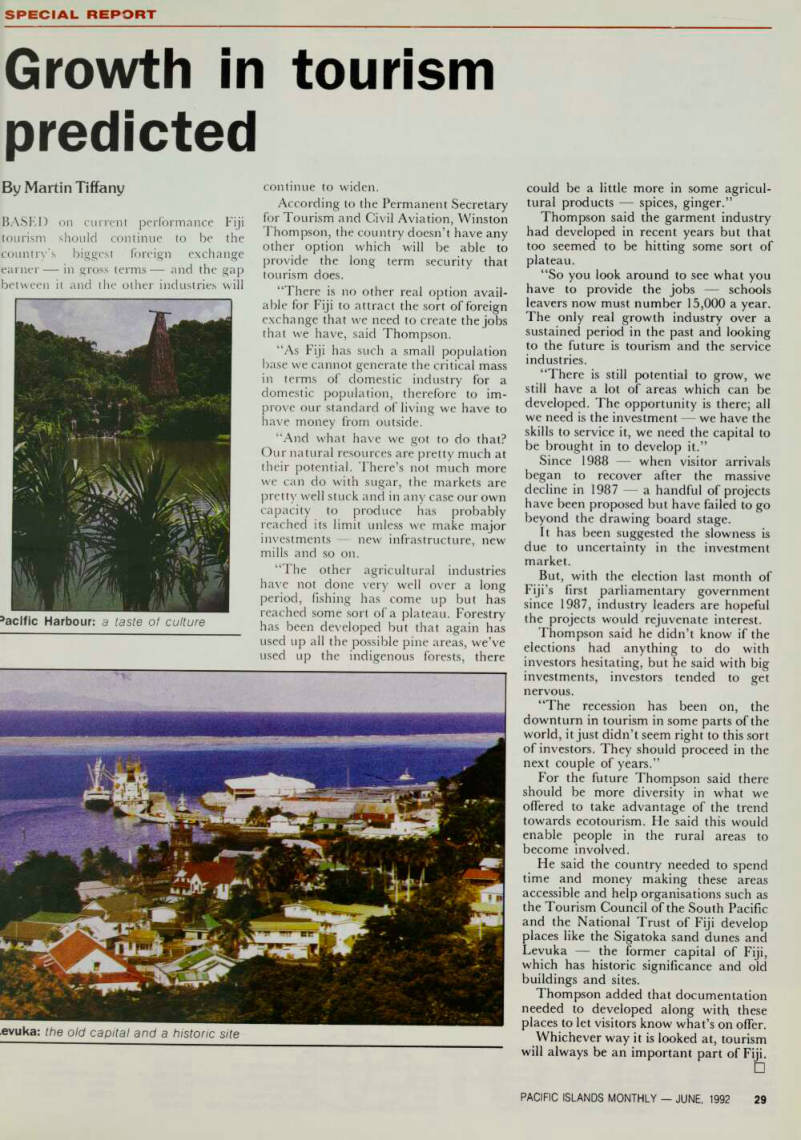
He said the country needed to spend time and money making these areas accessible and help organisations such as the Tourism Council of the South Pacific and the National Trust of Fiji develop places like the Sigatoka sand dunes and Levuka the former capital of Fiji, which has historic significance and old buildings and sites.
Thompson added that documentation needed to developed along with these places to let visitors know what’s on offer.
Whichever way it is looked at, tourism will always be an important part of Fiji.
I —l
Pacific Harbour: a taste of culture
[?]evuka: the old capital and a historic site