And who stopped the French?
pp. 39-43 · Read in the full issue
The Environment
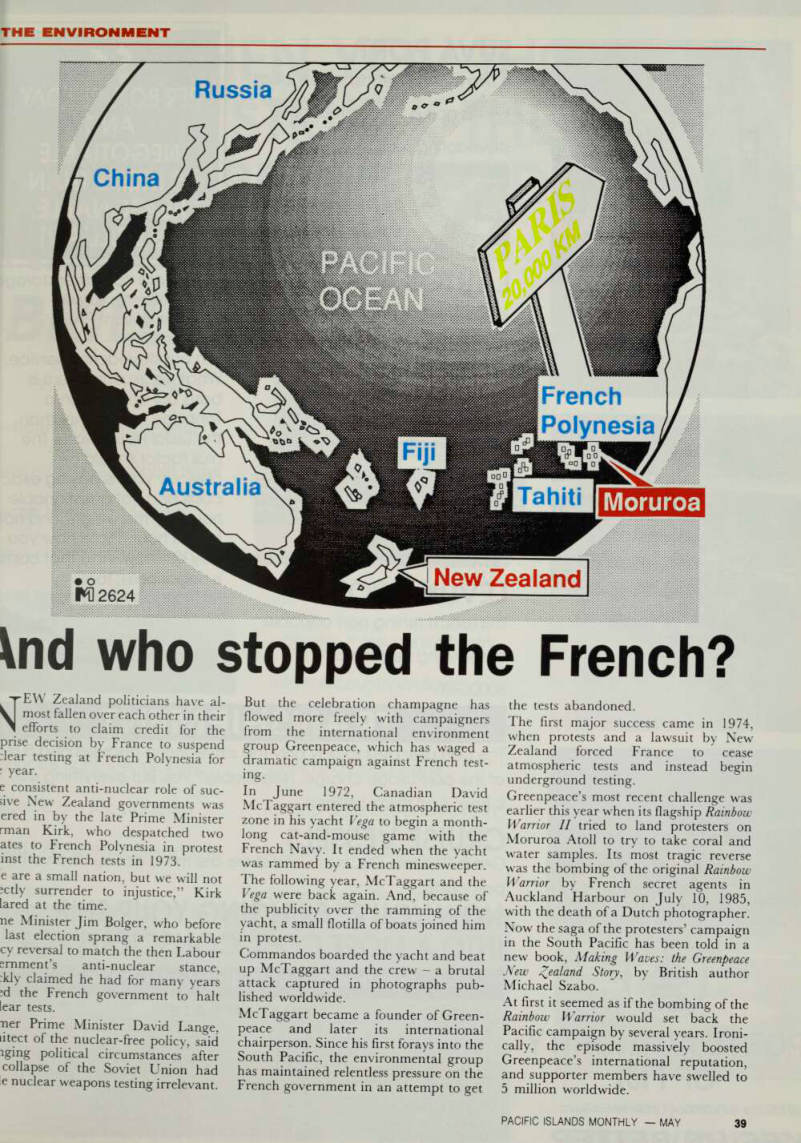
yEW Zealand politicians have al most fallen over each other in their 1 efforts to claim credit for the prise decision by France to suspend dear testing at French Polynesia for ; year. e consistent anti-nuclear role of suc >ive New Zealand governments was ered in by the late Prime Minister rman Kirk, who despatched two ates to French Polynesia in protest inst the French tests in 1973. e are a small nation, but we will not -ctly surrender to injustice,” Kirk lared at the time. ne Minister Jim Bolger, who before last election sprang a remarkable cy reversal to match the then Labour eminent s anti-nuclear stance, :kly claimed he had for many years td the French government to halt iear tests. ner Prime Minister David Lange, litect of the nuclear-free policy, said 1 gi J1 g political circumstances after collapse of the Soviet Union had e nuclear weapons testing irrelevant.
But the celebration champagne has flowed more freely with campaigners from the international environment group Greenpeace, which has waged a dramatic campaign against French test
ing.
In June 1972, Canadian David McTaggart entered the atmospheric test zone in his yacht Vega to begin a month long cat-and-mouse game with the French Navy. It ended when the yacht was rammed by a French minesweeper.
The following year, McTaggart and the Vega were back again. And, because of the publicity over the ramming of the yacht, a small flotilla of boats joined him in protest.
Commandos boarded the yacht and beat up McTaggart and the crew - a brutal attack captured in photographs pub lished worldwide.
McTaggart became a founder of Green peace and later its international chairperson. Since his first forays into the South Pacific, the environmental group has maintained relentless pressure on the French government in an attempt to get
the tests abandoned.
The first major success came in 1974, when protests and a lawsuit by New Zealand forced France to cease atmospheric tests and instead begin underground testing.
Greenpeace’s most recent challenge was earlier this year when its flagship Rainbow Warrior II tried to land protesters on Moruroa Atoll to try to take coral and water samples. Its most tragic reverse was the bombing of the original Rainbow Warrior by French secret agents in Auckland Harbour on July 10, 1985, with the death of a Dutch photographer.
Now the saga of the protesters’ campaign in the South Pacific has been told in a new book, Making Waves: the Greenpeace New Zealand Story , by British author Michael Szabo.
At first it seemed as if the bombing of the Rainbow Warrior would set back the Pacific campaign by several years. Ironi
cally, the episode massively boosted
Greenpeace’s international reputation, and supporter members have swelled to 5 million worldwide.
“When the bombing happened the ffair became a spy thriller and the issues nderlying the sabotage were perhaps ownplayed and buried under the in igue,” said Szabo.
He contrasts the hardline stance of Western countries over Libya with the ttitude shown towards French state rrorism in the South Pacific. One of the leged French bombers was arrested in witzerland late last year, but New ealand was pressured into not extradit ig him.
“If a Libyan bomb blows up an merican civil airliner and France, nong others, demands the extradition ' the suspected bombers,” said Szabo, hen for France or other countries to ive sought to prevent one of the spects in the Rainbow Warrior terrorist t being extradited is a double stan ird.”
When Szabo first heard of Greenpeace 1977, he was a 14-year-old schoolboy
id following reports of anti-sealing
monstrations in Canada.
The protests and a visit to Britain of ?roup of anti-nuclear women from the arshall Islands had a profound impact the young Szabo and he embarked on :areer of environmental activism and
king.
Son of a British mother and a mgarian father, he worked as a ilder’s labourer and electrician, then npleted an honours degree in com nication and cultural studies at Leeds iversity. ie researched the French nuclear ipons complex and a range of envir nental issues in the Pacific, and came New Zealand in 1988. He talked to eenpeace activists about writing a k on his research and instead they imissioned him to write a history of r movement. rom the group of idealists who tured on the first protest voyages to ruroa early in the seventies, the paigners have matured into the rse, sophisticated organisation that is snpeace New Zealand. It has 140,000 )orters and is affiliated to
iterdam-based Greenpeace Interna
al. reenpeace has carved for itself a e as probably the world’s leading >ure group on environmental and e issues, but in the nineties world of a consumerism and transnational orations, environmentalism has be- J far more complex, abo’s book recounts for the first time tory of Pacific Islanders involved in
environmental campaigns,
is dedicated to the memory of Elaine v, Greenpeace’s first Pacific earn er who had a friendship with al Pacific leaders. □
The Greenpeace yacht Vega: battling for the environment