Reason to smile: A happy Gordon Rice with prizes he won at
pp. 37-38 · Read in the full issue

The Fiji Times/Pacific Islands Monthly-sponsored Pacific Harbour Open International Gamefishing Tournament held over the Easter weekend. Rice was highest scoring male angler and won the most meritorious fish award for his record-braeking 28kg giant trevally and helped his team onboard E.T. win highest scoring team award.
Prizegiving time: From left - Rice. E.T. skipper David Ragg (middle), who won highest scoring skipper award, and The Fiji Times managing director Gene Swinstead.
Tough road to Barcelona
By Dr Robin Mitchell
OFFICIAL records show that Fiji was represented in the 1904 Olympic Games in St Louis and achieved its best perform ance ever - a fourth placing in the pole climbing event; just missing out on a bronze medal.
This event is no longer contested in the modern Olympics and Fiji’s apparent expertise at it will never result in the seemingly elusive Olympic medal.
It is 32 years since Fiji first sent a team to a modern Olympic Games. Fiji’s National Olympic Committee (NOG)
was officially recognised in 1955, paving
the way for their participation in the only Olympics ever held in the Southern Hemisphere, Melbourne 1956.
Since its appearance in Melbourne, competing in athletics, boxing and yachting, Fiji has been represented at all Olympic Games (with the exception of the boycott affected Moscow games where Fiji was represented by the NOG president, Les Martin).
Fiji’s best performance in recent times, was in the 1988 Olympic Games in Seoul where Albert Miller was placed 18th in the decathlon. The other notable per formance in Seoul was in judo. Josateki Wainiqolo came within a whisker (20 seconds) of causing one of the upsets of the judo competition by almost defeating the Russian silver medallist.
Until the Los Angeles Olympics, Fiji had been represented mainly in the athletic events of the games. Since then, Fiji has been represented in six different sports and in Seoul fielded its largest team to date. Thirty nine athletes and officials competed in athletics, boxing, judo, swimming and yachting.
Fiji has entered 36 athletes and officials in four sports for this year’s Olympics in Barcelona, Spain from July 25 to August 9. Athletics have nominate 11 athletes and officials, judo have nominated 6, swimming 9 and yachting 6.
The Fiji Amateur Sports Association and national Olympic Committee (FASANOC) has also appointed a head quarters staff of six led by chef de mission Vidhya Lakhan (FASANOC treasurer), who also led Fiji’s team to Seoul.
The four section managers will be Atma Maharaj (athletics), Ratu Epcnisa
Cakobau (judo), Harvie Probert (swimming), and Rocky Moody (yachting) plus Dr Jagdish Maharaj will be team physician. The number of athletes who are finally selected to represent Fiji in Barcelona have to achieve standards set by the Selection Justification of
Fasanoc.
Hence, the number who finally get to compete in Barcelona may be much lower than entered. In an attempt to acmeve these standards and perform well at the games all four sports are undertaking the most extensive (and expensive) preparations ever attempted by a Fiji j *,.,. , , , .
Athletics have just completed a development tour of Australia where their team of 11 competed in various stale competitions before competing in the Australian Championships. Their distance team is competing in the World Crosscountry Championships in Boston and the World Road Relay Championships in Portugal. They also have competitors trying to qualify for the Olympics by competing in the Los Angeles Marathon.
Judo is planning to send their competitors to New Zealand and Japan for training and competition.
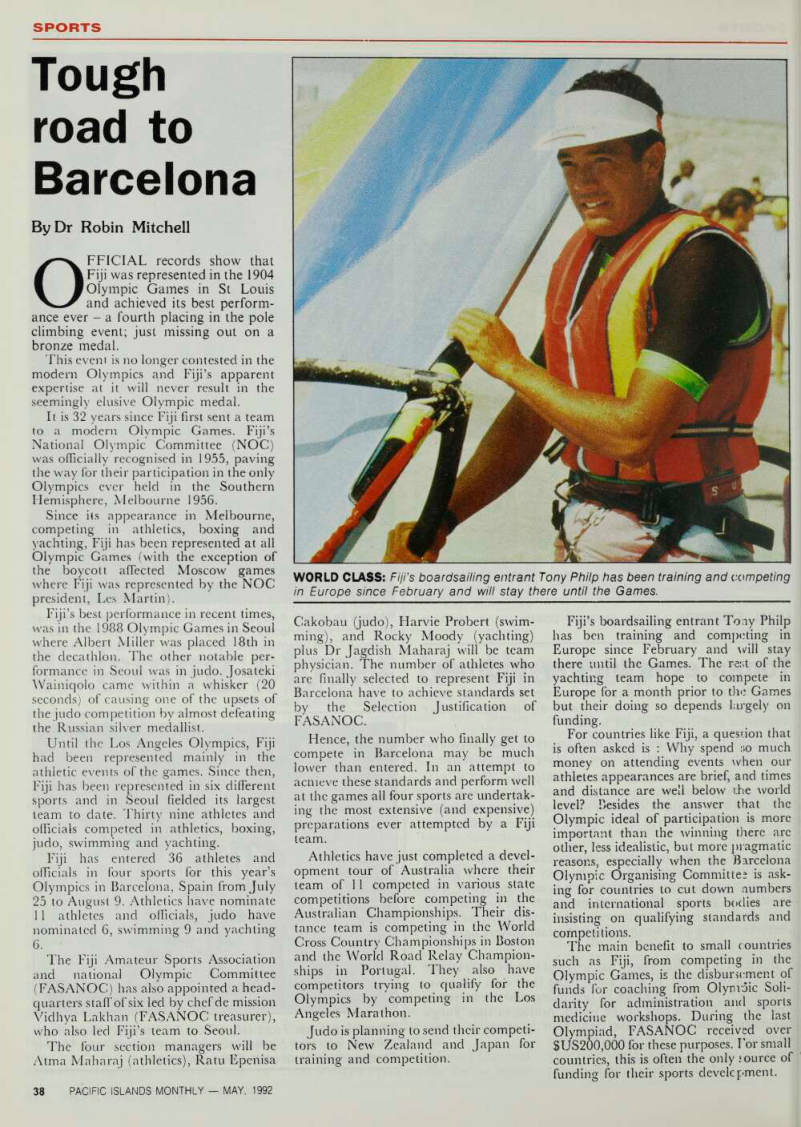
Fiji’s boardsailing entrant Tony Philp has ben training and competing in Europe since February and will stay there until the Games. The rest of the yachting team hope to compete in Europe for a month prior to the Games but their doing so depends largely on funding.
For countries like Fiji, a question that is often asked is : Why spend so much money on attending events when our athletes appearances are brief, and times and distance are well below die world level? besides the answer that the Olympic ideal of participation is more important than the winning there arc other, less idealistic, but more pragmatic reasons, especially when the Barcelona Olympic Organising Committee is ask ing for countries to cut down numbers and international sports bodies are insisting on qualifying standards and
competitions.
The main benefit to small countries such as Fiji, from competing in the Olympic Games, is the disbursement of funds for coaching from Olympic Soli darity for administration and sports medicine workshops. During the last Olympiad, FASANOC received over SUS2OO,OOO for these purposes. For small countries, this is often the only source of funding for their sports development.
WORLD CLASS: Fiji’s boardsailing entrant Tony Philp has been training and competing in Europe since February and will stay there until the Games.