Pacific
p. 27 · Read in the full issue
Islands
Monthly
Business
Manganese revival for Vanuatu?
By Davendra Sharma
AN Australian mining giant with massive interests in Queens land, Portman Mining com pany has unveiled plans to mine 60,000 tonnes of manganese a year in Vanuatu for exports to Japan and China.
Australian manganese giant Portman Mining is developing deposits on a small scale for export to industrial Asian markets. Manganese was last mined on Efate in 1979, when the mine at Forari was closed because of declining prospects and world prices.
A French prospector, Campagnie Francaise des Phosphates de I’Oceanie (CEPO), found manganese deposits of about two million tonnes in 1955. It
began development of open pitmine in
1960, and went into full production two years later.
CFPO pulled out in 1968, selling the mine to Port Vila-based consortium Le Manganese de Vate (LMV), which subsequently sold it to Australia’s South land Mining. Production was reactivated at full scale in 1970. Output began to decline slowly and the mine was closed in 1979.
Falling manganese prices in principal international markets were also to blame.
Portman directed its initial exploration on the extension of reserves beneath a limestone capping to the east and north of the disused mine. Deposits at Forari are under fairly shallow soil cover, spread across like a sheet, similar to the phosphate fields in Nauru, said Portman chairman, Charles Copeman.
Portman’s current exploration seeks to extend reserves to the north of the old mine. It is also engaged in metallurgical test work on ore samples and residual
tailings left by the former mining com pany on Efate.
“The project has considerable promise and involves the redevelopment of the Forari mine, which has indicated re serves of two million tonnes of metallur gical grade ore,” said Portman director Trevor Tenant. The company has a 95 per cent stake in the project, while LMV has retained the other five per cent.
Portman intends to inject investment of 5U53.75 million with promises of initial employment for about 40. Rev enue from the sales will be 5U55.25 million a year.
Copeman told Pacific Islands Monthly
the company decided to redevelop the Forari site with a recent jump in world prices. “World price of manganese has risen more than twice. That is what gave us the idea. We knew of this project.”
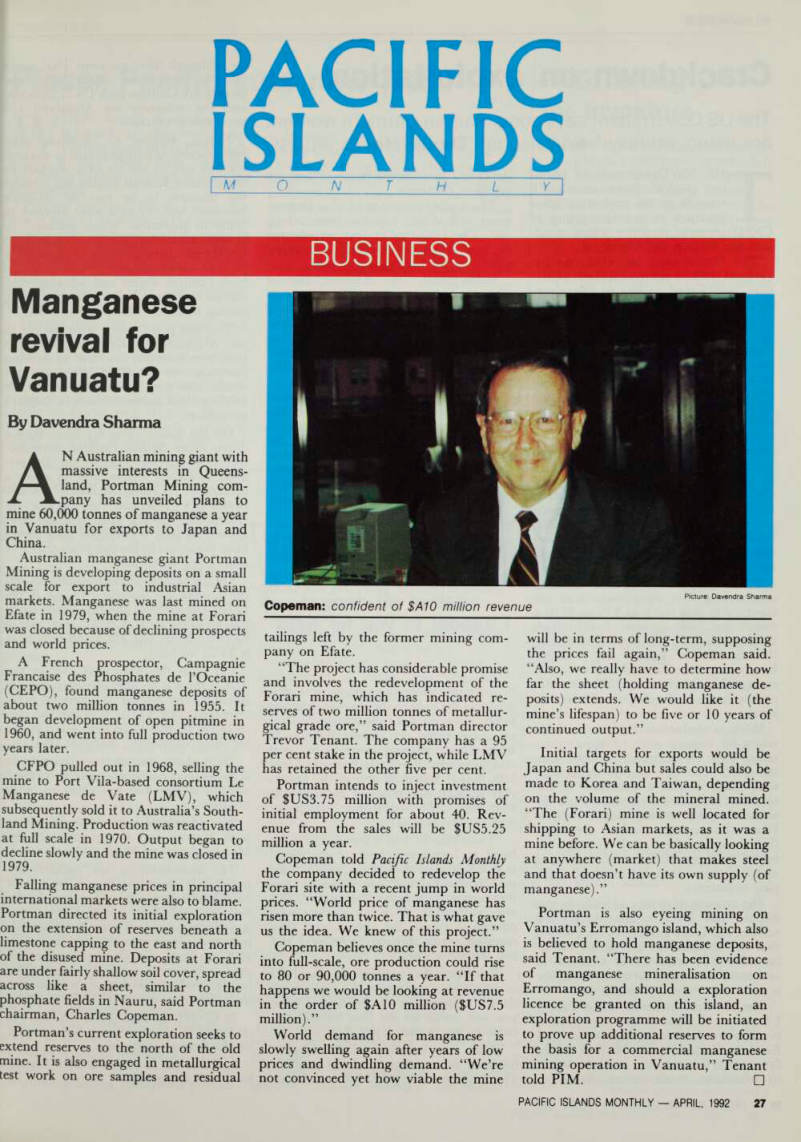
Copeman believes once the mine turns into full-scale, ore production could rise to 80 or 90,000 tonnes a year. “If that happens we would be looking at revenue in the order of SAIO million (SUS7.S
million).”
World demand for manganese is slowly swelling again after years of low prices and dwindling demand. “We’re not convinced yet how viable the mine
will be in terms of long-term, supposing the prices fail again,” Copeman said.
“Also, we really have to determine how far the sheet (holding manganese de posits) extends. We would like it (the mine’s lifespan) to be five or 10 years of
continued output.”
Initial targets for exports would be Japan and China but sales could also be made to Korea and Taiwan, depending on the volume of the mineral mined.
“The (Forari) mine is well located for shipping to Asian markets, as it was a mine before. We can be basically looking at anywhere (market) that makes steel and that doesn’t have its own supply (of
manganese).”
Portman is also eyeing mining on Vanuatu’s Erromango island, which also is believed to hold manganese deposits, said Tenant. “There has been evidence of manganese mineralisation on Erromango, and should a exploration licence be granted on this island, an exploration programme will be initiated to prove up additional reserves to form the basis for a commercial manganese mining operation in Vanuatu,” Tenant told PIM. □
Picture: Oavendra Sharma
Copeman: confident of $A10 million revenue