Warriors on a new battlefield
pp. 25-26 · Read in the full issue
Focus
By Liz Thompson
A YOUNG boy is dying slowly.
He has a fever; his mother wipes his brow. Eventually he is dead and both parents lie prostrate next to the body, crying,
stroking the young body
You sense their helpless confusion. The death which takes place in the Papua Mew Guinean feature film Warriors in Transit is a symbol, says Albert Toro, the director. He and William Takaku, direc or of the National Theatre Company, vrote the script.
They see the young boy as a symbol of 3 apua New Guinea his parents
netaphorically the government, wanting
vhat is best for the country, but not mowing how to reap it.
As problems intensify and social order ireaks down the government, says Toro, lo not know how to treat the disease icit er do the boys parents. They ecogmse that he is ill but never in erstand what exactly the illness is, or iow to improve his condition. • T his 1S an i m P ortant thread in the ight times 25-minute series.
This, and an examination of various ocial manifestations developing in the Tocess of modernisation. It moves across number of important issues, from the uman side of urban drift, tracing
particular families’ experience, to the very real problems of corruption in high P lace , s ’. politicians haying brawls in unnals. It is a powerful critique and unlc l“ e presenting them to a kroad . audlence >" accessible form. The , 15 theatrical, not highly polished, the P ace sometimes slow an d meander in Bi l3ut kis a P a “ f nd form appropriate to s P int °* Melanesia.
Not that the Melanesian spirit is slow and meandering, but it is a world away from the rapid, multi-stimuli of most western film forms. Whilst some have criticised Warriors in Transit for not being highly polished and slick and therefore probably unappealing to an overseas market, Takaku argues against such a proposition. He believes the film is for Papua New Guineans and is more in keeping with culture, Unfortunately, I and only a few others have had an opportunity to see it.
Largely funded by the tourism depart ment, it has not yet been shown. The on iy broadcasting channel operating in Papua New Guinea is MTV. Originally set up with a mandate which proposed the inclusion of 50 per cent nationally made films, its direction has changed dramatically. Never achieving this goal, the objective further diminished when the company was taken over by former entrepreneurial giant Alan Bond and
relied, and continues to rely, heavily on Channel 9 programming.
New Guinea BWS and a rather strange programme, Meditation with a pastor at 11pm, provide almost the only national content. The few persistent and dedicated film-makers bemoan this situ ation. Unfortunately, once again the government has overlooked the import ance of areas such as national film, and physically funded contemporary arts arena has struggled to survive in Papua New Guinea for years.
The National Art School has almost no materials, the National Theatre Com pany struggles to survive, and the film industry is in tatters. Arts sacrificed, in the words of Sir Julius Chan, the country’s opposition finance minister, for the sake of industrial development. It is, after all, a culture which relied heavily on creative ways of transmitting social codes and ethical beliefs in ritual and ceremony.
The government doesn’t seem to connect the fact that, in a country with a staggering illiteracy rate, film is an extremely powerful and potentially ex tremely useful medium for transmitting ideas. Film is a powerful medium. The country is overwhelmed with law-and order problems spiralling from a vortex of reasons, but most obviously from unemployment disillusionment and a breakdown of traditional structures.
Why, then, show films which focus on and celebrate violence?
Why not fund a national film industry
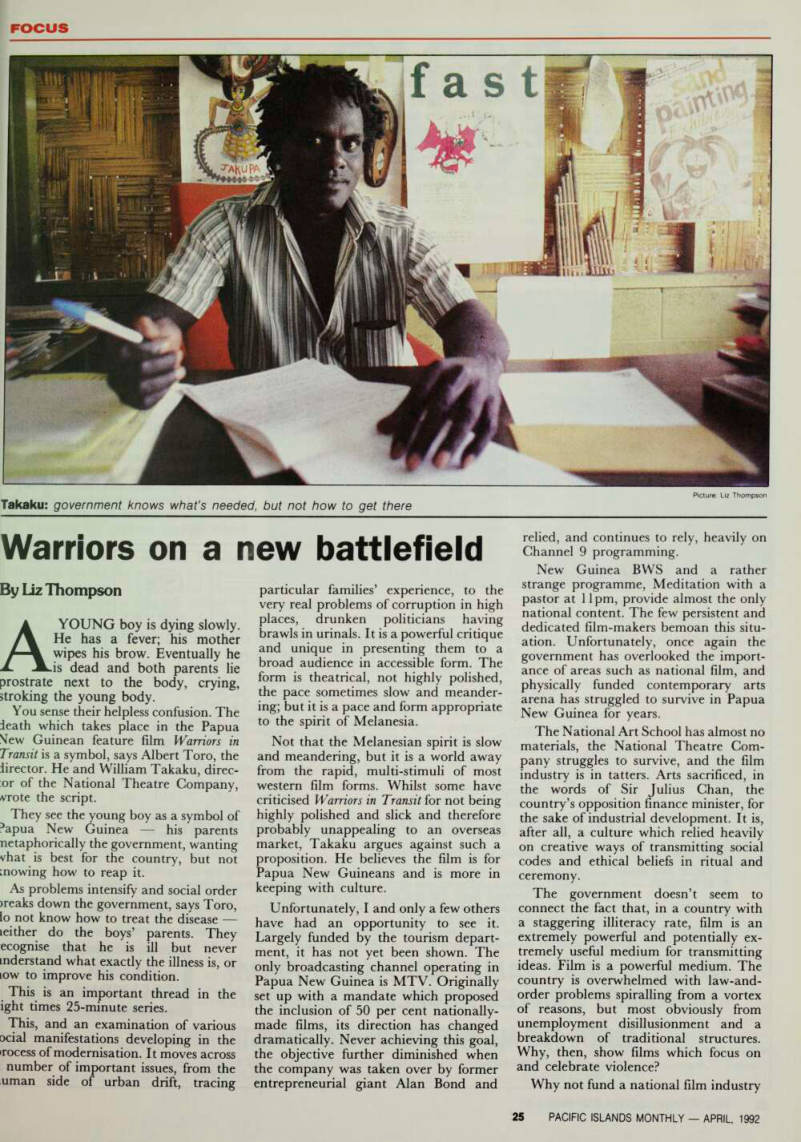
Takaku: government knows what's needed, but not how to get there
Picture: Liz Thompson
and film-makers who want to look at national issues in a sensitive and in formed way, and want to contribute to the forging of a new cultural identity?
Skool Bilong Wokim Piksa, a film school established in the Highlands and recent producer of the feature film Tin Pis , is a French-funded operation. Toro com plains the films it produces have become
too french, lacking an intrinsically Papua
New Guinean flavour.
Takaku says Papua New Guineans only see their own people appear in documentaries, which frequently look at them as the other, the exotic, primitive race, or in advertisements. It’s time, he says, the people could relate to their own heroes. Warriors in Transit doesn’t necess arily produce superheroes, but it does address numerous issues extremely perti nent to most Papua New Guineans, in a accessible and entertaining form.
It traces, through a few key figures and a squatter community, the pain of urban migration. It is directed on one level, says Takaku, to the grassroots-level Papua New Guinean, “attracted by the bright lights of the city, coming in from rural areas with the hope of good times, when they arrive the problems begin”.
Once there, they wonder where the food they imagined is, the shelter they envisaged, the money they assumed
flourished. The film looks at the move ment of youth away from parents, the rejection of all traditional. Sensitively, it examines family breakdown.
“The entire family unit,” says Takaku, “is crumbling, we must highlight this so people are aware. Families are the root of all love that kept societies together before and now that is crumbling, the house is rotting and things are going all over the place and people are wandering around mad.”
It scathingly examines workings and hypocrisy within government. Using the process of a real estate developer bribing government officials to bulldoze a squat ter settlement, it addresses issues close to home. Politicians get drunk, fight in toilets and are depicted as essentially self interested and corrupt.
Toro says government selfishness, combined with failure to understand the real problems as with the parents and dying child, compound to produce chaos.
The film is hard-hitting in it’s depic tion of the country’s government and bureaucracies maybe that’s why the industry’s so badly funded. But it is important, as in any country, to be able to examine these issues, and in Papua New Guinea a broadly received presen tation can only really take place in the medium of film or radio.
“Warriors”, as the film title suggests, are “in transit”. The film asks," says Takaku, “where do we go from here, how do we transit into this new era, and why do we have to do it?”
It is part of a process of production which could be extremely valuable and constructive in Papua New Guinea today. Already invited to appear in overseas festivals, MTV have offered Takaku and Toro about K 260 per episode, about As4oo. That, says Takaku, is a joke. Given the total lack of copywright laws in the country as soon as it went to air on TV, it would be pirated and the filmmakers would find it difficult to make any more money.
Takaku plans to try and screen it in theatres around the country.
NBC, the National Broadcasting Com mission from which the radio emerges, is
currently being revamped, along with
financial assistance from ABC correspon dent Sean Dorney. Hopefully, it will eventually provide an alternative tele vision broadcasting station. This, in conjunction with a better-funded film industry and the number of talented and committed directors who have already emerged, could start to turn film into an exciting, important and culturally useful medium. One can only hope that the film industry is in transit and on it’s way to better times. □