It's Paradise ... sort of
pp. 26-27 · Read in the full issue
I don’t walk on the plutonium, and I won’t swim near the old dioxin spill, so I guess km safer here than in Southern California where the air is so bad — Dr Beth Flint, wildlife biologist for the US Fish and Wildlife Service
UCH 18 the paradox of Johnston A' o ' 1 ’ an oc s an oas r ls , for birds sea t turtles, and reef fish who share th , elr ™d-Pac.fic home with a chen jl cal rrru.i.tiorrs storage dump, a standby nuclear test site and now Amenca s newest nerve-gas disposal sys em‘ “When you first arrive here,” said you have the urge to take short breaths and wash your hands regularly, U 8 rea,l Y spooky. But once you over c°me imtial culture shock acce P l that the contamination is safely con ta,,;.ed ’ the umc l ueneßß of this tropical atoll starts to captivate you.
P° r mc the it began with Doug Forsell, a biologist at the Johnston Atoll National Wildlife Refuge. “Meet me at the pier at five o’clock,” he said,‘Tm banding a few birds out on East Island, The outboard of the Boston Whaler roared to life, and I cast off the lines and Jumped the boat. Forsell backed from the small marina and accelerated into the lagoon. Coral heads rose like clouds from the sandy floor,the crystal water shim in a palette of blues, deep turquoise, azure, aquamarine. To the north, the outer reef broke the ocean swell in a tumult of white spray. It was
paradise.
Sort of. I had just left an
island holding a substantial chunk of America’s chemical
weapons stockpile.
On East Island, I first smelled the dusty guano smell. Then the incredible noise. Then the hundreds of thousands of birds. Every where.
The island had been built to house a transmission site in the mid-60’s that was later abandoned after newer tech nology made it obsolete. Like snow, bird droppings covered the corrugated tin buildings remaining on the 18-acre island. Forsell brought the boat alongside an abandoned prior, also white with drop pings. I was glad I wore my hat.
“Watch where you step,” he said as we walked up the pier to the island, “nests and chicks are everywhere.”
And indeed they were.
Birds were underfoot, over
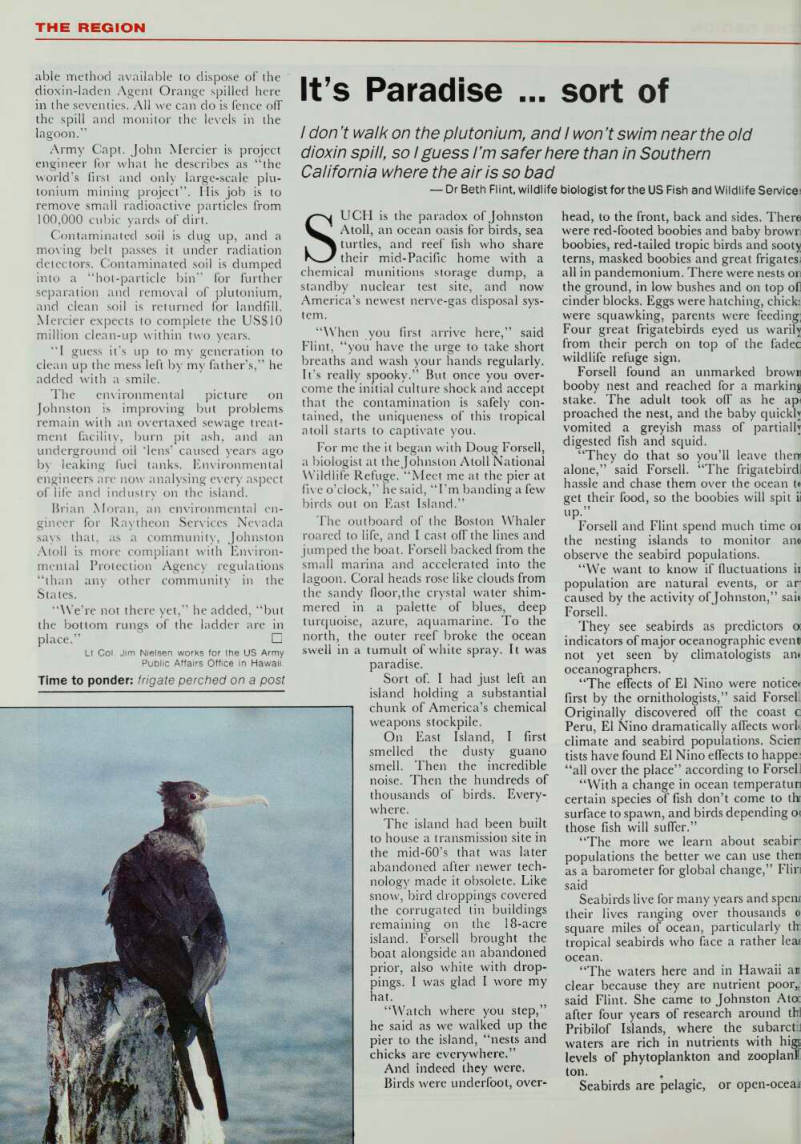
head, to the front, back and sides. There were red-footed boobies and baby brown boobies, red-tailed tropic birds and sooty terns, masked boobies and great frigates; all in pandemonium. There were nests on the ground, in low bushes and on top oil cinder blocks. Eggs were hatching, chick:, were squawking, parents were feeding; Four great frigatebirds eyed us warily from their perch on top of the fadec wildlife refuge sign.
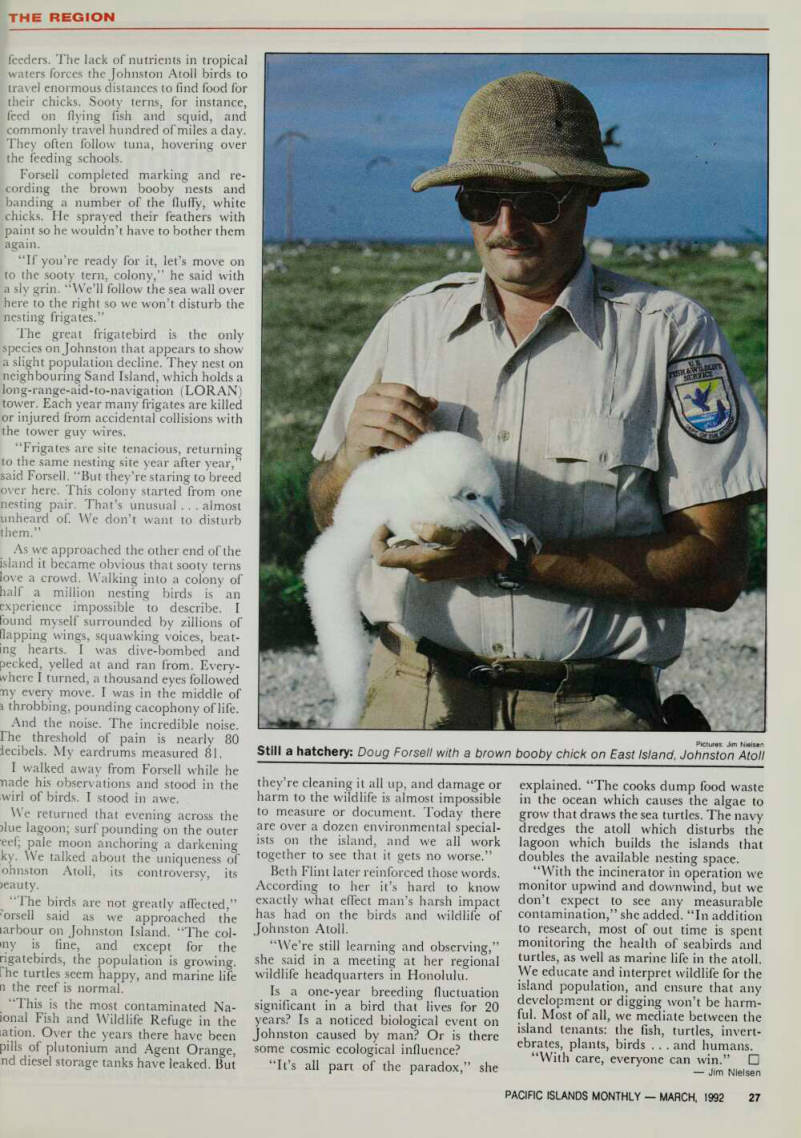
Forsell found an unmarked brown booby nest and reached for a marking stake. The adult took off as he ap* proached the nest, and the baby quickly vomited a greyish mass of partially digested fish and squid.
“They do that so you’ll leave there alone,” said Forsell. “The frigatebirdl hassle and chase them over the ocean t* get their food, so the boobies will spit ii up.”
Forsell and Flint spend much time 01 the nesting islands to monitor ano observe the seabird populations.
“We want to know if fluctuations ii population are natural events, or ar caused by the activity ofjohnston,” saw Forsell.
They see seabirds as predictors oc indicators of major oceanographic event not yet seen by climatologists am
oceanographers.
“The effects of El Nino were notice*: first by the ornithologists,” said ForselU Originally discovered off the coast o Peru, El Nino dramatically affects worM climate and seabird populations. Scien lists have found El Nino effects to happe; “all over the place” according to Forsell “With a change in ocean temperatun certain species of fish don’t come to thr surface to spawn, and birds depending 0( those fish will suffer.”
“The more we learn about seabin populations the better we can use then as a barometer for global change,” Flin said Seabirds live for many years and spent their lives ranging over thousands o square miles of ocean, particularly thi tropical seabirds who face a rather leaf ocean.
“The waters here and in Hawaii an clear because they are nutrient poor, t said Flint. She came to Johnston Atoc after four years of research around tH Pribilof Islands, where the subarctiJ waters are rich in nutrients with higs levels of phytoplankton and zooplanlL ton.
Seabirds are pelagic, or opcn-ocear
feeders. The lack of nutrients in tropical waters forces the Johnston Atoll birds to travel enormous distances to find food for their chicks. Sooty terns, for instance, feed on flying fish and squid, and commonly travel hundred of miles a day.
They often follow tuna, hovering over the feeding schools.
Forsell completed marking and re cording the brown booby nests and banding a number of the fluffy, white chicks. He sprayed their feathers with paint so he wouldn’t have to bother them again.
“If you’re ready for it, let’s move on to the sooty tern, colony,” he said with a sly grin. “We’ll follow the sea wall over here to the right so we won’t disturb the nesting frigates.”
The great frigatebird is the only species on Johnston that appears to show a slight population decline. They nest on neighbouring Sand Island, which holds a
long-range-aid-to-navigation (LORAN)
tower. Each year many frigates are killed or injured from accidental collisions with the tower guy wires.
“Frigates are site tenacious, returning to the same nesting site year after year,” said Forsell. “But they’re staring to breed over here. This colony started from one nesting pair. That’s unusual . . . almost unheard of. We don’t want to disturb them.”
As we approached the other end of the island it became obvious that sooty terns love a crowd. Walking into a colony of half a million nesting birds is an experience impossible to describe. I found myself surrounded by zillions of [lapping wings, squawking voices, beat ing hearts. I was dive-bombed and pecked, yelled at and ran from. Every where I turned, a thousand eyes followed my every move. I was in the middle of
i throbbing, pounding cacophony of life.
And the noise. The incredible noise.
Fhe threshold of pain is nearly 80 lecibels. My eardrums measured 81.
I walked away from Forsell while he nade his observations and stood in the wirl of birds. I stood in awe.
We returned that evening across the flue lagoon; surf pounding on the outer eef; pale moon anchoring a darkening ky. We talked about the uniqueness of ohnston Atoll, its controversy, its )eauty.
“The birds are not greatly affected,” ■orsell said as we approached the larbour on Johnston Island. “The col >ny is fine, and except for the rigatebirds, the population is growing, fhe turtles seem happy, and marine life n the reef is normal.
“This is the most contaminated Na ional Fish and Wildlife Refuge in the lation. Over the years there have been pills of plutonium and Agent Orange, nd diesel storage tanks have leaked. But
they’re cleaning it all up, and damage or harm to the wildlife is almost impossible to measure or document. Today there are over a dozen environmental specialists on the island, and we all work together to see that it gets no worse.”
Beth Flint later reinforced those words.
According to her it’s hard to know exactly what effect man’s harsh impact has had on the birds and wildlife of Johnston Atoll.
“We’re still learning and observing,” she said in a meeting at her regional wildlife headquarters in Honolulu.
Is a one-year breeding fluctuation significant in a bird that lives for 20 years? Is a noticed biological event on Johnston caused by man? Or is there some cosmic ecological influence? oil . r j „ i Its all part of the paradox,” she
explained. “The cooks dump food waste in the ocean which causes the algae to grow that draws the sea turtles. The navy dredges the atoll which disturbs the lagoon which builds the islands that doubles the available nesting space.
“With the incinerator in operation we monitor upwind and downwind, but we don’t expect to see any measurable contamination,” she added. “In addition to research, most of out time is spent monitoring the health of seabirds and turtles, as well as marine life in the atoll, W e educate and interpret wildlife for the island population, and ensure that any development or digging won t be harm ! , , ° st °^ a ’ 'ye mediate between the 18 an d tenants: the fish, turtles, invert ebf^^.s ’ P lants > birds . . . and humans.
With care, everyone can win.” □ 7
Jim Nielsen
Pictures: Jim Nielsen Still a hatchery: Doug Forsell with a brown booby chick on East Island, Johnston Atoll