Johnston Atoll: Paradox in Paradise?
pp. 24-26 · Read in the full issue
The Region
Story and photos by Jim Nielsen* FEARED by some as a toxic wasteland contaminated by scat tered plutonium and spilled dioxin, remote Johnston Atoll
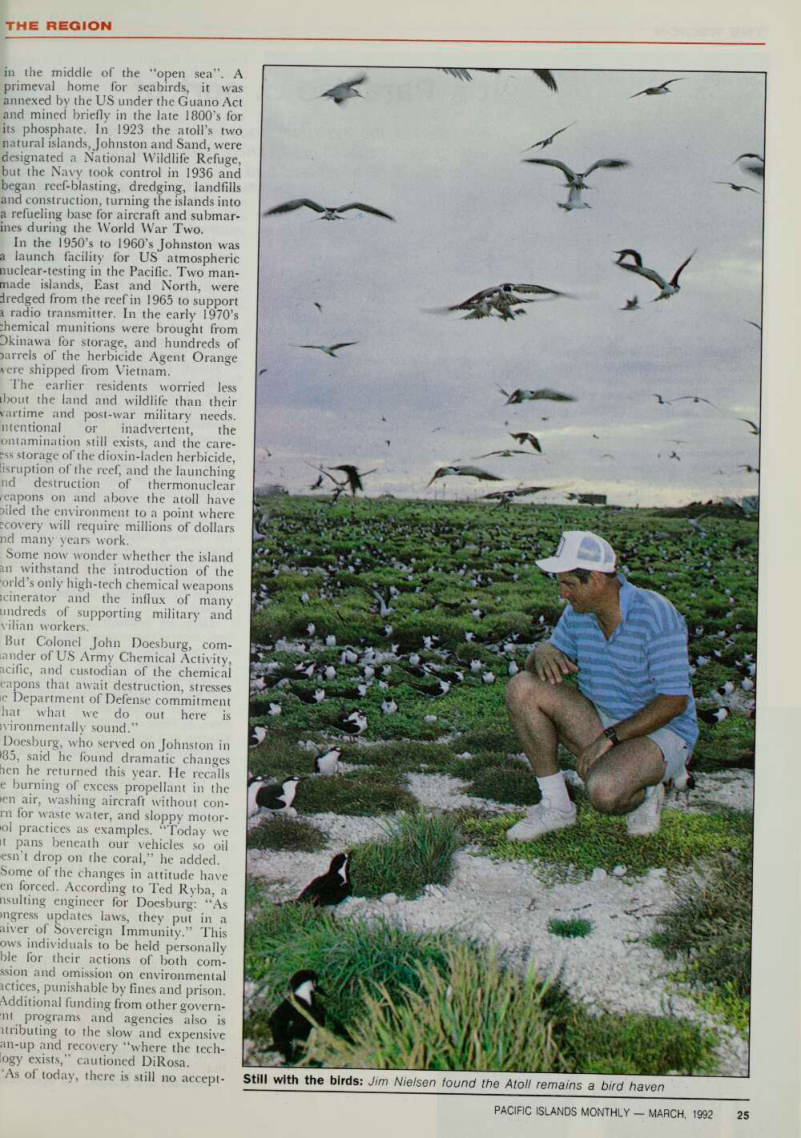
sits at the centre of a global environ mental controversy. It is the ac knowledged home to over six percent of America’s chemical weapons and the world’s first chemical destruction facility. Yet, while pushing the lead ing edge of military industrial tech nology, it is also a wildlife refuge; home to two of the world’s en dangered species and hundreds of thousands of seabirds.
Such is the nature of Johnston Atoll, a paradox in paradise.
According to manager of the Johnston Atoll National Wildlife Refuge, Roger Dißosa: “This is not an island paradise by any means, but it’s not a toxic wasteland either. And the military seems to be committed to cleaning up their mess.”
Dißosa is a key component in the atoll’s environmental security and,
along with wildlife biologists, visiting
research scientists from the Woods Hole Oceanographic Institute and on-site environmental engineers, he serves as a custodian of its future.
DiRosa sees a dramatic change in the attitude of military leaders and govern mental agencies; an attitude that he feels bodes well for the future.
“We’re looking at a new envir onmental ethic,” says DiRosa,.
“not just in the military, but iiu other agencies as well. They’re taking steps that are preventative and proactive. Compared to the attitudes of the past, these are big
steps.”
But he also acknowledges the serious contamination that haunts; the island from prior decades ot< abuse.
The past, from the perspective of the seabirds, seals and sharks.* has been difficult. One of the world’s oldest (estimated at 70 million years) and most remote tropical atolls, Johnston rests neaii. the centre of the North Pacific, 71 7\ nautical miles southwest of the Hawaiian island of Oahu. It wasi discovered in 1796 after an Ameri- i can ship accidentally ran agrouncb
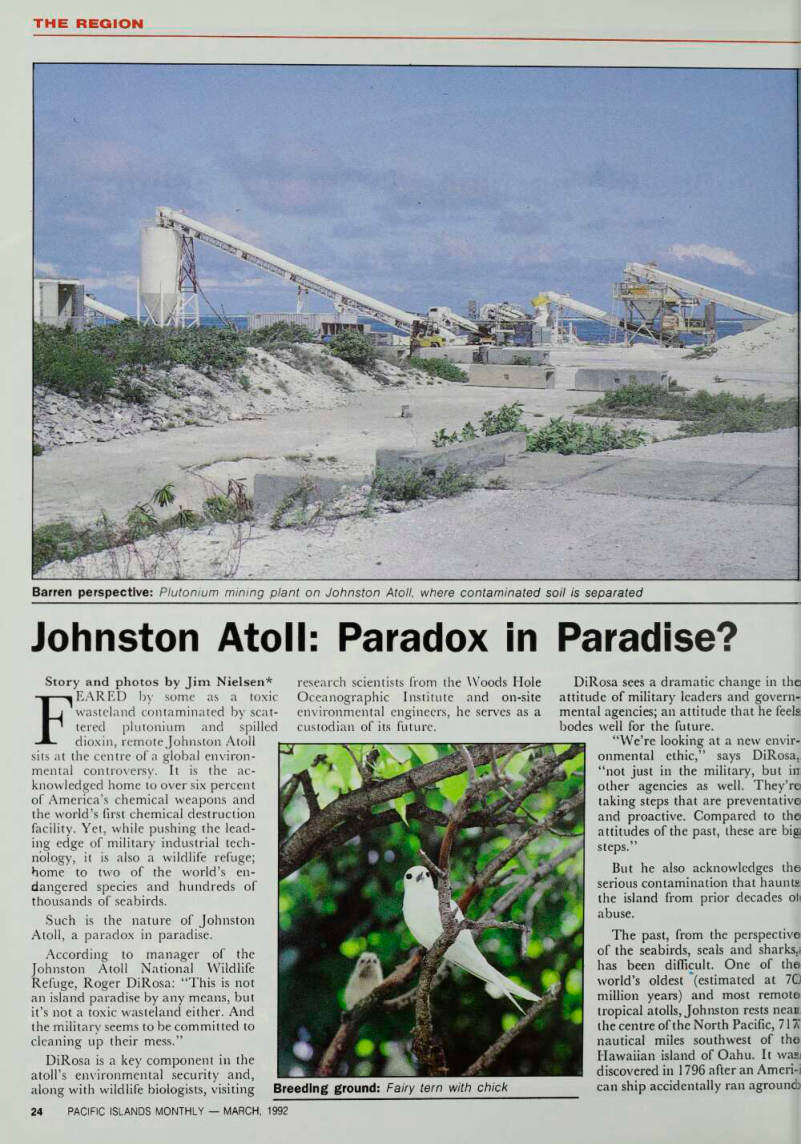
Barren perspective: Plutonium mining plant on Johnston Atoll, where contaminated soil is separated
Breeding ground: Fairy tern with chick
in the middle of the “open sea”. A primeval home for seabirds, it was annexed by the US under the Guano Act and mined briefly in the late 1800’s for its phosphate. In 1923 the atoll’s two natural islands, Johnston and Sand, were designated a National Wildlife Refuge, but the Navy took control in 1936 and began reef-blasting, dredging, landfills and construction, turning the islands into a refueling base for aircraft and submar ines during the World War Two.
In the 1950’s to 1960’s Johnston was a launch facility for US atmospheric nuclear-testing in the Pacific. Two man made islands, East and North, were dredged from the reef in 1965 to support a radio transmitter. In the early 1970’s :hemical munitions were brought from Dkinawa for storage, and hundreds of Darrels of the herbicide Agent Orange vere shipped from Vietnam.
The earlier residents worried less ibout the land and wildlife than their vartime and post-war military needs, intentional or inadvertent, the ontamination still exists, and the care ess storage of the dioxin-laden herbicide, lisruption of the reef, and the launching nd destruction of thermonuclear weapons on and above the atoll have Diled the environment to a point where ?covery will require millions of dollars nd many years work.
Some now wonder whether the island m withstand the introduction of the orld’s only high-tech chemical weapons Icin era tor and the influx of many und reds of supporting military and vilian workers.
But Colonel John Doesburg, com lander of US Army Chemical Activity, acific, and custodian of the chemical capons that await destruction, stresses c Department of Defense commitment hat what we do out here is i viron men tall y sou nd. ”
Doesburg, who served on Johnston in >BS, said he found dramatic changes hen he returned this year. He recalls e burning of excess propellant in the ten air, washing aircraft without con rn for waste water, and sloppy motor •ol practices as examples. “Today we it pans beneath our vehicles so oil esn’t drop on the coral,” he added.
Some of the changes in attitude have en forced. According to Ted Ryba, a nsulting engineer for Doesburg: “As ingress updates laws, they put in a
aiver of Sovereign Immunity.” This
ows individuals to be held personally ble for their actions of both com ssion and omission on environmental notices, punishable by fines and prison.
Additional funding from other oovern ■nt programs and agencies °also is itributing to the slow and expensive an-up and recovery “where the tech iogy exists,” cautioned Dißosa.
As of today, there is still no accept-
Still with the birds: Jim Nielsen found the Atoll remains a bird haven
able method available to dispose of the dioxin-laden Agent Orange spilled here in the seventies. All we can do is fence off the spill and monitor the levels in the lagoon.”
Army Capt. John Mercier is project engineer for what he describes as “the world’s first and only large-scale plu tonium mining project”. His job is to remove small radioactive particles from 100,000 cubic yards of dirt.
Contaminated soil is dug up, and a moving belt passes it under radiation detectors. Contaminated soil is dumped into a “hot-particle bin” for further separation and removal of plutonium, and clean soil is returned for landfill.
Mercier expects to complete the USSIO million clean-up within two years.
“I guess it’s up to my generation to clean up the mess left by my father’s,” he added with a smile.
The environmental picture on Johnston is improving but problems remain with an overtaxed sewage treat ment facility, burn pit ash, and an underground oil ‘lens’ caused years ago by leaking fuel tanks. Environmental engineers are now analysing every aspect of life and industry on the island.
Brian Moran, an environmental en gineer for Raytheon Services Nevada says that, as a community, Johnston Atoll is more compliant with Environ mental Protection Agency regulations “than any other community in the States.
“We’re not there yet,” he added, “but the bottom rungs of the ladder arc in
place.” □
LI Col. Jim Nielsen works for the US Army Public Affairs Office in Hawaii.
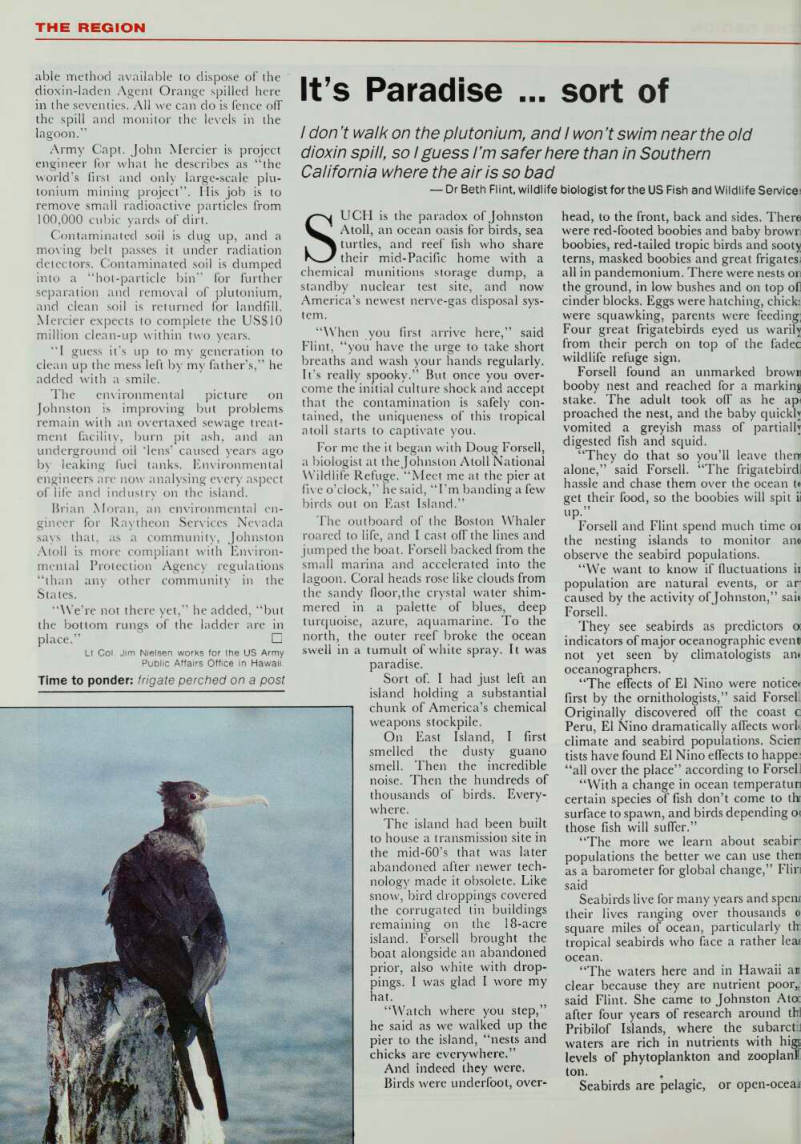
Time to ponder: frigate perched on a post