Natural,
pp. 28-29 · Read in the full issue
Focus
Natural, national treasure
TONGA, known for its long flat landscape and abundance of lobsters, has another natural treasure which could be a major part of its push for tourism.
Tonga’s quality crafts are beginning to catch the eye of tourists who have found they can carry even the largest woven pandanus baskets back as substitute suitcases through obliging airlines, or have them packed and forwarded home. “Very nice laundry baskets,” the locals will suggest obligingly.
The significance of high-quality crafts has not escaped the attention of local leaders either. Her Majesty, Queen Halaevalu Mata’aho, made the distinction last year between “handicrafts and cultural property”.
“Handicrafts as you know,” she explained, “are those traditional goods, like some of our baskets, beads and carvings, which are mainly utilitarian or decorative, but which possess no distinct cultural meaning, and play no distinct cultural roles.
“Cultural property, on the other hand, means mainly those traditional goods, like specific baskets, beads and carvings, as well as certain feather hats, dresses in Papua New Guinea, the very fine mats or ‘le in Samoa and Tonga, and the kava bowls throughout the Pacific. These traditional goods have distinct cultural significance and play distinct cultural roles. They cannot be replaced by any other articles.”
The Queen illustrated her distinction by noting that kava in legitimate traditional ceremonies always was prepared and served from large round wooden kava bowls.
“It cannot be prepared in a bucket, crystal bowl or any other container,” she said. Likewise, appropriate mats form a part of a bride’s trousseau: theyv cannot be replaced by linen or any other such fabric.
She made two conclusions based on her observations: “Firstly, like our indigenous languages, our possession and active use of our cultural property are among the
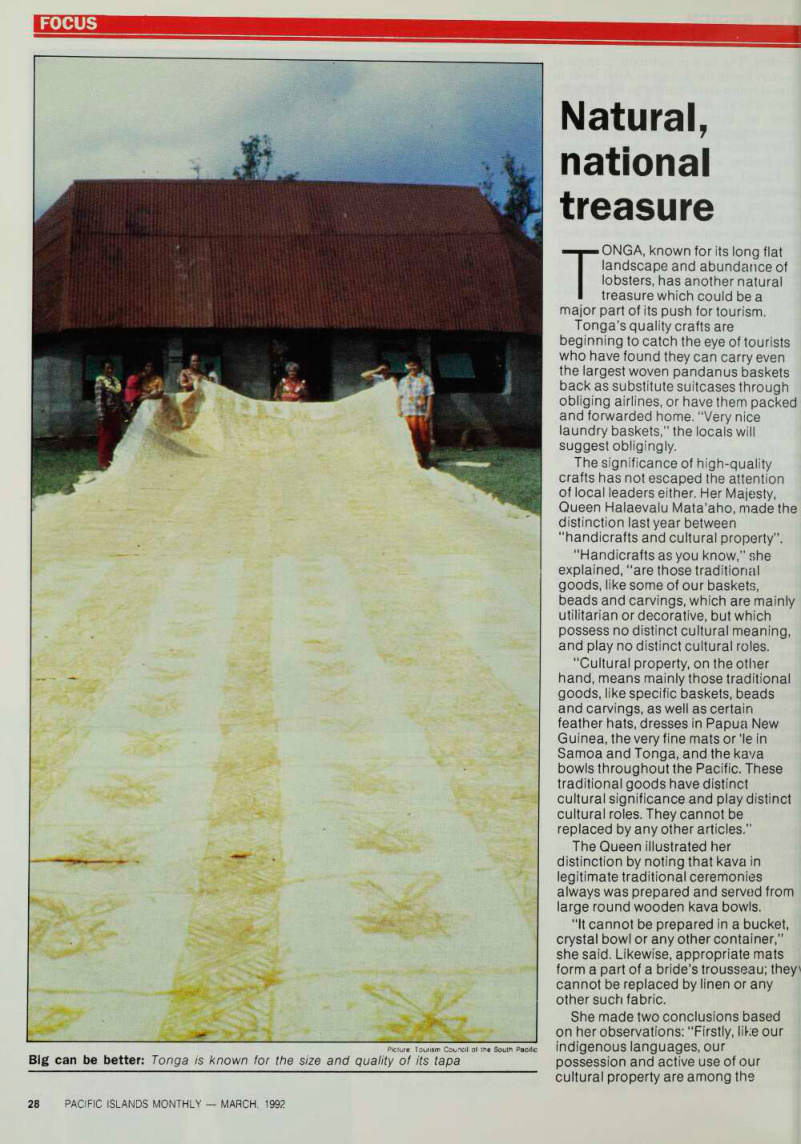
Picture; Tourism Council of the South Pacific Big can be better: Tonga is known for the size and quality of its tapa
strongest protectors and enhancers of our cultural heritage. Secondly, it is more than obvious that women play a key role in this respect.”
A South Pacific Trade Commission researcher, visiting the South Pacific to identify products which could be exported to Australia, also was enthused over Tonga’s quality crafts, but more from the business perspective.
Showing PlM about a dozen samples ranging from whalebone carvings to woven pandanus trays, she said: ‘Tongan handicrafts are particularly well-made. Some of the other Island countries have tended to fall back on quick-production methods and some even import handicrafts from Asia for resale, but in Australia consumers really are looking for quality goods these days.”
Visitors to Tonga could spend a noliday fossicking for handicrafts.
Fhere are a few official outlets, but nost villages make handicrafts and end to do to welcome their visitors.
Each artist and each village may
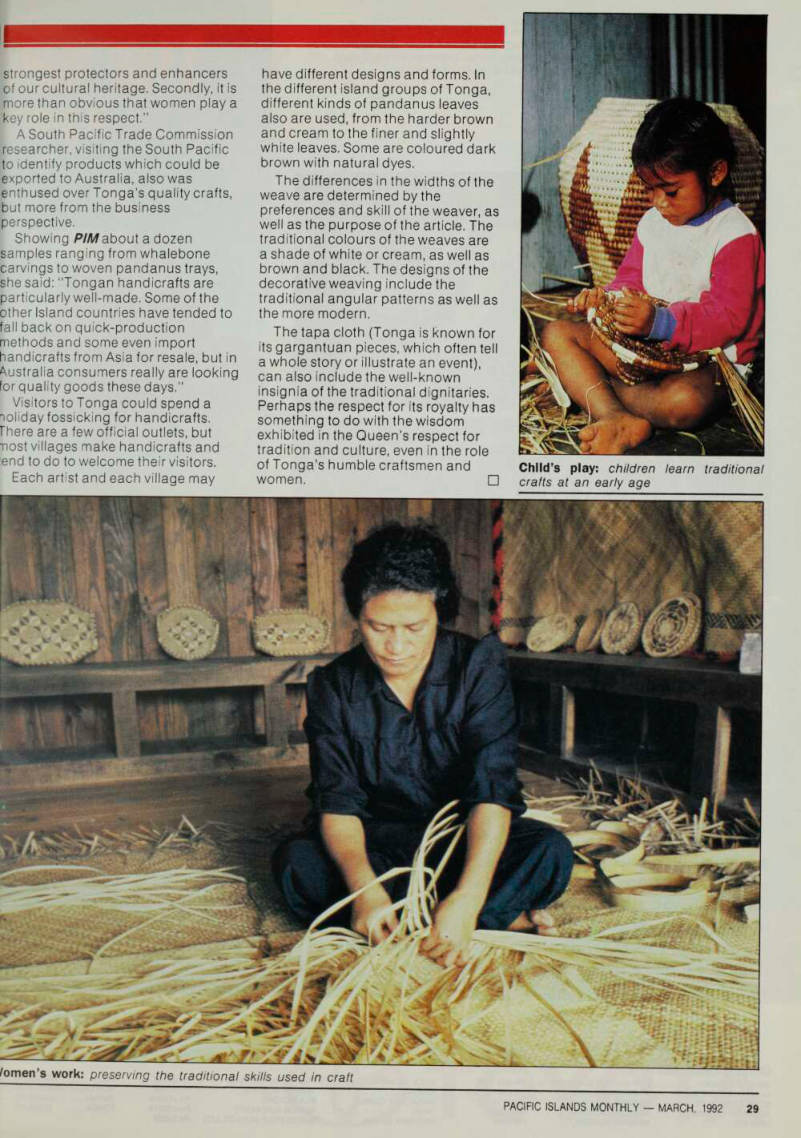
have different designs and forms. In the different island groups of Tonga, different kinds of pandanus leaves also are used, from the harder brown and cream to the finer and slightly white leaves. Some are coloured dark brown with natural dyes.
The differences in the widths of the weave are determined by the preferences and skill of the weaver, as well as the purpose of the article. The traditional colours of the weaves are a shade of white or cream, as well as brown and black. The designs of the decorative weaving include the traditional angular patterns as well as the more modern.
The tapa cloth (Tonga is known for its gargantuan pieces, which often tell a whole story or illustrate an event), can also include the well-known insignia of the traditional dignitaries.
Perhaps the respect for its royalty has something to do with the wisdom exhibited in the Queen’s respect for tradition and culture, even in the role of Tonga’s humble craftsmen and women. □
Child’s play; children learn traditional crafts at an early age
[?]omen's work: preserving the traditional skills used in craft