Strategy for success
pp. 49-51 · Read in the full issue
TODAY’S business world is becom ing more technical, competitive and complex, and the flow of new and changing information involved in decisionmaking is staggering. In this context businesses face "an ultimatum: manage and plan to keep up with the latest trends, or say sayonara to profit and growth.
According to technology pundits everything we need, homegrown or imported, is available in the region but governments, businesses and individuals must accept the challenge of using it.
Managing director of Pro Systems Charles Qiiai Hoi believes managing information through computer tech nology is today’s strategy for success.
“The way we did business five years ago and the way we do business today is very different,” he said. “If you don’t computerise you can’t adapt to change.
Today’s business is totally dependent on information. In the old days I’m talking about five years ago the pressure from the banks and financial institutions were very lax so ‘Okay you’re overdrawn, not a hassle, we just keep on rolling. But today, if you go one cent overdraft, the banks are really on to you.
“That's because the economy’s tightened up. There’s more competition, everbody’s going for the same slice of cake, and the margins are a lot smaller.
You have to sell a lot more to make the same dollars you used to make five years ago. So with the changing business environment, because you are fighting
for the same piece of cake, you have to know what the ingredients of the cake arc to make sure you get the most of it.”
The changing business environment means business managers having to make business decisions rather than just a traditional accounting decision.
“In the old days if the bottom line looked good you just kept going. Tra ditions and company cultures virtually no longer exist because it’s all come down to survival now.”
Governments also are, inadvertently, making business more complex with the introduction of taxes such as Value Added Tax. There is a strong argument for computerised assistance to keep accurate and up to date records, particu larly in Fiji where tougher penalties for Value Added Tax offenders have been framed.
International Computers Limited (ICL) Fiji General Manager, John Fisher, believes the technology is here and the attitude and price are right.
“It’s up to buyers to catch up with the rest of the world. There is still largely a PC mentality, it’s time to lake it to another level of true business usage with packages designed to cover the whole company instead of isolated islands of activity within the office,” he said.
The latest technology is available to the Pacific Islands at a fraction of the cost of 20 years ago, the range is more diversified, and businesses themselves are becoming more computer-conscious.
Fisher said there was a growing awareness and maturity of attitude to
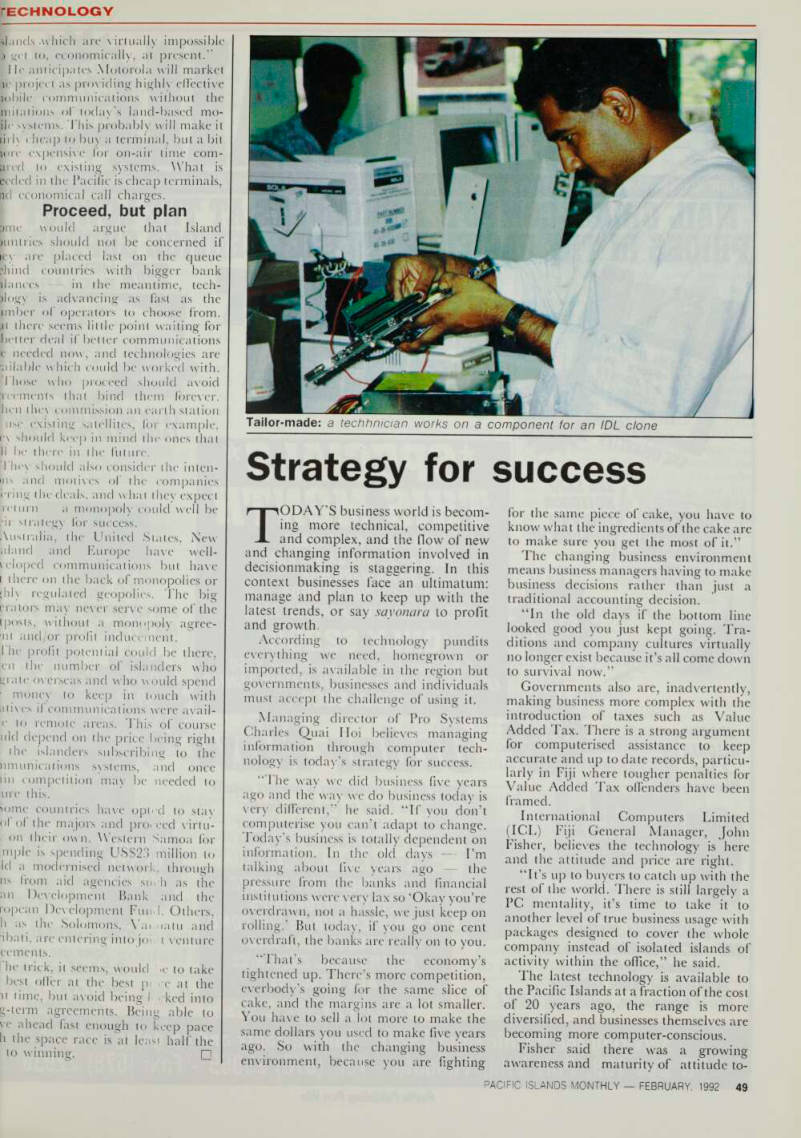
Tailor-made: a techhnician works on a component for an IDL clone
■vard computers and what they could do.
“There is an enthusiasm there instead >f just the old mystery. It’s a nice combination now: affordable solutions md people who want to use them.”
Prices also have gone down a lot. In ibout 1974 a small electro-mechanical nachine would cost about $50,000 to 180,000 dollars. Now the average per onal computer is far more powerful and css expensive.
“And for the sake of adding a couple f extra terminals you can start adding total business solution to a company for tenth of that price,” Fisher said.
He believes attitudes are slowly chang !g- “Small business sectors are looking tore toward computerisation to help lem run their businesses, and we’re spending to that with smaller but more owerful computers with application Iftware, with business solutions on lere. Whereas it might have been a sale r a computer to a company which then t about developing its own software, »day we’re focused on providing a total usiness solution which includes the ;btors ledger, creditors ledger, training ?ople and providing an ongoing assist ice to the users.”
Managers also are changing their
attitude toward users.
“They’re more aware of what commputers can do for them. We used to use a backroom computer which a few people used to work and produce historic reports about whether you made a profit or not, but now we are putting terminals out on desks and they’re being used by people in the day-to-day running of the business, helping to make business de cisions based on the information at your
fingertips.”
Fisher said there was not much technology that wasn’t available to Fiji and to a lesser extent the other islands.
“In general terms we’re providing technology which is as new as anywhere else in the world. The actual use of it still has a lot of catching up to do we’re about five or 10 years behind in that, but the opportunity is there.”
The market is fast catching up.
“The industry is much more market driven now because people know the things they need to succeed. That makes the market more price conscious and competitive, and that’s good.
“On top of that there is a great awareness of computers and a desire to learn which shows Fiji is desperately trying to be part of the world, and it is succeeding.” □