Solar power
pp. 47-49 · Read in the full issue
cuts costs
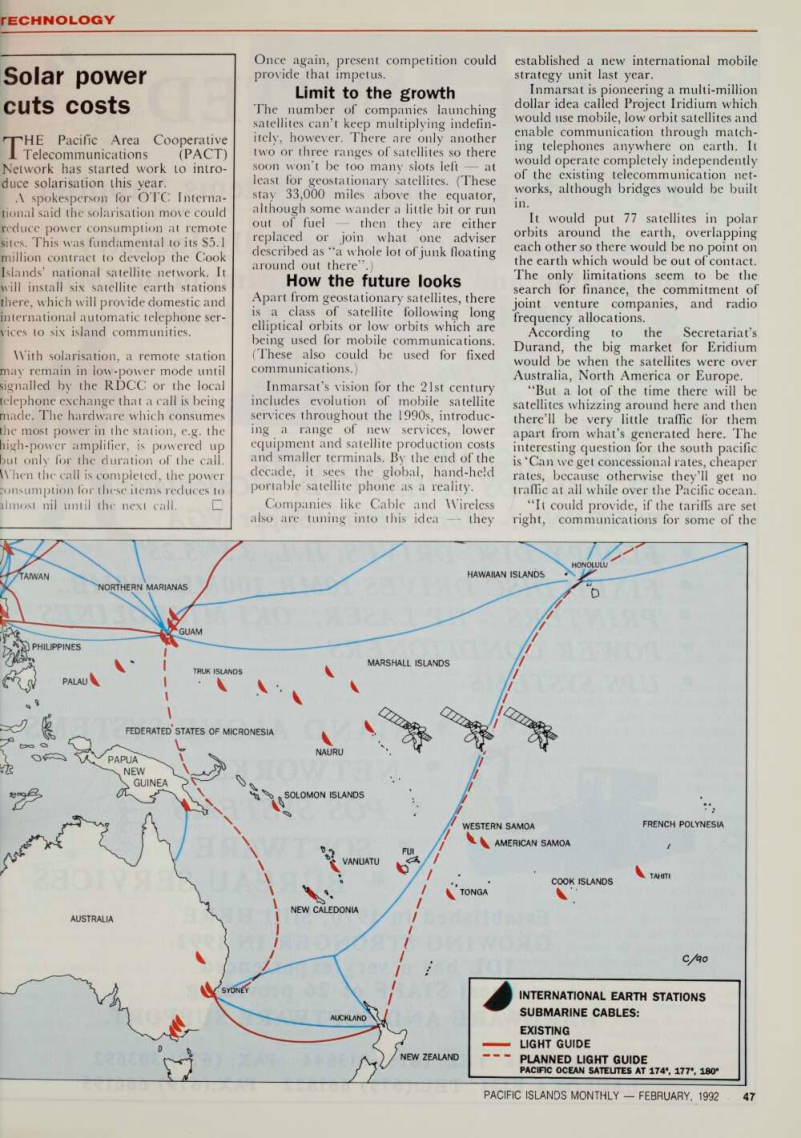
THE Pacific Area Cooperative Telecommunications (PACT) Network has started work to intro duce solarisation this year.
A spokesperson for OTC Interna tional said the solarisation move could reduce power consumption at remote sites. This was fundamental to its s>s.l million contract to develop the Cook Islands’ national satellite network. It will install six satellite earth stations there, which will provide domestic and international automatic telephone ser vices to six island communities.
W ith solarisation, a remote station may remain in low-power mode until signalled by the RDCC or the local telephone exchange that a call is being made. The hardware which consumes the most power in the station, e.g. the high-power amplifier, is powered up but only for the duration of the call.
When the call is completed, the power consumption for these items reduces to almost nil until the next call. □
Once again, present competition could provide that impetus.
Limit to the growth The number of companies launching satellites can’t keep multiplying indefin itely, however. There are only another two or three ranges of satellites so there soon won’t be too many slots left at least for geostationary satellites. (These stay 33,000 miles above the equator, although some wander a little bit or run out of fuel then they are either replaced or join what one adviser described as “a whole lot of junk floating around out there”.) How the future looks Apart from geostationary satellites, there is a class of satellite following long elliptical orbits or low orbits which are being used for mobile communications. (These also could be used for fixed communications.) Inmarsat’s vision for the 21st century includes evolution of mobile satellite services throughout the 19905, introduc ing a range of new services, lower equipment and satellite production costs and smaller terminals. By the end of the decade, it sees the global, hand-held portable satellite phone as a reality.
Companies like Cable and Wireless also are tuning into this idea they
established a new international mobile strategy unit last year.
Inmarsat is pioneering a multi-million dollar idea called Project Iridium which would use mobile, low orbit satellites and enable communication through match ing telephones anywhere on earth. It would operate completely independently of the existing telecommunication net works, although bridges would be built in.
It would put 77 satellites in polar orbits around the earth, overlapping each other so there would be no point on the earth which would be out of contact.
The only limitations seem to be the search for finance, the commitment of joint venture companies, and radio
frequency allocations.
According to the Secretariat’s Durand, the big market for Eridium would be when the satellites were over Australia, North America or Europe.
“But a lot of the time there will be satellites whizzing around here and then there’ll be very little traffic lor them apart from what’s generated here. The interesting question for the south pacific is ‘Can we get concessional rates, cheaper rates, because otherwise they’ll get no traffic at all while over the Pacific ocean.
“It could provide, if the tariffs are set right, communications for some of the
llands -w hich are virtually impossible d get to, economically, at present.” lie anticipates Motorola will market k project as providing highly effective lobile communications without the nutations of today’s land-based mo if systems. This probably will make it irly cheap to bu\ a terminal, but a bit lore expensive for on-air time com a red to existing systems. What is ceded in the Pacific is cheap terminals, bd economical call charges.
Proceed, but plan
Dine would argue that Island Inn tries should not be concerned if ley are placed last on the queue [hind countries with bigger bank dances in the meantime, tech ilogy is advancing as fast as the Imber of operators to choose from. .11 there seems little point waiting for better deal if better communications e needed now , and technologies are piilablc which could be worked with. 1 hose who proceed should avoid reernents that bind them forever, hen they commission an earth station I use existing satellites, lor example, i‘v should keep in mind the ones that II be there in the future.
I hey should also consider the inlcn ms and motives of the companies bring the deals, and what they expect return a monopoly could well be hr strategy for success.
Australia, the United Stales, New aland and Europe have w'dl ieloped communications but have l there on the back of monopolies or fhly regulated geopolies. The big praters may never serve some of the t posts, without a monopoly agree nt and/or profit inducement.
I he profit potential could be there, cn the number of islanders who grate overseas and w ho would spend money to keep in touch with mix es if communications xvere avail e to remote areas. This of course uld depend on the price being right the islanders subscribing to the n inimical ions systems, and once tin competition may be needed to lure this, iome countries have opt. cl to stay of of the majors and proceed virtu on their own. Western Samoa for mple is spending USS 23 million to Id a modernised network, through ns from aid agencies such as the an Dcxclopment Bank and the
ropean Development Fund. Others,
h as the Solomons, Vanuatu and ■ibati. are entering into job i venture cements. he trick, it seems, would be to take best offer at the best pi cc at the it time, but avoid being I ked into g-term agreements. Being able to xc ahead fast enough to keep pace li the space race is at least half the to winning. □