Wider gateway
p. 38 · Read in the full issue
to the world
A TAMA Beci sits in his office and smiles. His second floor office overlooks the Port of Lautoka in western Fiji he is happy with what he sees.
Upgrading is going on all around and as wharf manager this warms his heart.
Lautoka is the country’s second port, and Beci is confident its future growth will justify the Sl2 million upgrade.
Fiji’s future economic growth will rely a great deal on good port facilities for imports of basics such as onion, garlic, potatoes and flour; and for exports which range from sugar and timber to garments and shoes. All are transported mainly by sea. Demand for exports in particular has risen since late 1987 when the country introduced the Tax Free Factory scheme which has attracted many investors.
This is where the Ports Authority of Fiji (PAF) comes in. They manage the country’s ports to ensure that demand is met ■— now and in the future.
Lautoka is the heart of the country’s sugar belt. The city’s sugar mill is the country’s biggest and its port is the major outlet for the country’s sugar.
Sugar has been the mainstay of the economy for the past few decades and is
arguably the country’s top foreign
exchange earner (tourism has been earning more in recent years but many argue that a sizable proportion of this is sent back to the home-base of hotels).
Fiji is quite unique among the small island nations of the Pacific as it has two
major ports Suva, the country’s main port, and Lautoka. Most other island countries have one main port which they channel all their re sources into and trans ship the cargo.
Apart from the bulk sugar ships that dock at Lauloka’s Queens Wharf the port also handles wood-chip vessels that call to demolish the pine chip “mountain” that is
constantly being built.
The chips are produced
by Tropik Wood Indus
tries in Lautoka, ex ported to Japan and con verted to paper pulp.
The demand from Japan is growing and the possi bility of producing chips from other limber is be ing looked at.
This is mus ic to Beci’s ears. He sees the growth of industry as vi tal to the wharf s success and the
upgrading as
important to
the future.
The project was first con sidered in 1986, work started in 1989
when consultants were appointed, and physical work began in January 1990.
The first phase was maintenance and upgrading the wharf structure, including widening the wharf apron to enable easier handling of containers and better traffic circulation.
“The upgrading of the Queens Wharf was prompted as the structure was getting to the stage where something had to be done or the PAF would have to start limiting the loading on the wharf,” explained PAF’s senior engineer project,
Clive Simpson.
The wharf, Simpson said, was con structed in 1961-1962 and was never
designed for containerisation, although
most of the cargo now is containerised.
Upgrading had to be done to enable containers to be handled efficiently.
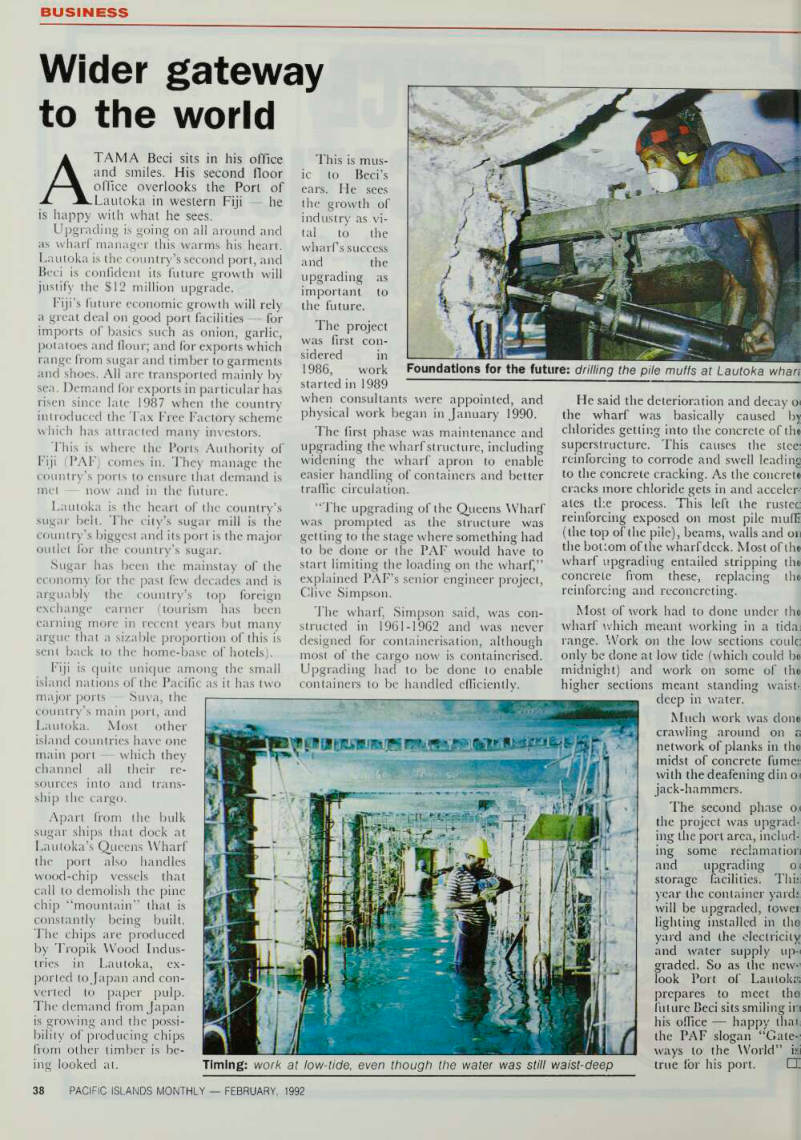
He said the deterioration and decay oi the wharf was basically caused by chlorides getting into the concrete of the superstructure. This causes the slec: reinforcing to corrode and swell leading to the concrete cracking. As the concrete cracks more chloride gets in and acceler ates the process. This left the rustec reinforcing exposed on most pile muff (the top of the pile), beams, walls and on the bottom of the wharf deck. Most of the wharf upgrading entailed stripping the concrete from these, replacing the reinforcing and reconcrcting.
Most of work had to done under the wharf which meant working in a tida. range. Work on the low sections conic only be done at low tide (which could be midnight) and work on some of the higher sections meant standing waist
deep in water.
Much work was clone crawling around on a network of planks in the midst of concrete fumei with the deafening din o<
jack-hammers.
The second phase o<
the project was upgrad
ing the port area, includ ing some reclamation and upgrading oi storage facilities. This year the container yards will be upgraded, tower lighting installed in the yard and the electricity and water supply up * graded. So as the new look Port of Lautokn prepares to meet the future Beci sits smiling in his office happy that the PAF slogan “Gate-' ways to the World” isi true lor his port. d
Timing: work at low-tide, even though the water was still waist-deep
Foundations for the future: drilling the pile muffs at Lautoka whan