home-owners
p. 36 · Read in the full issue
Catch 22 for home-owners
THE Catch 22 of insurance faced by many Pacific islanders was made glaringly obvious in Samoa after Cyclone Val in December.
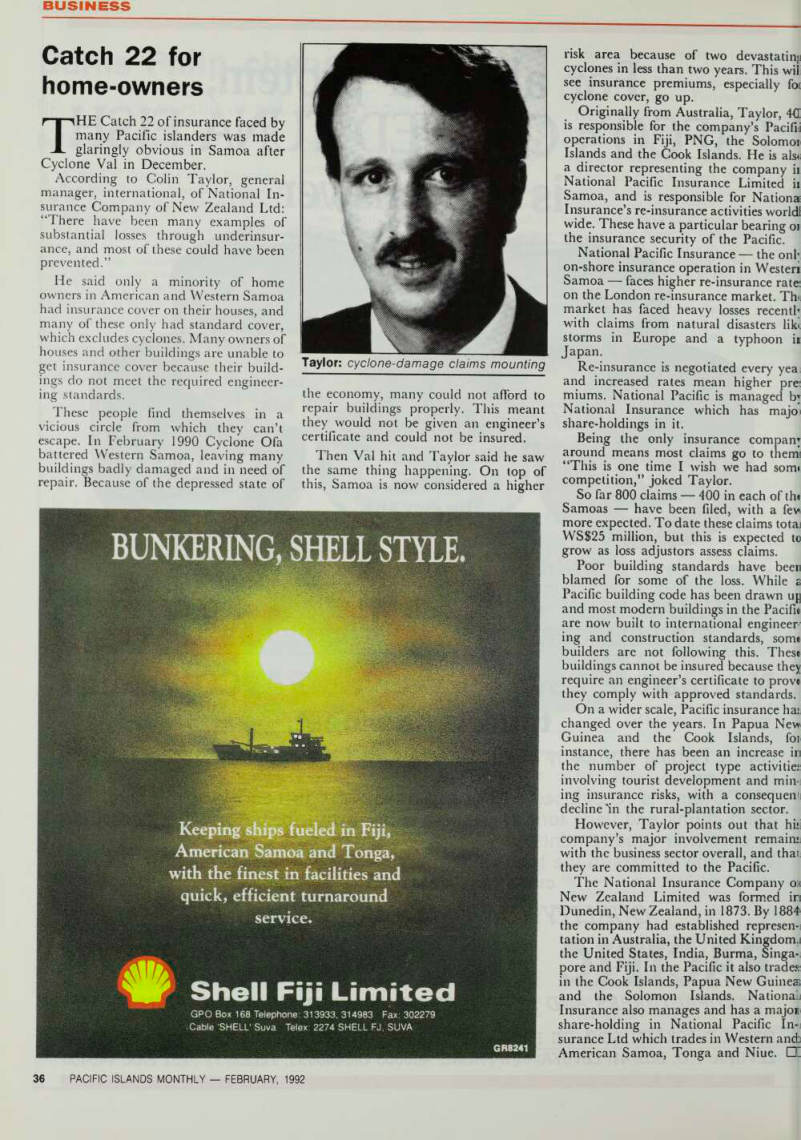
According to Colin Taylor, general manager, international, of National In surance Company of New Zealand Ltd: “There have been many examples of substantial losses through underinsur ance, and most of these could have been prevented.”
He said only a minority of home owners in American and Western Samoa had insurance cover on their houses, and many of these only had standard cover, which excludes cyclones. Many owners of houses and other buildings are unable to get insurance cover because their build ings do not meet the required engineer ing standards.
These people find themselves in a vicious circle from which they can’t escape. In February 1990 Cyclone Ofa battered Western Samoa, leaving many buildings badly damaged and in need of repair. Because of the depressed state of
the economy, many could not afford to repair buildings properly. This meant they would not be given an engineer’s certificate and could not be insured.
Then Val hit and Taylor said he saw the same thing happening. On top of this, Samoa is now considered a higher
risk area because of two devastating cyclones in less than two years. This wili see insurance premiums, especially foe cyclone cover, go up.
Originally from Australia, Taylor, 4(1 is responsible for the company’s Pacifii operations in Fiji, PNG, the Solomon Islands and the Cook Islands. He is als«; a director representing the company ii National Pacific Insurance Limited ii Samoa, and is responsible for Nationae Insurance’s re-insurance activities world! wide. These have a particular bearing oi the insurance security of the Pacific.
National Pacific Insurance the onh on-shore insurance operation in Westeri Samoa faces higher re-insurance rate; on the London re-insurance market. Thd market has faced heavy losses recenth with claims from natural disasters like storms in Europe and a typhoon in Japan.
Re-insurance is negotiated every yeaj and increased rates mean higher pre; miums. National Pacific is managed by National Insurance which has majo< share-holdings in it.
Being the only insurance company around means most claims go to therm “This is one time I wish we had sorm competition,” joked Taylor.
So far 800 claims 400 in each of th« Samoas have been filed, with a few more expected. To date these claims total VVSS2S million, but this is expected to grow as loss adjustors assess claims.
Poor building standards have been blamed for some of the loss. While s Pacific building code has been drawn ufj and most modern buildings in the Pacific are now built to international engineer' ing and construction standards, some builders are not following this. These buildings cannot be insured because they require an engineer’s certificate to prove they comply with approved standards.
On a wider scale, Pacific insurance hajj changed over the years. In Papua New Guinea and the Cook Islands, for instance, there has been an increase in the number of project type activities involving tourist development and min i ing insurance risks, with a consequent decline *in the rural-plantation sector.
However, Taylor points out that hisi company’s major involvement remains with the business sector overall, and than they are committed to the Pacific.
The National Insurance Company ok New Zealand Limited was formed in Dunedin, New Zealand, in 1873. By 1884 the company had established represen-i tation in Australia, the United Kingdom,! the United States, India, Burma, Singa-i pore and Fiji. In the Pacific it also trades; in the Cook Islands, Papua New Guineas and the Solomon Islands. National!
Insurance also manages and has a major share-holding in National Pacific In-j surance Ltd which trades in Western aneb American Samoa, Tonga and Niue. □!
Taylor: cyclone-damage claims mounting