Rare success story starred a tiny unknown
p. 26 · Read in the full issue
THE Forum Secretariat’s third decade of serving its 15-member governments (Australia, Cook Islands, Federated States of Micronesia, Fiji, Kiribati, Marshall Islands, Nauru, New Zealand, Niue, Papua New Guinea, Solomon Islands, Tonga, Tuvalu, Vanuatu and Western Samoa) and their people, begins in earnest this month.
By the time you are reading this article, the first of three
important meetings which the Suva-based regional organisation has organised and is hosting will have been under way.
Formerly the South Pacific Bureau for Economic Co-operation (SPEC), which has since changed title, the Forum Secretariat has grown from a tiny unknown to one of the region’s few success stories.
With a tiny staff and meagre budget in 1971, the Forum Secretariat now boasts 71 staff including professionals and consultants, drawn mainly from its 15-member nations and an annual budget in 1992 of FS 13,820,000 an increase of 17.9 per cent over last year.
Its task-master, the Forum, which meets annually at Prime Ministerial level, now serves as the region’s number one watchdog on political, economic, social and environ
mental issues facing the estimated 25 million people who live here.
The Forum Regional Security Committee (FRSC) meeting from February 18-21 will consider priority and resources needs for security and law enforcement in the South Pacific.
It is a culmination of a series of previous regional meetings, workshops and seminars including the Workshop on Extra dition, Drug Trafficking, Terrorism and Mutual Assistance in Criminal Matters which the Forum Secretariat’s Legal and Political Division hosted in Fiji last September.
A delegation from the French Pacific Territories attended this regional initiative for the first time.
Discussions in September focused on growing concern in the South Pacific region over the threat to regional economic security and well-being by various forms of criminal activities.
The concern about criminal elements gaining a foothold in the Pacific was earlier echoed by Forum leaders at the 22nd Forum in Ponhpei, Federated States of Micronesia, in July.
They have stressed that in the face of the rapidly changing global and economic scene, exchange of information and dialogue among member governments is increasingly import ant. Hence the need for effective regional co-operation in law enforcement areas.
At this month’s FRSC meeting, law enforcement agents including police, customs and government lawyers will discuss priority areas for regional action.
The second gathering, also at the Forum Secretariat, is that
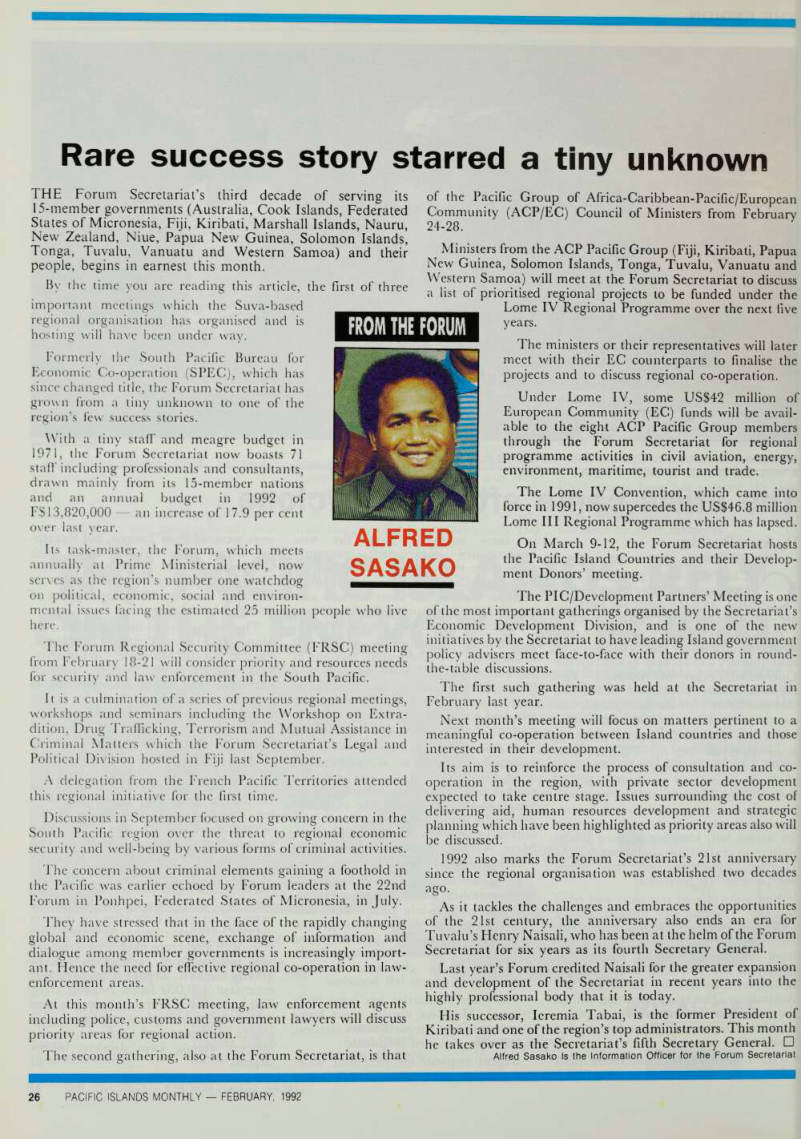
From The Forum
of the Pacific Group of Africa-Caribbean-Pacific/European Community (ACP/EC) Council of Ministers from February 24-28.
Ministers from the ACP Pacific Group (Fiji, Kiribati, Papua New Guinea, Solomon Islands, Tonga, Tuvalu, Vanuatu and Western Samoa) will meet at the Forum Secretariat to discuss a list of prioritised regional projects to be funded under the
Lome IV Regional Programme over the next five years.
The ministers or their representatives will later meet with their EC counterparts to finalise the projects and to discuss regional co-operation.
Under Lome IV, some US$42 million of European Community (EC) funds will be avail able to the eight ACP Pacific Group members through the Forum Secretariat for regional programme activities in civil aviation, energy, environment, maritime, tourist and trade.
The Lome IV Convention, which came into force in 1991, now supercedes the US$46.B million Lome 111 Regional Programme which has lapsed.
On March 9-12, the Forum Secretariat hosts the Pacific Island Countries and their Develop ment Donors’ meeting.
The PIC/Development Partners’ Meeting is one of the most important gatherings organised by the Secretariat’s Economic Development Division, and is one of the new initiatives by the Secretariat to have leading Island government policy advisers meet face-to-face with their donors in round the-table discussions.
The first such gathering was held at the Secretariat in February last year.
Next month’s meeting will focus on matters pertinent to a meaningful co-operation between Island countries and those interested in their development.
Its aim is to reinforce the process of consultation and co operation in the region, with private sector development expected to take centre stage. Issues surrounding the cost of delivering aid, human resources development and strategic planning which have been highlighted as priority areas also will Idc discussed. 1992 also marks the Forum Secretariat’s 21st anniversary since the regional organisation was established two decades ago.
As it tackles the challenges and embraces the opportunities of the 21st century, the anniversary also ends an era for Tuvalu’s Henry Naisali, who has been at the helm of the Forum Secretariat for six years as its fourth Secretary General.
Last year’s Forum credited Naisali for the greater expansion and development of the Secretariat in recent years into the highly professional body that it is today.
His successor, Icremia Tabai, is the former President of Kiribati and one of the region’s top administrators. This month he takes over as the Secretariat’s fifth Secretary General, □ Alfred Sasako Is the Information Officer for the Forum Secretariat