Solofa: playing
pp. 17-20 · Read in the full issue


Cover Stories
Solofa: playing [?] role in education
[T is fitting that some of Esekia Solofa’s earliest memories are of education he is soon to play one of the region’s most important lucation roles.
As a child in Magiagi village on the itskirts of Apia, he recalls going to the llage primary school carrying a mat d a soap box to write on. He also members, in his last four years of |mary school in the late 19505, being in all-boys’ boarding school and in the me class with boys twice his age.
It is this sort of experience of regional ucation that will be beneficial when lofa takes over as vice-chancellor of the liversity of the South Pacific (USP) Kt month. He will be the first citizen a South Pacific country to hold the sition. Solofa, T 6, takes over from glishman Geoffrey Gaston who has fen vice chancellor since 1983.
Solofa’s last two years of high school re in New Zealand, he then obtained bachelor of Science degree in math
atics from Canterbury University,
de trained as a teacher in New aland and taught there for a year ore returning to Western Samoa to ch at Samoa College. He taught there 10 years and resigned as principal of college to take on the chairmanship Western Samoa’s Public Service Com ision in 1980. n 1983 he joined the USP as Director the Institute of Social and Adminis tive Studies, and in 1989 was ap nted to his current position as Direc of Development. He is married with r children. iolofa sees both a good and a bad side being a regional person in the vice ncellor’s chair.
One side of the argument is that a son from the region tends to be more ire of the problems, needs and iitivities of the region, and therefore ild naturally want to do as much as be done maybe too much all at e, and run into problems,” he said.
Being regional, the person also will be
ected by countries particularly his
i country to do more for the on, perhaps more than they would ect an expatriate to do.
The particular country where the chancellor comes from will expect a nore from that person it’s natural, appens in the family situation, even ids. There are certain attractions and r hope benefits will be spread to them.
This makes the job a bit difficult.
“On the plus side of things there are certain sensitivities in relations between the university and individual countries of the region that maybe a person of the region, familiar with the culture, will be able to anticipate and respond to.”
Solofa added that it was unfortunate that the appointment of nationals in regional organisations tended to be seen as a kind of competition which detracted from the importance of the role the person was to undertake.
While Solofa acknowledges that to have a national in such an important position is something for a country to be proud of, he sees his appointment as a regional one. r T , , . . • r/ t col ( £ erned > 15 more important that I see the appointment as one of a regional person rather than as a national of a particular country. ‘Tt is important for any person appointed head of any regional organisbut P. artl( : l r llarl y for the y~ ■ that he sees himself not as a national of any one country but as a person e onging to each of the countries belonging to the university.
It is this recognition of USP’s regional
role not only in education but in fostering regional co-operation which Solofa sees as an important factor in the
region’s long-term inter-relationship,
“People talk to us about administra tion and programmes and staff, but often there are very few questions about stu . dents - It is an important aspect of this university that we have so many types of
cultural make-up.
“When you bring people together from different cultural backgrounds it is always a setting for problems. This is the case with al| the racial groups from the re ? lon and " 15 important for us at the university to ensure the right relation sh,.Pll are , ror " ,ecl : , . , Ihe kir l d °* relationship students built up while here will determine lone term relationships, and this attitude wUI be don to ‘ hi dren and |e (h /i „ y homey ' He said some of the university’s students would one day be leaders of their governments or be advising govern ments, and the university could cultivate a good relationship between students and help them gain experience in working together. 5 Last year the Marshall Islands joined
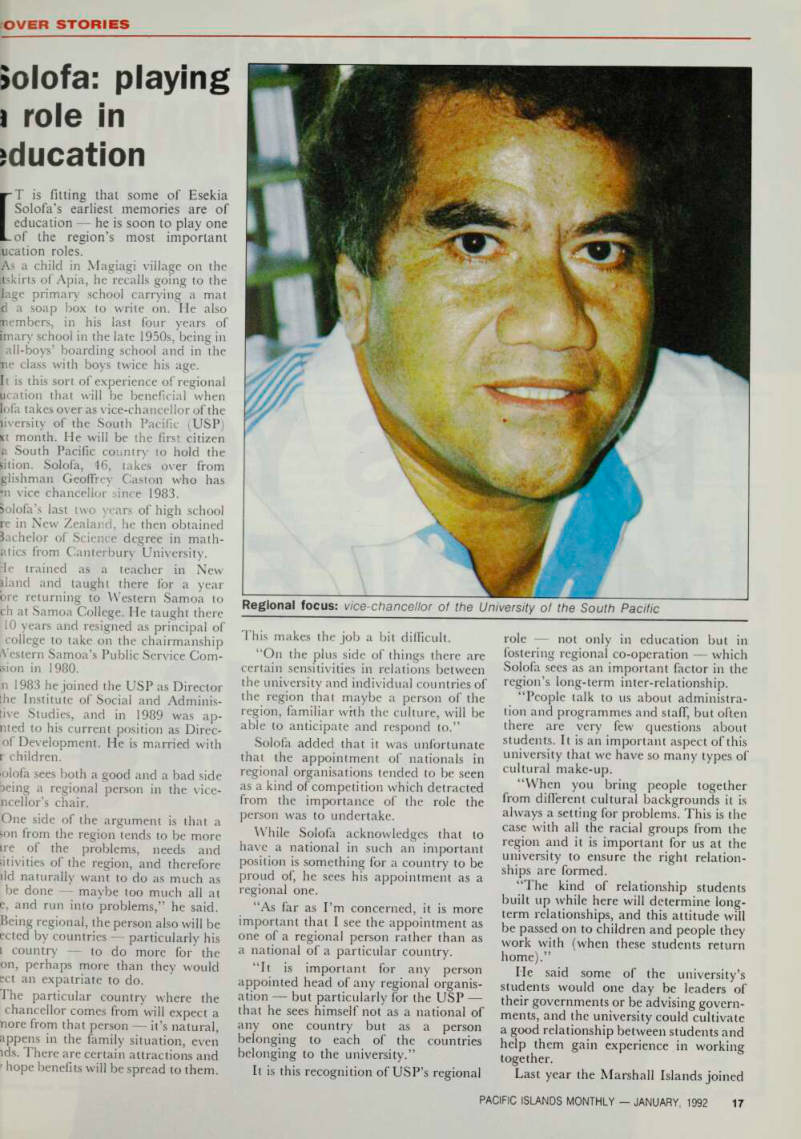
Regional focus: vice-chancellor of the University of the South Pacific
the Solomon Islands, Vanuatu, Fiji, Nauru, Kiribati, Tuvalu, the Tokelaus, Western Samoa, Tonga, Niue and the Cook Islands as members of the univer sity. This move will no doubt be watched with much interest by the Federated States of Micronesia which have shown interest in joining the USP.
Sitting in his office on Suva’s Laucala Campus, Solofa was realistic and frank about future plans, development and growth for the university.
“One tends to assume that things always go well and therefore just extrapolate where we are now to where we will be in 10 years time.”
He said at present the region was just as short of teachers as it was 10 years ago, with the rise in population and the demand for more education. He sus pects the university will have to again do something about training teachers.
“We can’t say in 10 years we will be producing nuclear scientists. Of course that is the direction we want to go, but it would be more realistic to say we would like to see the university continue to play a meaningful part in the development of individual countries of the region.
“I see a continuing need in all sorts of assistance in education curricu lum development, teacher training, in service up-grading of teachers.”
One question which Solofa thinks should be asked is “how affordable is education to the region”.
He said at present almost 90 per cent of the university’s students are spon sored by their government or some other source. He cautioned that, as aid diminishes, there will be less money for sponsored students which leaves the countries to fund their own students.
He said this might lead to a situation in 10 years time where there would be a higher proportion of self-paid students and the university might have to attract foreign students.
“If the university is to maintain its current levels of funding it may have to go out of its way to attract foreign students, which may mean attracting students from outside the region.
“This may mean a university quite different from what we have now our courses will have to recognise the needs of the international students ... (at present) many of the courses that we teach are more for regional relevance.”
Asked if he thought his appointment as vice chancellor was a coming of age for the university, Solofa said one could look at it that way. “One could also look at it as maybe it’s time the
university took the plunge into testing
the waters for the region to try to set its own directions. Whether or not it means we are ready to do that remains to be seen I would like to think we are.” □