Kotobalavu: sense of deja vu
p. 16 · Read in the full issue
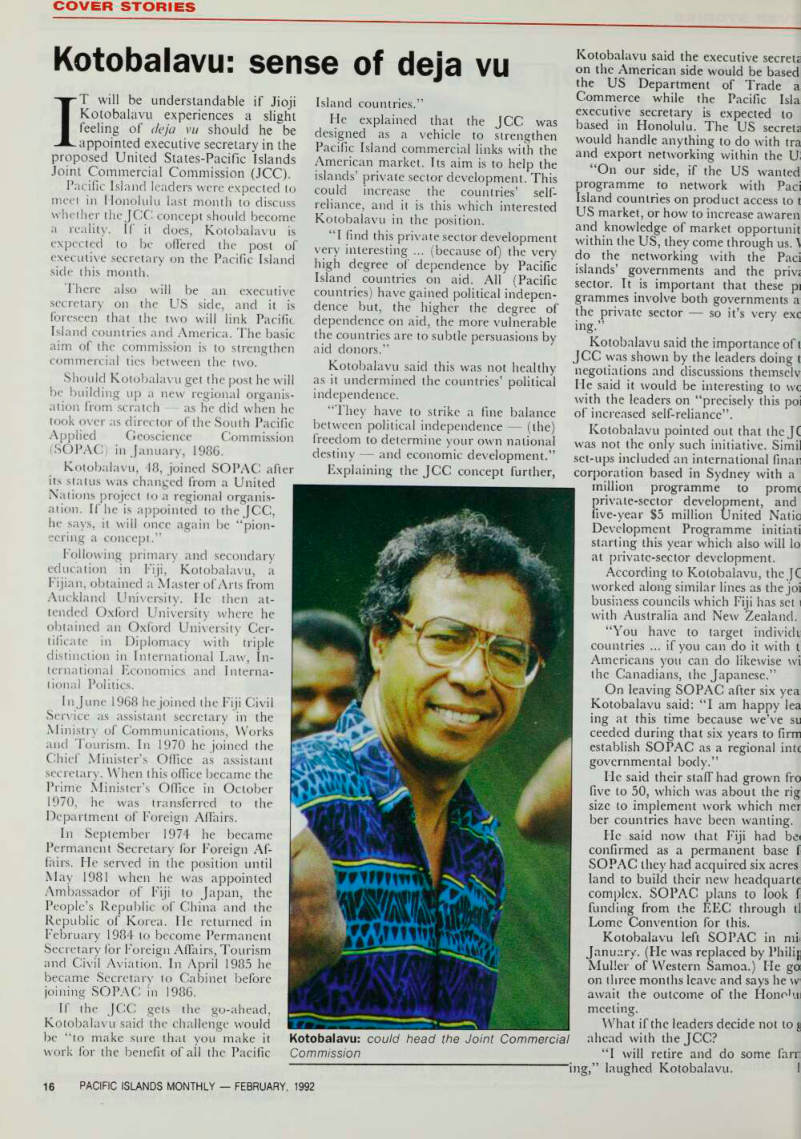
IT will be understandable if Jioji Kotobalavu experiences a slight feeling of deja viz should he be appointed executive secretary in the proposed United States-Pacific Islands Joint Commercial Commission (JCC).
Pacific Island leaders were expected to meet in Honolulu last month to discuss whether the JCC concept should become a reality. If it does, Kotobalavu is expected to be offered the post of executive secretary on the Pacific Island side this month.
There also will be an executive secretary on the US side, and it is foreseen that the two will link Pacific Island countries and America. The basic aim of the commission is to strengthen commercial ties between the two.
Should Kotobalavu get the post he will be building up a new regional organis ation from scratch as he did when he took over as director of the South Pacific Applied Geoscience Commission (SOPAC) in January, 1986.
Kotobalavu, 48, joined SOPAC after
its status was changed from a United Nations project to a regional organis ation. If he is appointed to the JCC, he says, it will once again be “pion eering a concept.”
Following primary and secondary education in Fiji, Kotobalavu, a Fijian, obtained a Master of Arts from Auckland University. He then at tended Oxford University where he obtained an Oxford University Cer tificate in Diplomacy with triple distinction in International Law, In ternational Economics and Interna tional Politics.
In June 1968 he joined the Fiji Civil Service as assistant secretary in the
Ministry of Communications, Works
and Tourism. In 1970 he joined the Chief Minister’s Office as assistant secretary. When this office became the Prime Minister’s Office in October 1970, he was transferred to the
Department of Foreign Affairs.
In September 1974 he became Permanent Secretary for Foreign Af fairs. He served in the position until May 1981 when he was appointed Ambassador of Fiji to Japan, the People’s Republic of China and the Republic of Korea. He returned in February 1984 to become Permanent Secretary for Foreign Affairs, Tourism and Civil Aviation. In April 1985 he became Secretary to Cabinet before joining SOPAC in 1986.
If the JCC gets the go-ahead, Kotobalavu said the challenge would be “to make sure that you make it work for the benefit of all the Pacific
Island countries.”
He explained that the JCC was designed as a vehicle to strengthen Pacific Island commercial links with the American market. Its aim is to help the islands’ private sector development. This could increase the countries’ self reliance, and it is this which interested Kotobalavu in the position.
“I find this private sector development very interesting ... (because of) the very high degree of dependence by Pacific Island countries on aid. All (Pacific countries) have gained political indepen dence but, the higher the degree of dependence on aid, the more vulnerable the countries are to subtle persuasions by aid donors.”
Kotobalavu said this was not healthy as it undermined the countries’ political
independence.
“They have to strike a fine balance
between political independence (the)
freedom to determine your own national
destiny and economic development.”
Explaining the JCC concept further,
Kotobalavu said the executive secrets on the American side would be based the US Department of Trade a Commerce while the Pacific Isla executive secretary is expected to based in Honolulu. The US secrets would handle anything to do with tra and export networking within the Ui “On our side, if the US wanted programme to network with Paci Island countries on product access to t US market, or how to increase awaren and knowledge of market opportunit within the US, they come through us. \ do the networking with the Paci islands’ governments and the privz sector. It is important that these pi grammes involve both governments a the private sector so it’s very exc
ing.”
Kotobalavu said the importance of t JCC was shown by the leaders doing t negotiations and discussions themselv He said it would be interesting to wc with the leaders on “precisely this poi of increased self-reliance”.
Kotobalavu pointed out that the JC was not the only such initiative. Simil set-ups included an international fiman corporation based in Sydney with a
million programme to promt private-sector development, and five-year S 5 million United Natio Development Programme initiati starting this year which also will lo at private-sector development.
According to Kotobalavu, the JC worked along similar lines as the joi business councils which Fiji has set i with Australia and New Zealand.
“You have to target individu countries ... if you can do it with t Americans you can do likewise wi the Canadians, the Japanese.”
On leaving SOPAC after six yea Kotobalavu said: “I am happy lea ing at this time because we’ve su ceedcd during that six years to firm establish SOPAC as a regional intc governmental body.”
He said their staff had grown fro five to 50, which was about the rig size to implement work which mer ber countries have been wanting.
He said now that Fiji had be* confirmed as a permanent base f SOPAC they had acquired six acres land to build their new headquarte complex. SOPAC plans to look f funding from the EEC through tl Lome Convention for this.
Kotobalavu left SOPAC in mu January. (He was replaced by Philifj Muller of Western Samoa.) Me got on three months leave and says he w' await the outcome of the HonoUu meeting.
What if the leaders decide not lo g ahead with the JCC?
“I will retire and do some farn
ing,” laughed Kotobalavu. I
Kotobalavu: could head the Joint Commercial Commission