Eco-fix that needs fixing
p. 54 · Read in the full issue
By Sean Weaver
IN the rush for an eco-fix to the environmental problems faced by many countries, advocates and managers of environmental protec tion frequently forget a vital ingredient the local people.
Enormous amounts of data are col lected by multinational environmental agencies at great expense to quantify the problems. Environmental management and planning tools are then made and distributed, amid much concern for whether the local people or the govern ment involved will be capable of using such tools. If the tools fail it tends to be attributed to the inadequately educated people in the host nation.
What is so often forgotten is the social side of the environment equation the need to understand the local social environment so that appropriate tools can be made and used by local people and by their government departments.
Many opportunities for environmental management currently exist within the context of traditional cultures
and customs if only the planners took the time to look.
Traditional wisdom One of the problems, of course, is that in the deluge of western values, products, and
philosophies exported to Pacific
Island countries, much of the value of tradition is being lost.
Many environmental man agement professionals are quick to complain of the lack of good environmental education.
What they often mean is a lack of western-styled environ mental education to which they themselves are accustomed.
Through a brief look at the very foundations of the tra ditional world view of indigen ous Fijians, one can find much in the way of ecologically
benign philosophies. The con
cept of vanua formed the core of the traditional pantheon and the basis for social and econ omic existence. A close look at the notion of vanua reveals many similarities with the philosophies that lie at the leading edge of western environmentalism. In fact the most enlightened western
styled environmental
philosophies have borrowed much from eastern world views and those of traditional cul tures, which the west has done
so much over the centuries to destroy.
The vanua The vanua is the Fijian version of an inherently ecological notion of existence that can be traced throughout the Pacific. In Hawaii it is known as aina, in Tonga and Samoa it is fanua, and in Aotearoa it is whenua. To many it simply means “land”.
In reality it means much more. The physical aspects of the vanua could be approximated to mean “ecosystem”, but the word vanua also encompasses a spiritual dimension. It represents an extension of the individual, encompass ing one’s physical and social surround ings into a greater whole that is inherently woven into the fabric of life itself. It also incorporates the past, present, and future genealogical relation ship between people and their ecosystems, as well as forming the basis for local political organisation.
The English language did not possess words representing holistic concepts such as “ecosystem” until late in the 19th century. Even today the word ecosystem
is misunderstood by most of the people who use it, to a large extent because the western world view is simply too narrow.
A mechanistic world view that fails U> incorporate ecology into its economics will inevitably be confronted with eco logical problems, hence the various national and international ecological disasters that have their roots in western
economic imperialism.
A lot of indigenous knowledge, philos ophy and wisdom has been eroded since the arrival of western religions, but much still is used every day in the context of traditional village life. Some of it has been transferred into the context of the new Christian religious order that
presently prevails.
It is within this local social- and philosophical framework that environ mental management in Fiji should fit. If it does not it is likely to be discarded by the people who are the guardians of the nation’s valuable ecological resources.
Social alienation A conservation project that becomes a social failure is also likely to become an environmental failure because, in the long run, the local people are the ones who are going to live with the environ mental management. If the benefits ol
environmental manage ment cannot be perceived by the local people in their own terms it becomes an other form of social alien ation.
In Fiji most of the land that would fall into a system or protected areas is tribally owned. To many villagers, who own these sensitive ecosystems, the western styled methods of indigen ous forest conservation on their land endowment is just another form of oppression.
Environmental manage ment which ignores the needs of the local people simply translates into mess ages like “no health ser vices”, “no housing im provements”, “no church” or “no school”. Conser vation becomes synony mous with hardship, social impacts begin to outweigh ecological gains, and at the end oF the day the loca people seek different ways ol using their resources. Fod this to be reversed the needs of local people must be catered for in the design ol
conservation projects, and
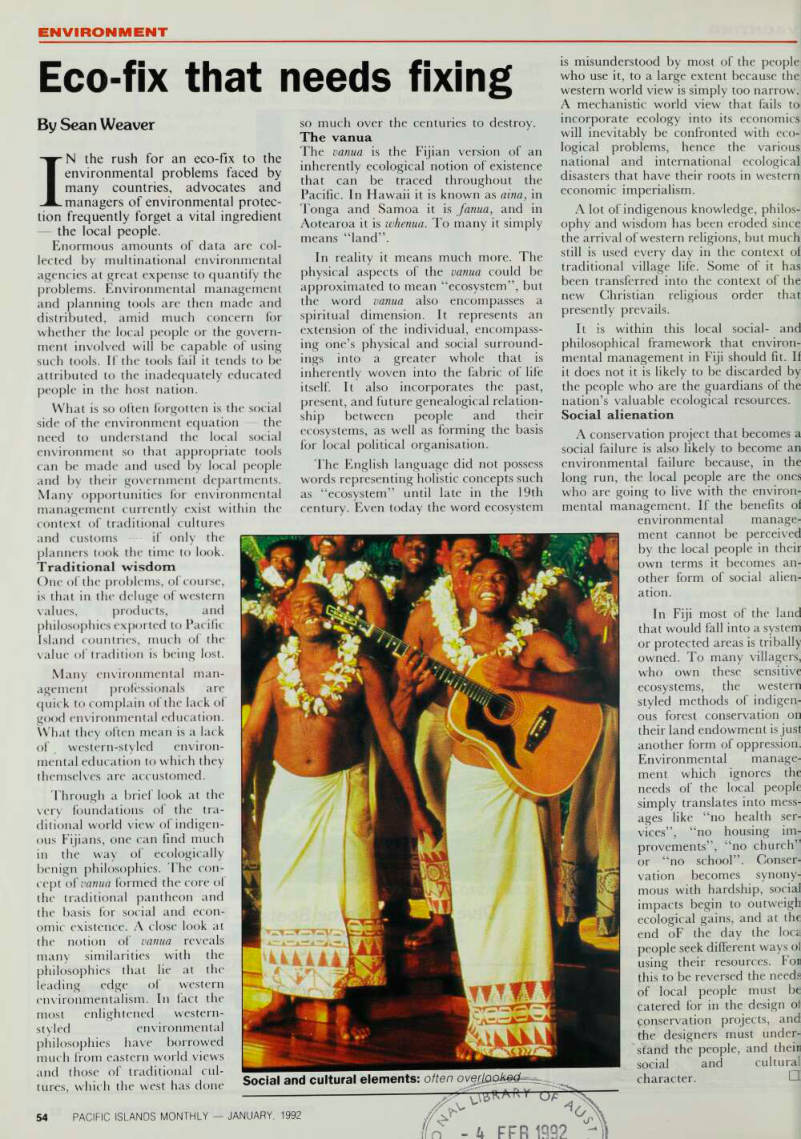
the designers must under stand the people, and thein social and cultural character.
Social and cultural elements: often overlooked