More than fair weather friendships
pp. 52-53 · Read in the full issue
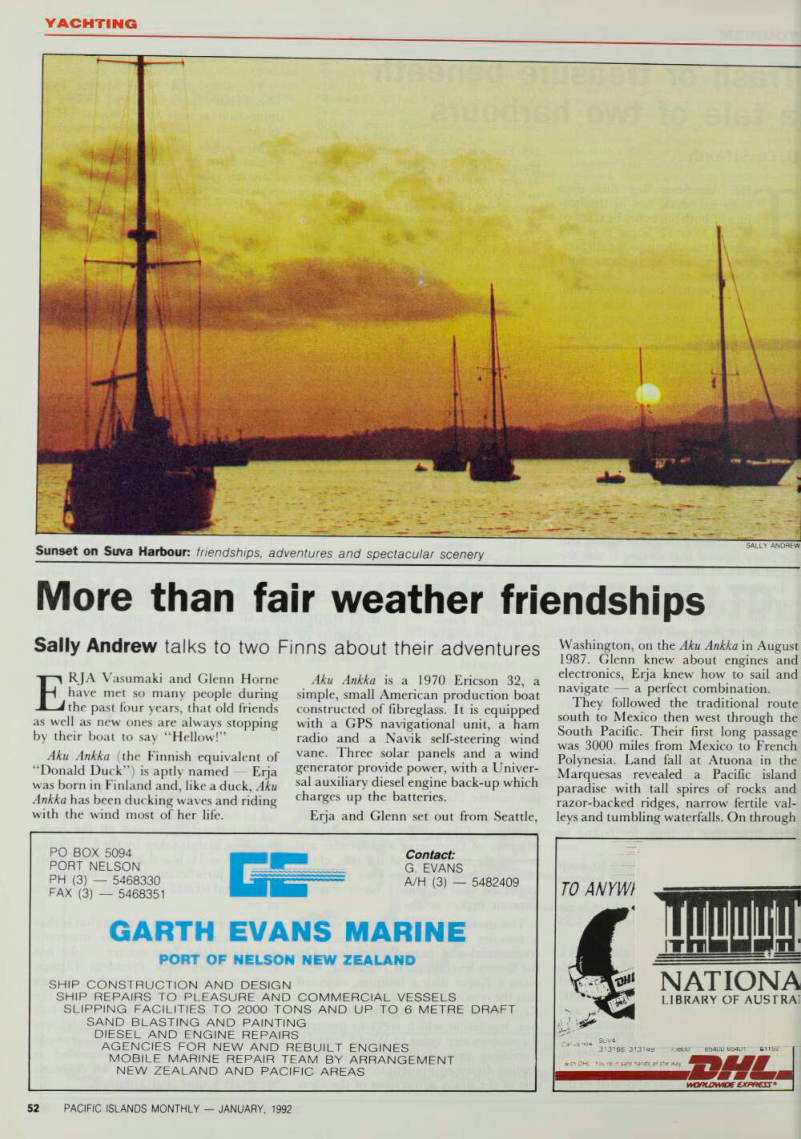
Sally Andrew talks to two Finns about their adventures
ERJA Vasumaki and Glenn Horne have met so many people during the past four years, that old friends as well as new ones are always stopping by their boat to say "Mellow!”
Aku Ankka (the Finnish equivalent of “Donald Duck") is aptly named - Erja was born in Finland and, like a duck, Aku Ankko. has been ducking waves and riding with the wind most of her life.
Aku Ankka is a 1970 Ericson 32, a simple, small American production boat constructed of fibreglass It is equipped with a GPS navigational unit, a ham radio and a Navik self-steering wind >-pi , , , 5 • , vane - Three solar panels and a wind generator provide power, with a Un.ver sal auxiliary diesel engine back-up which charges up the batteries.
Erja and Glenn set out from Seattle,
Washington, on the Mu Ankka in August 1987. Glenn knew about engines and tlcctronics ’ Er J a k r nevv h< T. t 0 sail and na ~Jf ate f „ a t combination, TEe y f °! lowed ' he tradltl ° nal rou‘e S e OU p M " xlc ° ‘ hcn p west , throu B h the T was 3000 miles from Mexico to French Polynesia Land fall at Atuona in the Marquesas revealed a Pacific island 3 ise with taU ires of rocks and razor-backed ridges, narrow fertile val leys and tumbling waterfalls. On through
the Societies, Aku Ankka sailed to Aitutaki in the Cooks, Niue then Tonga.
Erja and Glenn spent the hurricane
season in New Zealand. In May, they headed to Fiji.
After permision to visit the Lau group was granted by Fijian Affairs, Glenn and Erja stocked up on kava (Fijian yangona) for use in the traditional sevusevu to village chiefs and headed for Matuku.
The village on their chart didn’t exist most charts are based on surveys made nearly 100 years ago, so some locals redirected them to a different anchorage. At high tide it was a
one-and-a-half-mile dinghy ride
to the village where they per formed sevusevu.
At night, the men sat around
irinking kava, smoking foot-long
:igarettes made of shredded bits )f twist tobacco rolled in news japer and relaxing under the dim ight of a kerosene lantern.
While at Matuku, Glenn oaned his spear gun to Cama to lunt some turtles at night with iis Lauan buddies. Late that vening, as Glenn and Erja were itting in the cockpit drinking a
up of tea under a canopy of stars, they card a horrible commotion in the
istance yelling, screaming, splashing,
’hey waited anxiously.
When Cam finally appeared, wet and r orn out, it was to apologise for losing le tip to Glenn’s speargun. No one had een hurt, or bitten by a shirk, but poor lama had tried to spear a tough old irtle who was wise to the ways of man. he turtle dived deep under the water hile Cama wrestled with the speargun, i the darkness, out of breath, trying to Ltract it from the turtle’s hide!
When it eventually came time to leave, was very hard to say goodbye. Erja and lenn had become a part of village life.
But goodbyes were said, and Aku Ankka iled out the pass and headed east.
There are no good charts of Fulaga so they relied on a Fijian aerial land survey, local information and eyeball navi-
gation. Inside the well-defined pass, there is lots of anchorage space and hundreds of tiny islets in the lagoon have been undercut by wave action into spectacular mushroom shapes.
Divers mingle with colourful reef fish, turtles, manta rays, sharks, 400 pound
gropers and double-humped parrot fish five feet long on the “freeway” in and out of the lagoon.
No kava is grown on the island, so when they went ashore the following day to perform sevusevu, Glenn and Erja were welcomed with open arms.
They met Marau, a woodcarver, at the “Youth Club” in Muana-I-Caka, where local men under the age of 40 sit and spend the day carving.
Glenn and Erja spent almost a year in Fiji, but eventually they had to move on to find work.
At Niuatoputapu in northern Tonga they met Tui, an agent at
the Niuatoputapu Airport, who
proved an excellent Scrabble player. He could spell and play Scrabble very well even though English was his second language.
Glenn and Erja sailed to Am erican Samoa where they worked for a year, then returned to Fiji via Western Samoa and Wallis.
Tui, the Tongan scrabble player, arrived in Suva aboard another yacht and came alongside to sav “Hello!”. But Fijian woodcarver Matua gave them the biggest surprise. Matua had first come
aboard two years earlier in 1989 at Fulaga in the Lau group.
Aku Ankka is now in Vanuatu and will spend the upcoming hurricane season in the Solomons. Glenn and Erja plan to head toward Papua New Guinea, Indon esia, and Singapore.
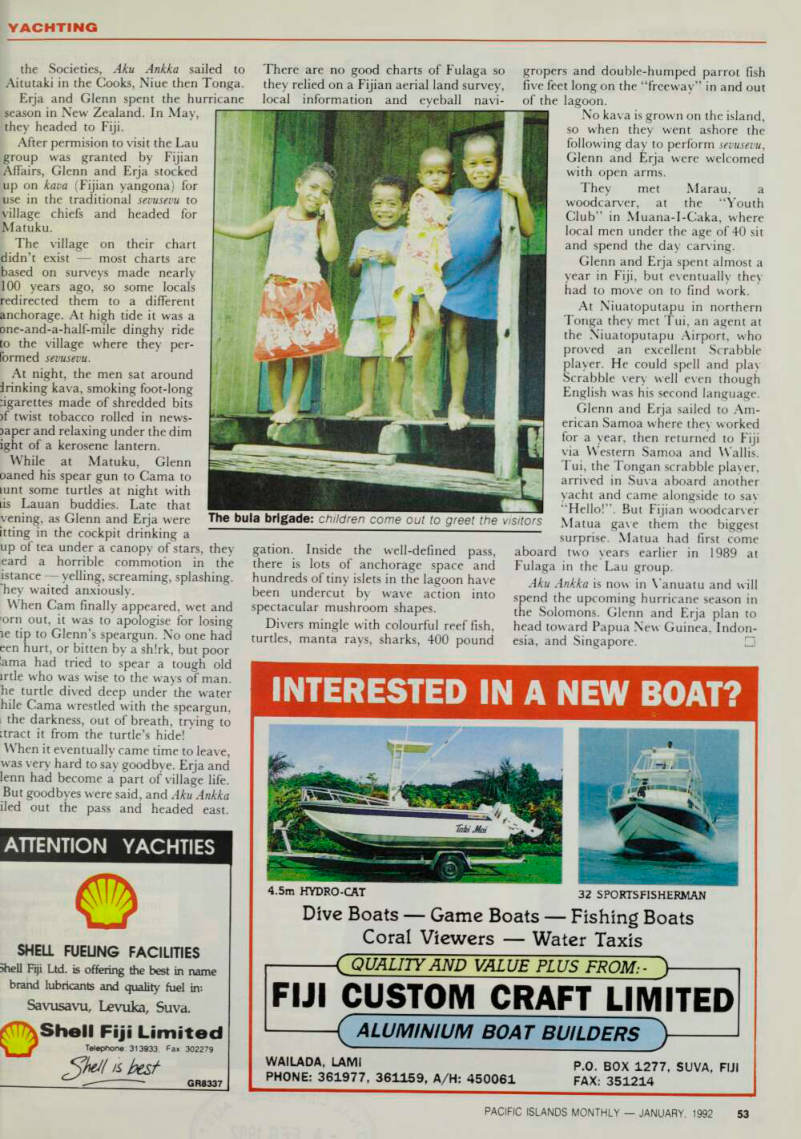
The bula brigade: children come out to greet the visitors