A new, but modest, spirit
pp. 44-45 · Read in the full issue
ON the second floor of a modest two-storey building on Mendana Avenue in down town Honiara is a fairly modest office. In it are two modest men.
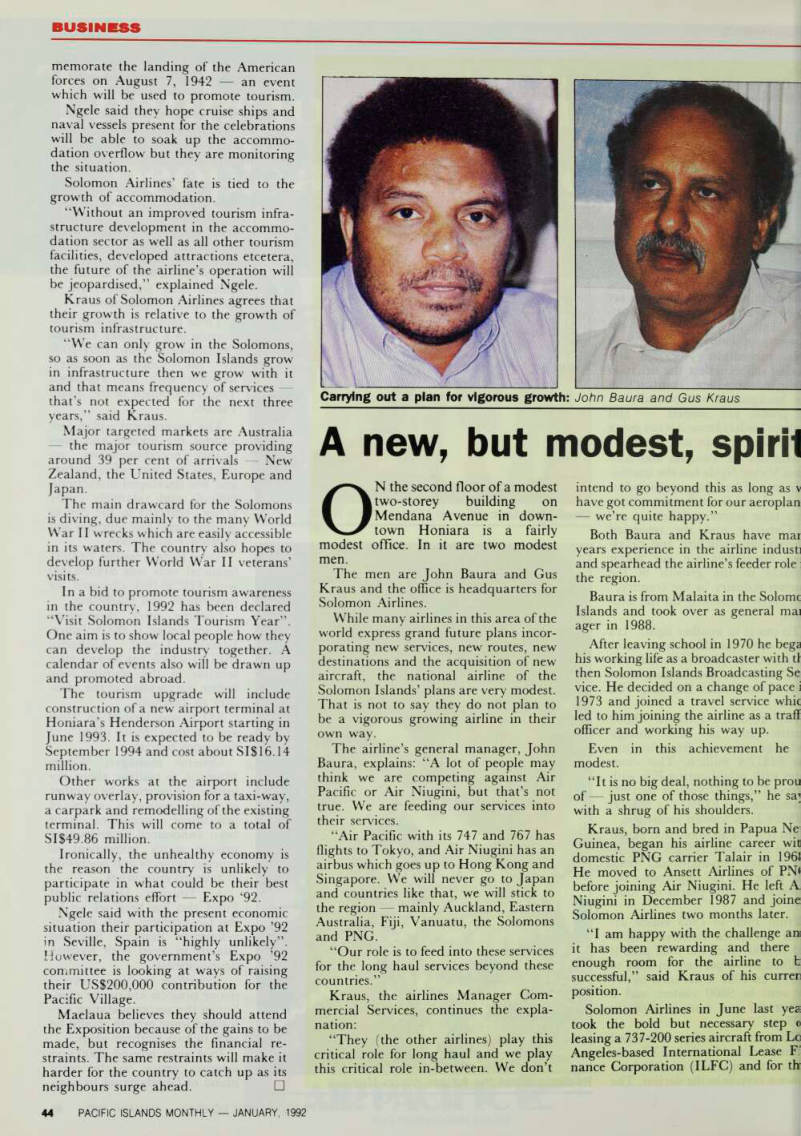
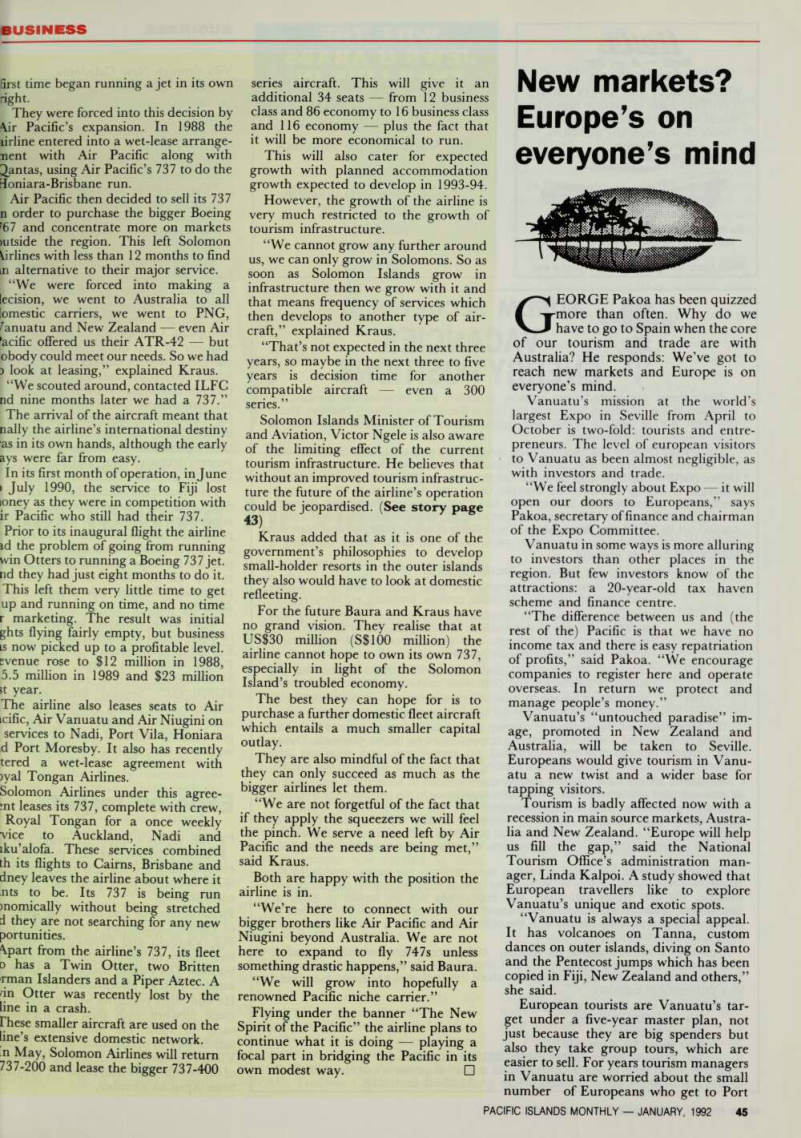
The men are John Baura and Gus Kraus and the office is headquarters for Solomon Airlines.
While many airlines in this area of the world express grand future plans incor porating new services, new routes, new destinations and the acquisition of new aircraft, the national airline of the Solomon Islands’ plans are very modest.
That is not to say they do not plan to be a vigorous growing airline in their own way.
The airline’s general manager, John Baura, explains: “A lot of people may think we are competing against Air Pacific or Air Niugini, but that’s not true. We are feeding our services into their services.
“Air Pacific with its 747 and 767 has flights to Tokyo, and Air Niugini has an airbus which goes up to Hong Kong and Singapore. We will never go to Japan and countries like that, we will stick to the region mainly Auckland, Eastern Australia, Fiji, Vanuatu, the Solomons and PNG.
“Our role is to feed into these services for the long haul services beyond these countries.”
Kraus, the airlines Manager Com mercial Services, continues the expla nation: “They (the other airlines) play this critical role for long haul and we play this critical role in-between. We don’t
intend to go beyond this as long as v have got commitment for our aeroplan we’re quite happy.”
Both Baura and Kraus have mar years experience in the airline industi and spearhead the airline’s feeder role i the region.
Baura is from Malaita in the Solomc Islands and took over as general mai ager in 1988.
After leaving school in 1970 he bega his working life as a broadcaster with tl then Solomon Islands Broadcasting Se vice. He decided on a change of pace i 1973 and joined a travel service whic led to him joining the airline as a trail officer and working his way up.
Even in this achievement he modest.
“It is no big deal, nothing to be prou of just one of those things,” he with a shrug of his shoulders.
Kraus, born and bred in Papua Ne’
Guinea, began his airline career witl domestic PNG carrier Talair in 1961 He moved to Ansett Airlines of PNf before joining Air Niugini. He left A.
Niugini in December 1987 and joine Solomon Airlines two months later.
“I am happy with the challenge am it has been rewarding and there enough room for the airline to h successful,” said Kraus of his curren
position.
Solomon Airlines in June last yea took the bold but necessary step o leasing a 737-200 series aircraft from Lc Angeles-based International Lease F' nance Corporation (ILFC) and for thr
Carrying out a plan for vigorous growth: John Baura and Gus Kraus
first time began running a jet in its own right- They were forced into this decision by \ir Pacific’s expansion. In 1988 the iirline entered into a wet-lease arrange nent with Air Pacific along with using Air Pacific’s 737 to do the floniara-Brisbane run.
Air Pacific then decided to sell its 737 n order to purchase the bigger Boeing f 67 and concentrate more on markets mtside the region. This left Solomon Urlines with less than 12 months to find in alternative to their major service. [ “We were forced into making a [ecision, we went to Australia to all lomestic carriers, we went to PNG, Vanuatu and New Zealand even Air ’acific offered us their ATR-42 but obody could meet our needs. So we had 5 look at leasing,” explained Kraus.
“We scouted around, contacted ILFC nd nine months later we had a 737.”
The arrival of the aircraft meant that nally the airline’s international destiny as in its own hands, although the early ays were far from easy.
In its first month of operation, in June » July 1990, the service to Fiji lost loney as they were in competition with ir Pacific who still had their 737.
Prior to its inaugural flight the airline id the problem of going from running win Otters to running a Boeing 737 jet. nd they had just eight months to do it.
This left them very little time to get up and running on time, and no time r marketing. The result was initial ghts flying fairly empty, but business is now picked up to a profitable level, evenue rose to $l2 million in 1988, 5.5 million in 1989 and $23 million 5t year.
The airline also leases seats to Air icific, Air Vanuatu and Air Niugini on services to Nadi, Port Vila, Honiara d Port Moresby. It also has recently tered a wet-lease agreement with
)yal Tongan Airlines.
Solomon Airlines under this agree mt leases its 737, complete with crew,
Royal Tongan for a once weekly
vice to Auckland, Nadi and iku’alofa. These services combined th its flights to Cairns, Brisbane and dney leaves the airline about where it nts to be. Its 737 is being run
momically without being stretched
d they are not searching for any new portunities. \part from the airline’s 737, its fleet d has a Twin Otter, two Britten rman Islanders and a Piper Aztec. A fin Otter was recently lost by the line in a crash.
Fhese smaller aircraft are used on the line’s extensive domestic network, n May, Solomon Airlines will return 737-200 and lease the bigger 737-400
series aircraft. This will give it an additional 34 seats from 12 business class and 86 economy to 16 business class and 116 economy plus the fact that it will be more economical to run.
This will also cater for expected growth with planned accommodation growth expected to develop in 1993-94.
However, the growth of the airline is very much restricted to the growth of tourism infrastructure.
“We cannot grow any further around us, we can only grow in Solomons. So as soon as Solomon Islands grow in infrastructure then we grow with it and that means frequency of services which then develops to another type of air craft,” explained Kraus.
“That’s not expected in the next three years, so maybe in the next three to five years is decision time for another compatible aircraft even a 300 series.”
Solomon Islands Minister of Tourism and Aviation, Victor Ngele is also aware of the limiting effect of the current tourism infrastructure. He believes that without an improved tourism infrastruc ture the future of the airline’s operation could be jeopardised. (See story page Kraus added that as it is one of the
government’s philosophies to develop
small-holder resorts in the outer islands they also would have to look at domestic
reflecting.
For the future Baura and Kraus have no grand vision. They realise that at US$3O million (Ssloo million) the airline cannot hope to own its own 737, especially in light of the Solomon Island’s troubled economy.
The best they can hope for is to purchase a further domestic fleet aircraft which entails a much smaller capital outlay.
They are also mindful of the fact that they can only succeed as much as the bigger airlines let them.
“We are not forgetful of the fact that if they apply the squeezers we will feel the pinch. We serve a need left by Air Pacific and the needs are being met,” said Kraus.
Both are happy with the position the airline is in.
“We’re here to connect with our bigger brothers like Air Pacific and Air Niugini beyond Australia. We are not here to expand to fly 747 s unless something drastic happens,” said Baura.
“We will grow into hopefully a renowned Pacific niche carrier.”
Flying under the banner “The New Spirit of the Pacific” the airline plans to continue what it is doing playing a focal part in bridging the Pacific in its own modest way. □