On the tourism trail
pp. 43-44 · Read in the full issue
Business
By Martin Tiffany
Frying to find the Solomon Islands
Ministry of Tourism and Aviation n Honiara can be a bit tricky.
“It’s behind the post office,” a isitor is told, “down the side of the
figh Court building.”
After slipping down a little path ►eside the post office and squeezing last a couple of buildings you are reeled with a bright sign indicat ig that you have found the Ministry of Tourism.
Its tucked-away location and lodest offices reflect the situation f the industry here. Tourism is in
le background economically
s profits are modest and mrism leaders know it is not going ) develop in leaps and bounds.
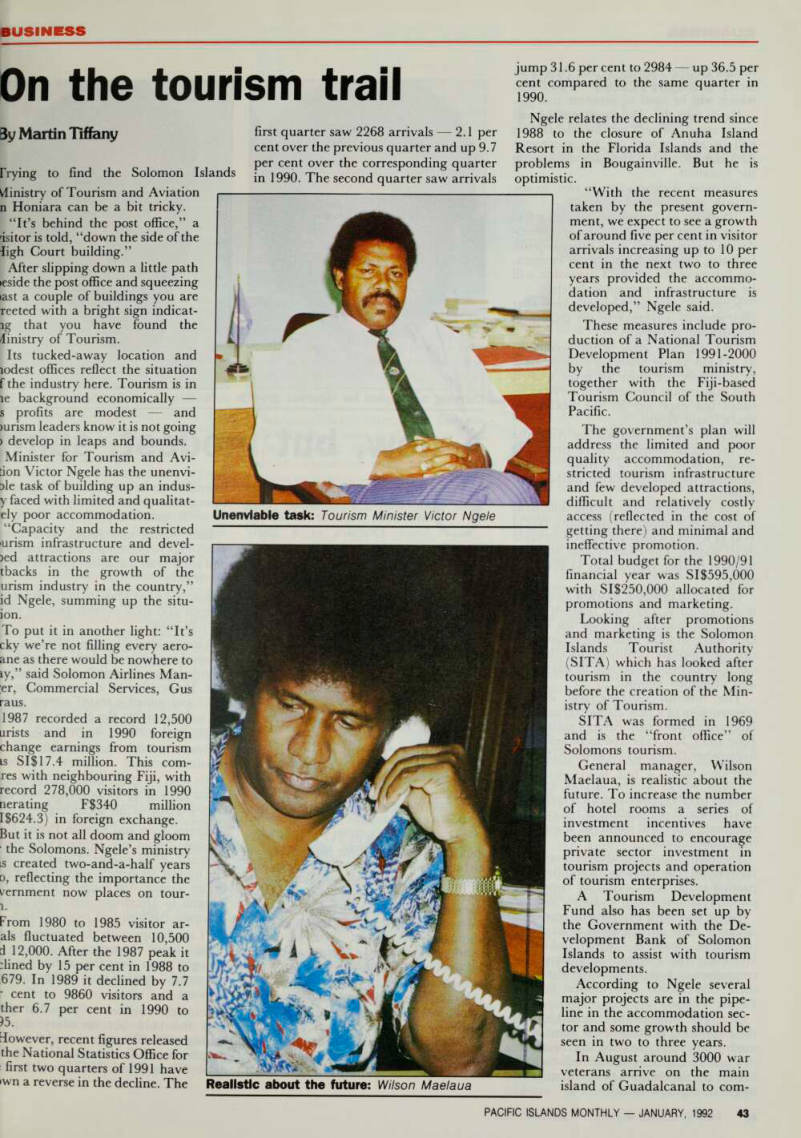
Minister for Tourism and A vi sion Victor Ngele has the unenvi- Dle task of building up an indus y faced with limited and qualitat ely poor accommodation.
“Capacity and the restricted urism infrastructure and devel )ed attractions are our major tbacks in the growth of the urism industry in the country,”
id Ngele, summing up the situ
ion.
To put it in another light: “It’s cky we’re not filling every aero ane as there would be nowhere to ly,” said Solomon Airlines Man er, Commercial Services, Gus raus. 1987 recorded a record 12,500 Lirists and in 1990 foreign change earnings from tourism is SIS 17.4 million. This corn
res with neighbouring Fiji, with
record 278,000 visitors in 1990 tierating Fs34o million
15624.3) in foreign exchange.
But it is not all doom and gloom the Solomons. Ngele’s ministry is created two-and-a-half years
0, reflecting the importance the
vernment now places on tour 1, From 1980 to 1985 visitor ar als fluctuated between 10,500 d 12,000. After the 1987 peak it dined by 15 per cent in 1988 to 679. In 1989 it declined by 7.7 cent to 9860 visitors and a ther 6.7 per cent in 1990 to )5.
riowever, recent figures released
the National Statistics Office for first two quarters of 1991 have iwn a reverse in the decline. The
first quarter saw 2268 arrivals 2.1 per cent over the previous quarter and up 9.7 per cent over the corresponding quarter in 1990. The second quarter saw arrivals
jump 31.6 per cent to 2984 —up 36.5 per cent compared to the same quarter in 1990.
Ngele relates the declining trend since 1988 to the closure of Anuha Island Resort in the Florida Islands and the problems in Bougainville. But he is
optimistic.
“With the recent measures taken by the present govern ment, we expect to see a growth of around five per cent in visitor arrivals increasing up to 10 per cent in the next two to three years provided the accommo dation and infrastructure is developed,” Ngele said.
These measures include pro duction of a National Tourism Development Plan 1991-2000 by the tourism ministry, together with the Fiji-based Tourism Council of the South Pacific.
The government’s plan will address the limited and poor quality accommodation, re stricted tourism infrastructure and few developed attractions, difficult and relatively costly access (reflected in the cost of getting there) and minimal and ineffective promotion.
Total budget for the 1990/91 financial year was 515595,000 with 515250,000 allocated for
promotions and marketing.
Looking after promotions and marketing is the Solomon Islands Tourist Authority (SITA) which has looked after tourism in the country long before the creation of the Min istry of Tourism.
SITA was formed in 1969 and is the “front office” of Solomons tourism.
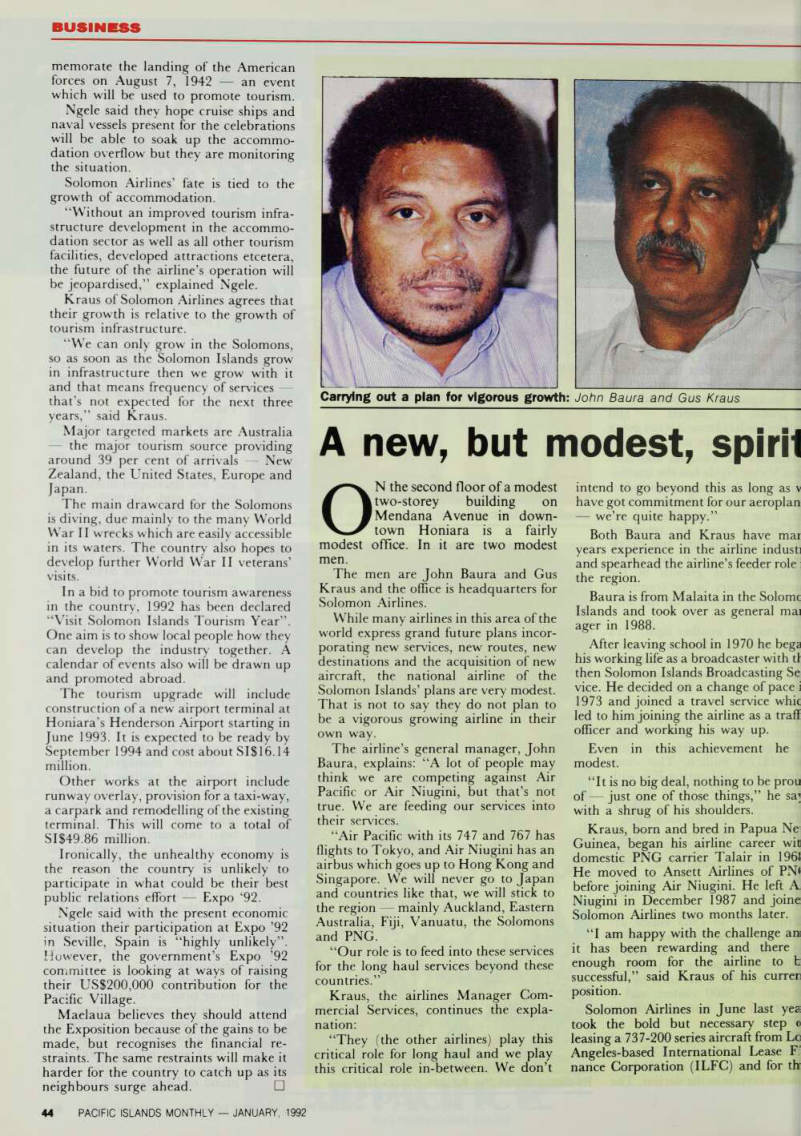
General manager, Wilson Maelaua, is realistic about the future. To increase the number of hotel rooms a series of investment incentives have been announced to encourage private sector investment in tourism projects and operation of tourism enterprises.
A Tourism Development Fund also has been set up by the Government with the De velopment Bank of Solomon Islands to assist with tourism
developments.
According to Ngele several major projects are in the pipe line in the accommodation sec tor and some growth should be seen in two to three years.
In August around 3000 war veterans arrive on the main island of Guadalcanal to com
Unenviable task: Tourism Minister Victor Ngele
Realistic about the future: Wilson Maelaua
memorate the landing of the American forces on August 7, 1942 an event which will be used to promote tourism.
Ngele said they hope cruise ships and naval vessels present for the celebrations will be able to soak up the accommo dation overflow but they are monitoring the situation.
Solomon Airlines’ fate is tied to the growth of accommodation.
“Without an improved tourism infra structure development in the accommo dation sector as well as all other tourism facilities, developed attractions etcetera, the future of the airline’s operation will
be jeopardised,” explained Ngele.
Kraus of Solomon Airlines agrees that their growth is relative to the growth of tourism infrastructure.
“We can only grow in the Solomons, so as soon as the Solomon Islands grow in infrastructure then we grow with it and that means frequency of services that’s not expected for the next three years,” said Kraus.
Major targeted markets are Australia the major tourism source providing around 39 per cent of arrivals New Zealand, the United States, Europe and
japan.
The main drawcard for the Solomons is diving, due mainly to the many World War II wrecks which are easily accessible in its waters. The country also hopes to develop further World War II veterans’ visits.
In a bid to promote tourism awareness in the country, 1992 has been declared “Visit Solomon Islands Tourism Year”.
One aim is to show local people how they can develop the industry together. A calendar of events also will be drawn up and promoted abroad.
The tourism upgrade will include construction of a new airport terminal at Honiara’s Henderson Airport starting in June 1993. It is expected to be ready by September 1994 and cost about SIS 16.14 million.
Other works at the airport include runway overlay, provision for a taxi-way, a carpark and remodelling of the existing terminal. This will come to a total of 51549.86 million.
Ironically, the unhealthy economy is the reason the country is unlikely to participate in what could be their best public relations effort Expo ‘92.
Ngele said with the present economic situation their participation at Expo ’92 in Seville, Spain is “highly unlikely”.
However, the government’s Expo ’92 committee is looking at ways of raising their US$2OO,OOO contribution for the
Pacific Village.
Maelaua believes they should attend the Exposition because of the gains to be made, but recognises the financial re straints. The same restraints will make it harder for the country to catch up as its neighbours surge ahead. □