Thank you for the Memories
pp. 51-52 · Read in the full issue
Sport
Western Samoa gave the world a party to remember
“IT’S been a helluva party but it’s all over now.” Even with tears in his eyes as he said it, it was still an understatement
from All Black great Bryan Williams, the technical ad visor to the Western Samoan Rugby side.
His side
had just
bowed out to Scotland in the
quarterfinals
of the rugby union World Cup, but for the Samoans the whole tournament had been a
raging party
of which they’d poss ibly been the life and soul.
Much of
the early play in the competition had been like champagne in paper cups still drinkable but somewhat lifeless as all the pre-tournament favourites fired blanks. The champion All Blacks looked ring-rusty, the English had lost, the French were split by internal ructions and the Fijians, usually a safe bet to provide some pizzazz, looked out of their
depth.
To top it off the referees went whistle happy, driving everyone to the edge with frustration. But a spark was needed to ignite those preliminary rounds and to win over Wales in their first game.
The Samoans were it.
Leading into the tournament they were dubbed the “minnows”, the dark horses with potential to surprise though no-one expected them to surprise as much as they did. Nor were they expected to capture the imaginations of the British public as much as they did.
It was their tackling against the Welsh that did it at first and then it was their ability to run with the ball. Next it was
their out and out enjoyment of the game and finally it was their graciousness in defeat.
Whatever it was, they were never far from the headlines.
Journalists, pushed by editors to find a different “angle” on the South Seas visitors, came up with the “sexiest men in the World Cup”.
Outside their team hotels, television crews camped, waiting for the chance for an interview and, like birthday boys at a surprise party, one, or more often 10, Samoans were willing to oblige.
“This is the one single event in the history of the world to attract this kind of attention to our country,” said manager Tate Simi. Judging from the number of maps in newspapers explain ing exactly where Western Samoa is in relation to New Zealand and Australia, Simi was probably right.
As the only Samoan journalist follow ing the tournament, the memories are
many. Certainly the Games them selves; the first ever
Samoan victory
over Wales; the close loss to the Australians; the win over Argen
tina sealing a place
in the
quarterfinals; and
the subsequent loss to Scotland in front of 60,000 people as the sta dium reverberated to the tune of Flower of Scotland.
Glorious achievemnts all of them but three events outside the field of play stand out.
The sight of the most senior player in the side, full back Anitelea
Aiolupo leading
his side in their war dance, Mam, before the Welsh game is one of them. In the middle of the famous Cardiff Arms Park, sur rounded by 40,000 of the ‘enemy’ it seemed an exercise
in futility as 15 men prepared to take on the might of the whole nation.
But you couldn’t have told that to Aiolupo, such was the ferocity with which he challenged the Welsh. He’d Piously lost twice to the ‘Red P ra g° ns - and from the way he slapped p s bod >' and , g |ared at f he opponents he knew li wasn 1 g om g to be three m a row - Looking so small but so proud and deflant s he warmed the heart *; That was at the start of their cam . • xhe second highlight came a few 5 “ )ater at St A ba s ns p rimary School in 'Cardiff. Sure, the children loved it,
.they never stopped yelling while tugging
a t the players’ jackets insisting On “another autograph, please sir”. The delight was obvious and infectious, but t h e surprise came from the players’ reactions.
After all the media atention they’d received and the pressure of their next game upon them, they might easily have brushed the school visit off as just another
World Cup
Loveni
Enari
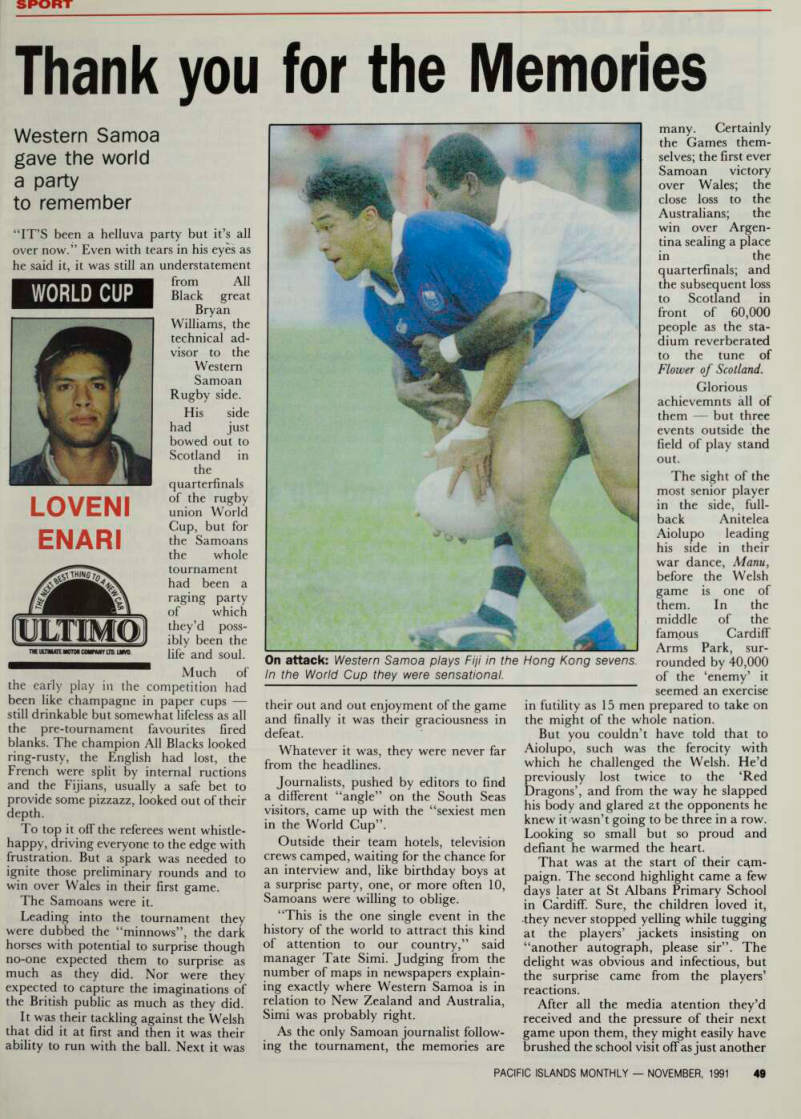
On attack: Western Samoa plays Fiji in the Hong Kong sevens.
In the World Cup they were sensational.
one in the long line and “let’s get back to the hotel”.
But there was Palemia Lilomiava, the big no-nonsense prop, sitting amidst a group of youngsters explaining what palusami was and the fact that raw fish with coconut cream is actually quite nice to eat.
Then there was Filipo Saena, who delighted in leading the kids in a private chant he’d invented for them.
“Who’s going to win the World Cup?” he’d ask.
“Western Samoa!” they’d scream back.
“Who’s the best player in the World
Cup?”
“Phillip!” they’d shout back, as he rewarded those who yelled loudest by not only autographing their books but their bags as well.
It was a trip that was supposed to only last an hour but stretched to nearly two, and not one of the players regretted the delay.
Finally it was the by-now famous farewell. The Samoan players and Scot tish crowd bade each other at
Murrayfield Stadium in Edinburgh.
Samoa’s dream run had ended, and as the referee brought the curtain down with his whistle, skipper Peter Fatialofa pulled his players together to begin their “non-victory lap” as he called it.
They ran to each corner of the pitch waving to the crowd, which responded in kind with a standing ovation. And when the Manu was performed for the last time, the hordes accompanied it with
rhythmic hand-clapping.
“It was one of the nicest touches imaginable,” said Scottish coach lan McGeechan. “Western Samoa gave a lot to the competition and what they did at the end was the nicest finish to a match you could hope for. It left everyone with a warm feeling.”
For a Rugby-mad country which has long awaited its moment of recognition on the international stage, Western Samoa couldn’t have hoped for a better end to the party.
Here’s to many more. □