Reshaping the investment climate
p. 49 · Read in the full issue
A TRADE and investment forum of the quality and scope of “Networking South Pacific” takes a great deal of detailed planning and organisation to put together, but no matter how good that is, an investment forum will achieve little if the country it is promoting lacks one essential element a favourable investment climate.
Such a forum may bring potential investors face to face with a thousand opportunities, but they will not take them up if closer investigation suggests problems with land titles, restrictive labour requirements and
industrial procedures, taxes or repatriation of
capital and dividends, to name a few of the
more important considerations.
Nor are potential investors going to waste too much of their time if they can’t get firm, quick answers to their questions, or they are hedged about with promises are told, for example, that legislation that would resolve
some of their doubts “is on the drawing board.”
Serious investors looking for opportunities to expand need to know not just what a government is offering, but to feel that the offer is secure before they develop time and expense on the finer details.
Investors looking at Fiji have no such difficulties. In my view, 10 island country has worked harder than Fiji to establish a favourable investment climate. It welcomes investment and has 'ong recognised that no investor can be expected to allocate serious money unless the rules are spelt out. As a result, I Dredict that “Networking South pacific” will be a positive boost :o investment, which since 1988 has already seen a significant
•evival in Fiji.
The major investor in Fiji has been Australia and Fiji’s major ndustries have all benefited from extensive Australian nvestment. But Fiji has made up its mind to penetrate world narkets on many fronts and develop a wide range of :ompetitive products. It is seeking to attract and develop the mtrepreneurial and manufacturing skills that will enable it to expand in this direction, and that means investment from many )laces.
Fiji has a long track record of officially encouraging nvestment. It began along that path even before independence n 1970. Because of it, the country has built up a comparatively >road industrial base. In the past two or three years its nvestment policies have been strengthened, with the govern nent implementing strategies aimed at promoting exports and Diinging domestic prices more into line with world prices which will help manufacturers who want to set up in Fiji). Its nore recent policies have included trade reforms export jromotion, and reforms in the public sector, tax structure and abour market.
Fiji’s Deputy Prime Minister and Minister of Finance and Economic Planning, Josevata Kamikamica, told a joint neeting of Fiji-Australia and Australia-Fiji business councils in September that these efforts had already begun to pay off. After he difficulties of 1987, growth recovered in 1989 and 1990, mployment rose and government revenues have been moyant.
He gave this message: “Primary product prices are likely to emain depressed. However, the demand for manufacturing md for tourism is likely to be strong. If we are to benefit from his environment, new investment will be needed, especially in nanufacturing and tourism, but also in forestry and fisheries.
“To achieve sustained economic growth there must be corresponding long-term investment. Given our relatively limited domestic resources and ability to borrow, much of that investment must, by defi nition, come from overseas.
“It therefore follows that private sector investment is the key to our future
economic policies that provide appropri
ate incentives to encourage the private sector to invest and develop.”
This month’s Networking South Pacific forum is of course only one promotional effort designed to attract trade and investment. New initiatives are going on all the time. Fiji expects to benefit from Expo 92, which opens in Seville, Spain in April. For the entire six months of the Expo, a South Pacific village, exhibitions and cultural groups will promote South Pacific tourism, trade and investment
opportunities, and this should certainly help tap into the great pool of European investors. In Sydney in September 1992 the Fiji Trade and Investment Board and the Fiji and Australian business councils will be presenting “Lako Mai Fiji”, another significant trade, tourism and investment expo.
Nevertheless, despite the practical foundations for investors that Fiji has already laid, and tested, a wide range of new investment and joint partnerships can’t be attracted in five minutes. This is because there are sure to be some potential investments that are too big for Fiji’s infrastructure, no matter how keen their promoters might to be set up in Fiji.
Tourism is one of the few areas that can attract and absorb millions quickly (the tourism development now well under way on Denarau Island is worth more than Fs4oo million). Fiji is very familiar with the tourist market and its many require ments. The economy, the workforce and the service industries are geared to handle it and are able to keep up with its expansion, which will be dramatic. Fiji has the roads, waters, power, telecommunications, ports and airports, excellent transport and skilled workers. Under the Hotel Aids Act, profits of a hotel can be exempted from income tax to the extent of 55 per cent of the capital expenditure incurred in the hotel’s construction or extension.
The development of many other, new industries may not move at the same speed, for factories may need a workforce with different skills, but yet be untrained for them, and for the kind of heavy transport that is not yet available, and perhaps for port extensions not yet contemplated. An American industrialist used to large-scale production, prepared to invest millions, may find that an island infrastructure is simply not big enough to cope with it and go elsewhere.
But those opportunities will not continually be lost if planning for investment is ongoing. As Fiji is aware, no government can simply pass an Act of parliament and sit back and wait. Investment policy needs frequent reappraisal to take advantage of trade opportunities as they appear and to mould infrastructures to meet the new demands, “Networking South Pacific” will give a great number of potential investors the opportunity to see for themselves that Fiji really does know about business.
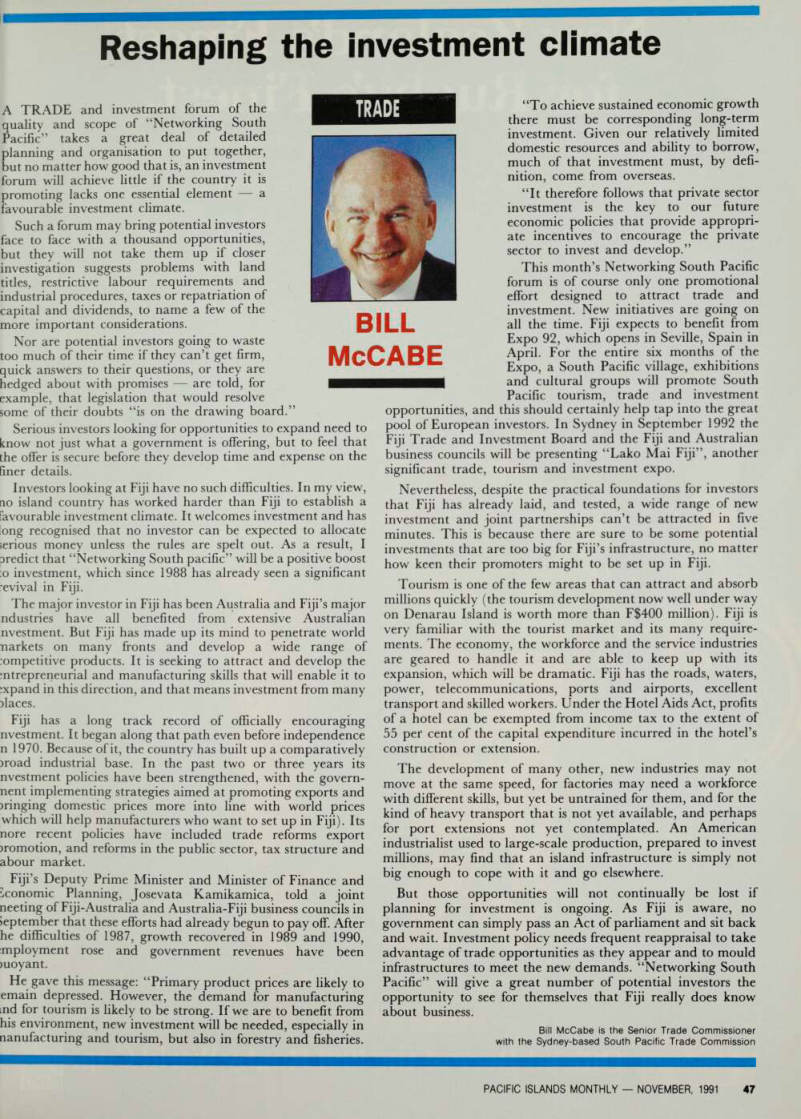
Bill McCabe is the Senior Trade Commissioner with the Sydney-based South Pacific Trade Commission