Gajda’s Guns of Betio
pp. 30-31 · Read in the full issue
IF ever a country and a man with a hobby were made for each other, it would have to be Kiribati and Stan Gajda. Gajda is an Australian who has lived in Kiribati since 1989, working as Project Site Supervisor for a major Australian International Development
Assistance Bureau engineering project.
He is training a local team to construct a series of causeways and bridges linking Kiribati’s outer islands.
But Gajda’s hobby more of a passion, to tell the truth is collecting
and painstakingly restoring historic
relics. And on Kiribati, the site of one of the Pacific’s bloodiest battles during World War Two, that means what he calls “combat relics”.
In November 1943, thousands of United States and Japanese troops died in 76 hours in the Battle of Tarawa, when the US forces pushed Japan from one of its strongest command bases in the Pacific, on the island of Betio in Kiribati.
Almost half a century later, Betio where Gajda now lives is Kiribati’s most populous urban centre. But it is also still home to an uncounted number of relics of that epic battle fought long ago.
Gajda, who has now become Kiribati’s “unofficial war relics consultant”, dis covered this when he first visited Kiribati
on holidays in the early 1980 s; in fact, it was the main reason he went there in the first place. Said he: “We just walked around and you looked down and you
could see bullets and all sorts of other bits and pieces. Even now, I walk along the beach at low tide and see all sorts of rubbish left over from the war.
“There’s a Japanese tank down on the beach.
When I first had a look at that, it still had the machine gun in it. I couldn’t believe it. There was a lot of stuff just waiting to be saved from eventual de struction by the el ements.”
So Gajda began searching Betio, and the other islands of Kiribati’s North and South Tarawa chain.
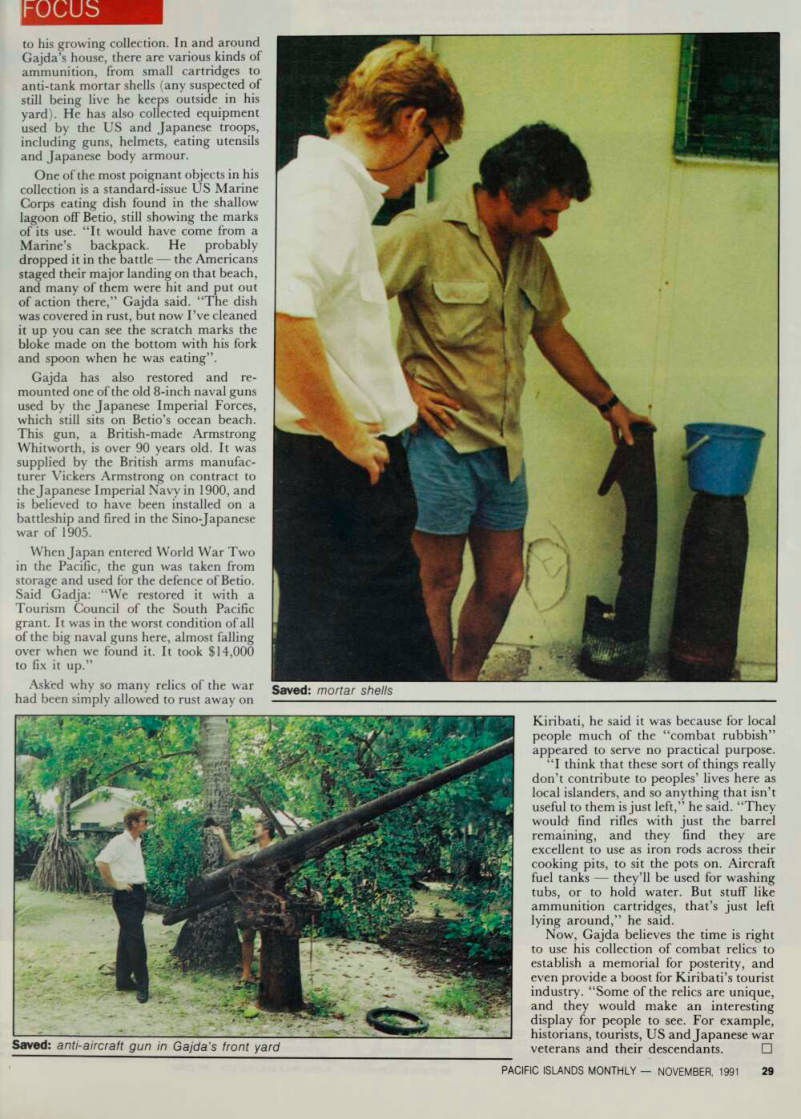
Taking a metal detector with him, he discovered war relics everywhere, and took the best-preserved and most un usual examples home to restore and add
Saved: Gajda and fellow Australian Phil Young with combat relics
to his growing collection. In and around Gajda’s house, there are various kinds of ammunition, from small cartridges to anti-tank mortar shells (any suspected of still being live he keeps outside in his yard). He has also collected equipment used by the US and Japanese troops, including guns, helmets, eating utensils and Japanese body armour.
One of the most poignant objects in his collection is a standard-issue US Marine Corps eating dish found in the shallow lagoon off Betio, still showing the marks of its use. “It would have come from a Marine’s backpack. He probably dropped it in the battle the Americans staged their major landing on that beach, and many of them were hit and put out of action there,” Gajda said. “The dish was covered in rust, but now I’ve cleaned it up you can see the scratch marks the bloke made on the bottom with his fork and spoon when he was eating”.
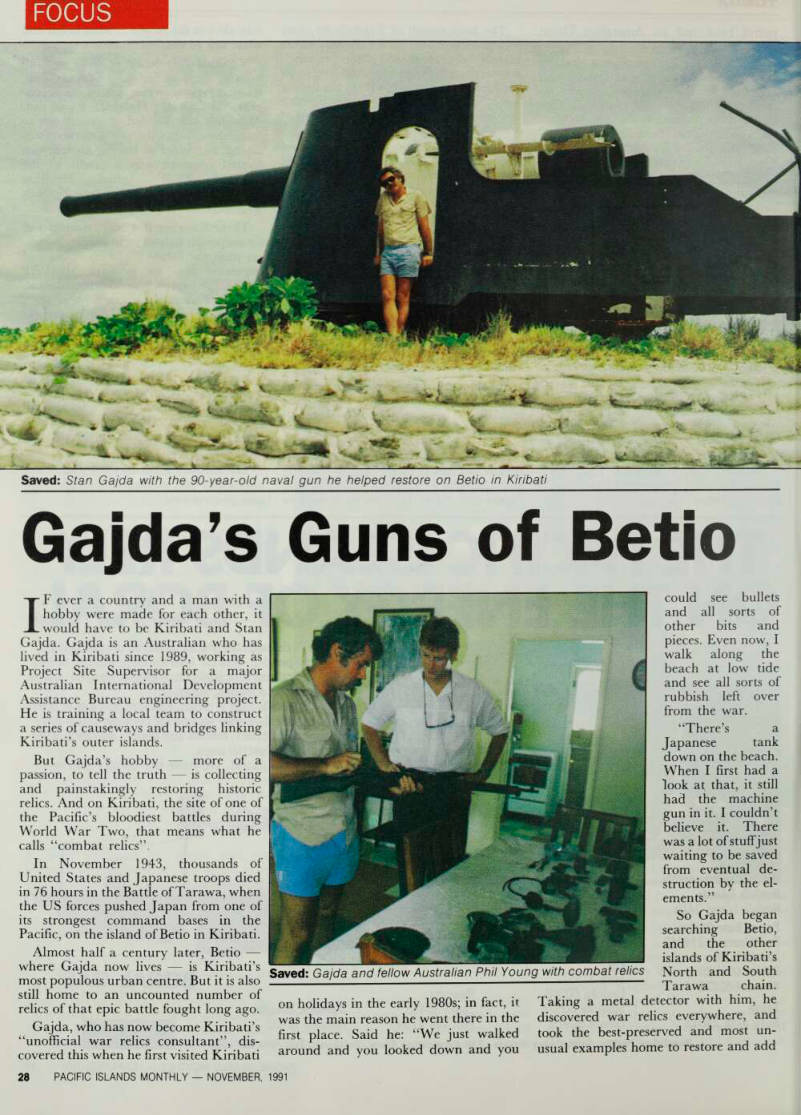
Gajda has also restored and re mounted one of the old 8-inch naval guns used by the Japanese Imperial Forces, which still sits on Betio’s ocean beach.
This gun, a British-made Armstrong Whitworth, is over 90 years old. It was supplied by the British arms manufac turer Vickers Armstrong on contract to the Japanese Imperial Navy in 1900, and is believed to have been installed on a battleship and fired in the Sino-Japanese war of 1905.
When Japan entered World War Two in the Pacific, the gun was taken from storage and used for the defence of Betio.
Said Gadja: “We restored it with a Tourism Council of the South Pacific grant. It was in the worst condition of all of the big naval guns here, almost falling over when we found it. It took $14,000 to fix it up.”
Asked why so many relics of the war had been simply allowed to rust away on
Kiribati, he said it was because for local people much of the “combat rubbish” appeared to serve no practical purpose.
“I think that these sort of things really don’t contribute to peoples’ lives here as local islanders, and so anything that isn’t useful to them is just left,” he said. “They would find rifles with just the barrel remaining, and they find they are excellent to use as iron rods across their cooking pits, to sit the pots on. Aircraft fuel tanks they’ll be used for washing tubs, or to hold water. But stuff like ammunition cartridges, that’s just left lying around,” he said.
Now, Gajda believes the time is right to use his collection of combat relics to establish a memorial for posterity, and even provide a boost for Kiribati’s tourist industry. “Some of the relics are unique, and they would make an interesting display for people to see. For example, historians, tourists, US and Japanese war veterans and their descendants. □
Saved: mortar shells
Saved: anti-aircraft gun in Gajda's front yard