have landed
pp. 28-29 · Read in the full issue
Tonga
Eua awake! the Marines
By Kevin Doll
FOR the Tongan population on Eua Island, it was a normal night; the cool southeasterly breeze was whis
tling, almost tunefully, through the tall,
swaying palm trees, as the vast Pacific Ocean belched itself, with resounding sighs, onto the island’s coral-sand beaches.
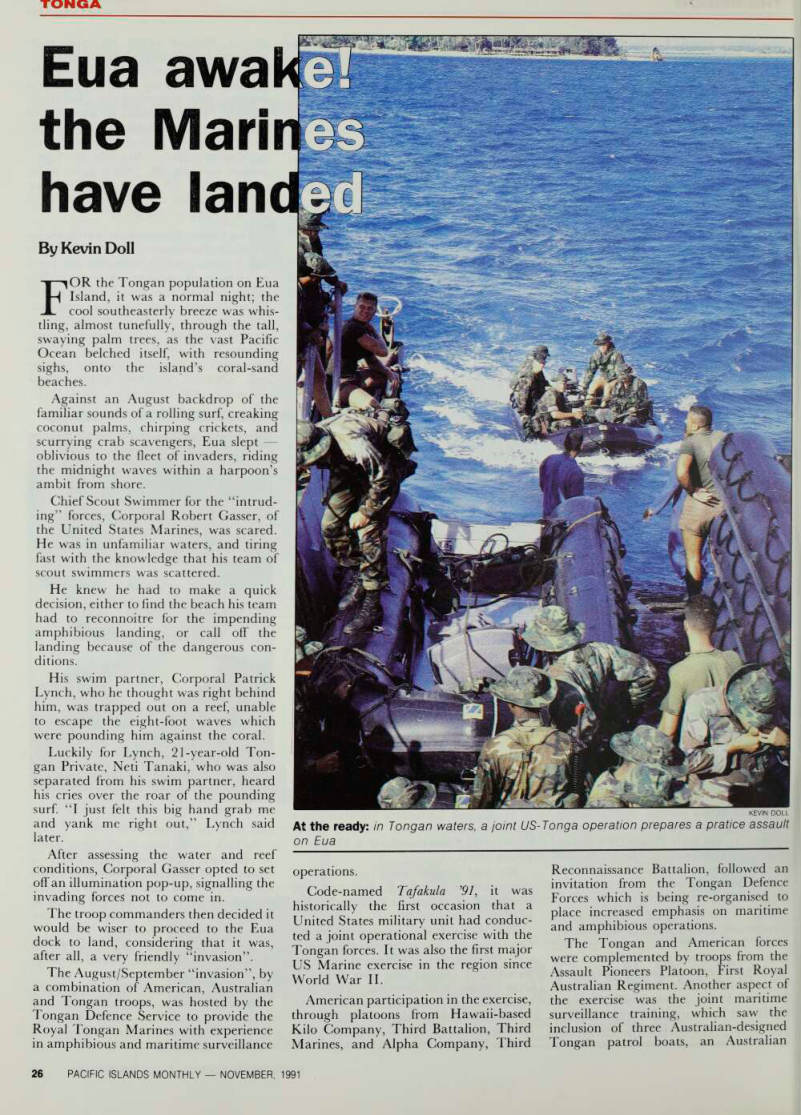
Against an August backdrop of the familiar sounds of a rolling surf, creaking coconut palms, chirping crickets, and scurrying crab scavengers, Eua slept oblivious to the fleet of invaders, riding the midnight waves within a harpoon’s ambit from shore.
Chief Scout Swimmer for the “intrud ing” forces, Corporal Robert Gasser, of the United States Marines, was scared.
He was in unfamiliar waters, and tiring fast with the knowledge that his team of scout swimmers was scattered.
He knew he had to make a quick decision, either to find the beach his team had to reconnoitre for the impending amphibious landing, or call olf the landing because of the dangerous con ditions.
His swim partner, Corporal Patrick Lynch, who he thought was right behind him, was trapped out on a reef, unable to escape the eight-foot waves which were pounding him against the coral.
Luckily for Lynch, 21-year-old Ton gan Private, Neti Tanaki, who was also separated from his swim partner, heard his cries over the roar of the pounding surf. “I just felt this big hand grab me and yank me right out,” Lynch said later.
After assessing the water and reef conditions, Corporal Gasser opted to set off an illumination pop-up, signalling the invading forces not to come in.
The troop commanders then decided it would be wiser to proceed to the Eua dock to land, considering that it was, after all, a very friendly “invasion”.
The August/September “invasion”, by a combination of American, Australian and Tongan troops, was hosted by the Tongan Defence Service to provide the Royal Tongan Marines with experience in amphibious and maritime surveillance
operations.
Code-named Tafakula ’9l, it was historically the first occasion that a United States military unit had conduc ted a joint operational exercise with the Tongan forces. It was also the first major US Marine exercise in the region since World War 11.
American participation in the exercise, through platoons from Hawaii-based Kilo Company, Third Battalion, Third Marines, and Alpha Company, Third
Reconnaissance Battalion, followed an invitation from the Tongan Defence Forces which is being re-organised to place increased emphasis on maritime
and amphibious operations.
The Tongan and American forces were complemented by troops from the Assault Pioneers Platoon, First Royal Australian Regiment. Another aspect of the exercise was the joint maritime surveillance training, which saw the inclusion of three Australian-designed Tongan patrol boats, an Australian
Kevin Doll
At the ready: in Tongan waters, a joint US-Tonga operation prepares a pratice assault on Eua
patrol boat and an Australian Orion aircraft.
The US Marine contingent, led by Captain Leon Pappa, was tasked with assisting in the various amphibious operations Tafakula ’9l required. This included the training of a scout swimmer team composed of Tongans and Austra lians, and led by Corporal Gasser and other Kilo Company scout swimmers.
“Last year, during exercise Late Tofua ’9O, the emphasis was maritime,”
Lieutenant Colonel Fetu’utolu Tupou, the Commander of the Tonga Defence Services said. “This year Tafakula ’9l also emphasised ground training.”
The Tongans and Australians were the driving force behind the ground ma noeuvres of Tafakula ’9l, with the island of Eua as the battlefield. The multi national forces found the jungle, hills, grasslands and sheer cliffs of Eua a foe in itself.
Beginning with the midnight amphibi ous landing, platoons from the three participating countries conducted day and night patrols to neutralise the “enemy” forces of a similar but smaller, mulfi-national group, composed of US Marines, Australians and Tongans.
Neutral judges roamed Eua, and
during firefights, designated the “dead”
and “captured”
The final assault of Tafakula ’9l came in a pre-dawn raid as the friendly forces attacked the stronghold of the “enemy”, an abandoned house on a cliff overlook ing the ocean. Firing blanks at the fleeing forces with illumination rounds lighting up the sky, the “fight” was brought quickly to an end.
Tupou and Pappa said the exercise was a success. “The familiarisation of equipment at the start was a very good move,” Tupou said. “The training teams must be congratulated for their efforts.”
For the Americans, Pappa said most of their training objectives had been achieved. “We were able to provide some basis for future operating procedures for the Tongans in ship-to-shore transfers.”
The Kilo Company commander ex plained this was of vital importance to the Tongans due to their available resources and the need for a high state of readiness in amphibious-styled oper ations.
He said the training and subsequent amphibious operations also showed the pitfalls and dangers of such training, evident in high surf and coral obstacles in the region. “We gained good learning experiences from the Tongans and Aus tralian, because of their different training and patrolling techniques,” Captain Pappa said. “The Tongans know how to
stay alive in the jungle ... what to eat and what not to eat.”
Tafakula however, was not all camouflagedj ri fl e -wielding, Rambo . t pe tower i n g giants, as seven- Q , d aro||n( . H alahala found out.
Although she needed a translator to understand what the tall American was sayingj her re lief at having an ingrown toenail removed was a credit to the Medical Civil Action Program (MedCAP), that coincided with Tafakula >gj -p, „ , D , , Three Kanehoe Bay Navy doctors and SIX cor helped local medical work ers FC f , lu, ? Ca S c that perform MedCAP
Camaln Rohm' Knudson '“Therearea
u P Robert Knudson. Ihere are a shortage of doctors m Tonga; medical a cc,cfanK take nn the slack ”
P He most of the illnesses treated were similar to those in the United ® tates ' “J he nutriti ° nal balance.of the Ton p n dlet . ls ? ood and „ th fV hav , e a good immunisation plan, he added.
Illnesse , s . ' reated ran g ed from skln lnfec tlons > diabetes and tumors, to ear and viral inf ections.
The medical team donated five tons of antibiotics and medications to the Ton gan government. □