the U.N.
pp. 22-23 · Read in the full issue
The United Nations
Islands unite at
By Ian Willaims
DESPITE the unfore seen defeat of Papua New Guinea’s Sir Michael Somare for the presidency of the 46th
United Nations General Assembly, the session was a good one for the Pacific.
The breakdown of the Cold War allowed many more original contributions from delegates freed from party lines and point-scoring. In that constructive at mosphere, Pacific states reiterated shared Forum themes; qualified approval of French cooperation in implementing the Matignon Accords in New Caledonia; distress at continuing nuclear testing, and a firm concentration on environ mental issues. Frequent references to the work of the Alliance of Small Island States (AOSIS), reminded the General Assembly who paid the price for Greenhouse gas emissions in the industri alised world. Attention was drawn to driftnetting in the Pacific.
But the shared policies were dealt with in highly individual ways, and with ad ditions reflecting the foreign policy concerns of the states. Frequent refer ences to the need for an equitable solution to the Middle East question were but one demonstration that Pacific Islands states need not be insular in their outlook. Indeed, in face of the break down of the old blocs, the Forum and AOSIS may be among some of the more coherent alliances.
To begin with, they were strengthened
by the arrival of the Marshall Islands and the Federated States of Micronesia at the United Nations, marking the end of the old era for the former Trust Territories. But there are signs that the differences which led to the break-up of the old federation still linger on. While FSM has opened an office at the Commonwealth Secretariat’s building in New York, the Marshalls have set up home in a commercial building.
The seriousness with which they treated the occasion was apparent in the size of the delegations 35 from the Marshalls alone (pro rata, that would mean a million strong delegation for China).
Some US diplomats were worried that riding round Manhattan in limousines may have excited a taste for hyperactive diplomacy on the part of the fledgling republics - which may be beyond their budgetary capacity. Indeed there are
some suggestions that the Marshalls asked the US for aid in setting up the mission. While the US welcomes two new friendly votes in the General Assembly, it is unlikely to pay for them. Less happy will be France, whose ambassador sprang to his feet three times to exercise a right to reply to Forum nations complaining about French nuclear testing.
Greening
the U.N.
AS Forum chairman, after hitting at nuclear testing, FSM President Bailey Olter welcomed the US’s attention to the Forum’s concerns over the chemical weapons destruction programme on Johnston Atoll. “We hope the point has been made effectively that our region cannot be considered by the larger nations as a convenient empty space for the disposal of toxic and hazardous waste and chemicals and radioactive ma terials,” he said.
His main thrust was on global warming.
Pointing out that FSM’s sovereign terri tory was approaching the size of the continental US, he said: “We do not think of ourselves as small islands separated by great empty spaces. The ocean has been and always will be our great provider. Its bounty alone is our principle resource for economic survival, and we are conscious of our need to live in constant harmony with it. Until recently we believed that we were too few in number for our actions to affect the great ocean.” But no longer, he con tinued, since the discovery of the global warming effect and rising sea levels.
Law
and order
MARSHALL Islands President Amata Kabua said the most fundamental issue facing the UN is “the quality of life of mankind ... consistent with national agendas and policies, people need the opportunity and freedom to develop themselves.”
On global warming, he said: “There is very little if anything, that one of the smallest and most isolated countries in the world can do to alleviate the problem.” Kabua called for “a new and
comprehensive vision of a global society,
supported by a new system of values.
This recognition does not imply the abondonment of legitimate loyalties, the suppression of cultural diversity, nor the abolition of national autonomy. It calls
for a wider loyalty, for a far higher aspiration than has thus far animated human efforts”.
Lone
voice
PAPUA New Guinea’s Education Min ister, Utula Samana, was alone among all the 166 nations in addressing the problems besetting UN staff. “Never before have the international civil ser vants been called upon to help guide so many different peoples to peace, democ racy and independence,” he said: “Many have been detained and held hostage during the courses of their duties. We call upon those responsible to release and free them to their important duties”.
Vanuatu
warning
ROBERT Van Lierop, of Vanuatu, warned against double standards, “Prin ciples which are selectively applied are not really principles but are instead
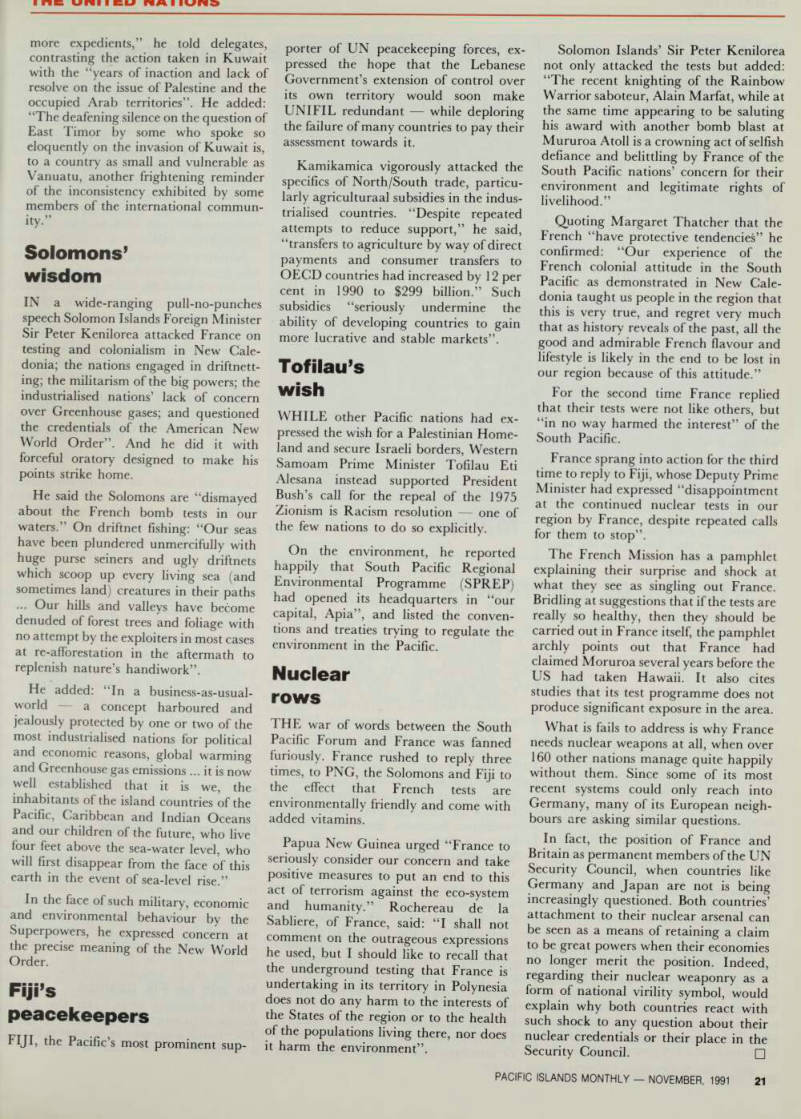
Dangerous playground: children in the Marshalls
more expedients,” he told delegates, contrasting the action taken in Kuwait with the “years of inaction and lack of resolve on the issue of Palestine and the occupied Arab territories”. He added: “The deafening silence on the question of East Timor by some who spoke so eloquently on the invasion of Kuwait is, to a country as small and vulnerable as Vanuatu, another frightening reminder of the inconsistency exhibited by some members of the international commun
ity.”
Solomons’
wisdom
IN a wide-ranging pull-no-punches
speech Solomon Islands Foreign Minister Sir Peter Kenilorea attacked France on testing and colonialism in New Cale donia; the nations engaged in driftnett ing; the militarism of the big powers; the industrialised nations’ lack of concern over Greenhouse gases; and questioned the credentials of the American New World Order”. And he did it with forceful oratory designed to make his points strike home.
He said the Solomons are “dismayed about the French bomb tests in our waters.” On driftnet fishing: “Our seas have been plundered unmercifully with huge purse seiners and ugly driftnets which scoop up every living sea (and sometimes land) creatures in their paths ... Our hills and valleys have become denuded of forest trees and foliage with no attempt by the exploiters in most cases at re-afforestation in the aftermath to replenish nature’s handiwork”.
He added: “In a business-as-usual world a concept harboured and jealously protected by one or two of the most industrialised nations for political and economic reasons, global warming and Greenhouse gas emissions ... it is now well established that it is we, the inhabitants of the island countries of the Pacific, Caribbean and Indian Oceans and our children of the future, who live four feet above the sea-water level, who will first disappear from the face of this earth in the event of sea-level rise.”
In the face of such military, economic and environmental behaviour by the Superpowers, he expressed concern at the precise meaning of the New World Order. ■■■
Fiji’s
peacekeepers
FIJI, the Pacific’s most prominent sup
porter of UN peacekeeping forces, ex pressed the hope that the Lebanese Government’s extension of control over its own territory would soon make UNIFIL redundant while deploring the failure of many countries to pay their assessment towards it.
Kamikamica vigorously attacked the specifics of North/South trade, particu larly agriculturaal subsidies in the indus trialised countries. “Despite repeated attempts to reduce support,” he said, “transfers to agriculture by way of direct payments and consumer transfers to OECD countries had increased by 12 per cent in 1990 to $299 billion.” Such subsidies “seriously undermine the ability of developing countries to gain more lucrative and stable markets”.
Tofilau’s
wish
WHILE other Pacific nations had ex pressed the wish for a Palestinian Home land and secure Israeli borders, Western Samoam Prime Minister Tofilau Eti Alesana instead supported President Bush’s call for the repeal of the 1975 Zionism is Racism resolution one of the few nations to do so explicitly.
On the environment, he reported happily that South Pacific Regional
Environmental Programme (SPREP)
had opened its headquarters in “our capital, Apia”, and listed the conven tions and treaties trying to regulate the environment in the Pacific.
Nuclear
rows THE war of words between the South Pacific Forum and France was fanned furiously. France rushed to reply three times, to PNG, the Solomons and Fiji to the effect that French tests are environmentally friendly and come with added vitamins.
Papua New Guinea urged “France to seriously consider our concern and take positive measures to put an end to this act of terrorism against the eco-system and humanity.” Rochereau de la Sabliere, of France, said: “I shall not comment on the outrageous expressions he used, but I should like to recall that the underground testing that France is
undertaking in its territory in Polynesia
does not do any harm to the interests of the States of the region or to the health of the populations living there, nor does it harm the environment”.
Solomon Islands’ Sir Peter Kenilorea not only attacked the tests but added: “The recent knighting of the Rainbow Warrior saboteur, Alain Marfat, while at the same time appearing to be saluting his award with another bomb blast at Mururoa Atoll is a crowning act of selfish defiance and belittling by France of the South Pacific nations’ concern for their environment and legitimate rights of livelihood.”
Quoting Margaret Thatcher that the French “have protective tendencies” he confirmed: “Our experience of the French colonial attitude in the South Pacific as demonstrated in New Cale donia taught us people in the region that this is very true, and regret very much that as history reveals of the past, all the good and admirable French flavour and lifestyle is likely in the end to be lost in our region because of this attitude.”
For the second time France replied that their tests were not like others, but “in no way harmed the interest” of the South Pacific.
France sprang into action for the third time to reply to Fiji, whose Deputy Prime Minister had expressed “disappointment at the continued nuclear tests in our region by France, despite repeated calls for them to stop”.
The French Mission has a pamphlet explaining their surprise and shock at what they see as singling out France.
Bridling at suggestions that if the tests are really so healthy, then they should be carried out in France itself, the pamphlet archly points out that France had claimed Moruroa several years before the US had taken Hawaii. It also cites studies that its test programme does not produce significant exposure in the area.
What is fails to address is why France needs nuclear weapons at all, when over 160 other nations manage quite happily without them. Since some of its most recent systems could only reach into Germany, many of its European neigh bours are asking similar questions.
In fact, the position of France and Britain as permanent members of the UN Security Council, when countries like Germany and Japan are not is being increasingly questioned. Both countries’ attachment to their nuclear arsenal can be seen as a means of retaining a claim to be great powers when their economies no longer merit the position. Indeed, regarding their nuclear weaponry as a form of national virility symbol, would explain why both countries react with such shock to any question about their nuclear credentials or their place in the Security Council. □