Locals get the break
p. 20 · Read in the full issue
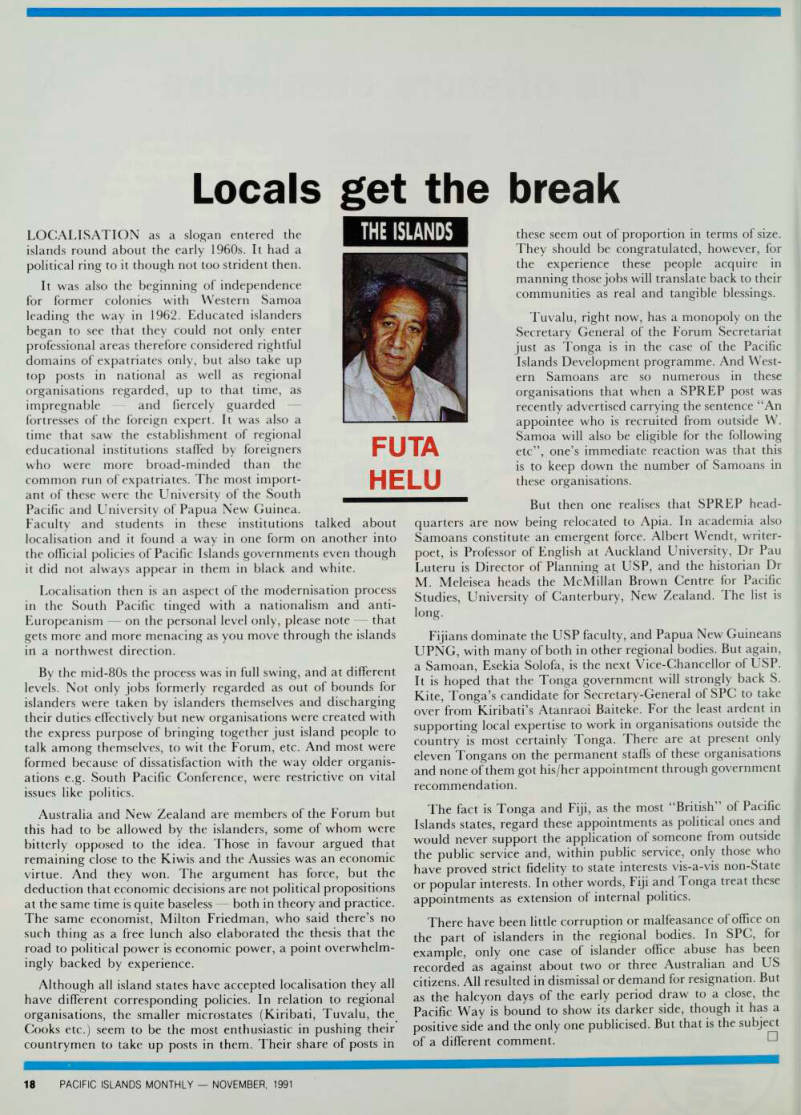
LOCALISATION as a slogan entered the islands round about the early 19605. It had a political ring to it though not too strident then.
It was also the beginning of independence for former colonies with Western Samoa leading the way in 1962. Educated islanders began to see that they could not only enter professional areas therefore considered rightful domains of expatriates only, but also take up top posts in national as well as regional organisations regarded, up to that time, as
impregnable and fiercely guarded
fortresses of the foreign expert. It was also a time that saw the establishment of regional educational institutions staffed by foreigners who were more broad-minded than the common run of expatriates. The most import ant of these were the University of the South Pacific and University of Papua New Guinea.
Faculty and students in these institutions talked about localisation and it found a way in one form on another into the official policies of Pacific Islands governments even though it did not always appear in them in black and white.
Localisation then is an aspect of the modernisation process in the South Pacific tinged with a nationalism and anti- Europeanism on the personal level only, please note that gets more and more menacing as you move through the islands in a northwest direction.
By the mid-80s the process was in full swing, and at different levels. Not only jobs formerly regarded as out of bounds for islanders were taken by islanders themselves and discharging their duties effectively but new organisations were created with the express purpose of bringing together just island people to talk among themselves, to wit the Forum, etc. And most were formed because of dissatisfaction with the way older organis ations e.g. South Pacific Conference, were restrictive on vital issues like politics.
Australia and New Zealand are members of the Forum but this had to be allowed by the islanders, some of whom were bitterly opposed to the idea. Those in favour argued that remaining close to the Kiwis and the Aussies was an economic virtue. And they won. The argument has force, but the deduction that economic decisions are not political propositions at the same time is quite baseless both in theory and practice.
The same economist, Milton Friedman, who said there’s no such thing as a free lunch also elaborated the thesis that the road to political power is economic power, a point overwhelm ingly backed by experience.
Although all island states have accepted localisation they all have different corresponding policies. In relation to regional organisations, the smaller microstates (Kiribati, Tuvalu, the Cooks etc.) seem to be the most enthusiastic in pushing their countrymen to take up posts in them. Their share of posts in
these seem out of proportion in terms of size.
They should be congratulated, however, for the experience these people acquire in manning those jobs will translate back to their communities as real and tangible blessings.
Tuvalu, right now, has a monopoly on the Secretary General of the Forum Secretariat just as Tonga is in the case of the Pacific Islands Development programme. And West ern Samoans are so numerous in these organisations that when a SPREP post was recently advertised carrying the sentence “An appointee who is recruited from outside W.
Samoa will also be eligible for the following etc”, one’s immediate reaction was that this is to keep down the number of Samoans in
these organisations.
But then one realises that SPREP head
quarters are now being relocated to Apia. In academia also Samoans constitute an emergent force. Albert Wendt, writer poet, is Professor of English at Auckland University, Dr Pau Luteru is Director of Planning at USP, and the historian Dr M. Meleisea heads the McMillan Brown Centre for Pacific Studies, University of Canterbury, New Zealand. The list is long.
Fijians dominate the USP faculty, and Papua New Guineans UPNG, with many of both in other regional bodies. But again, a Samoan, Esekia Solofa, is the next Vice-Chancellor of USP.
It is hoped that the Tonga government will strongly back S.
Kite, Tonga’s candidate for Secretary-General of SPC to take over from Kiribati’s Atanraoi Baiteke. For the least ardent in supporting local expertise to work in organisations outside the country is most certainly Tonga. There are at present only eleven Tongans on the permanent staffs of these organisations and none of them got his/her appointment through government recommendation.
The fact is Tonga and Fiji, as the most “British” of Pacific Islands states, regard these appointments as political ones and would never support the application of someone from outside the public service and, within public service, only those who have proved strict fidelity to state interests vis-a-vis non-State or popular interests. In other words, Fiji and Tonga treat these appointments as extension of internal politics.
There have been little corruption or malfeasance of office on the part of islanders in the regional bodies. In SPC, for example, only one case of islander office abuse has been recorded as against about two or three Australian and US citizens. All resulted in dismissal or demand for resignation. But as the halcyon days of the early period draw to a close, the Pacific Way is bound to show its darker side, though it has a positive side and the only one publicised. But that is the subject of a different comment.