Let's go
pp. 12-13 · Read in the full issue
Expo!
By Jale Moala
A T a lunch in Suva, someone /\ was asking why Pacific Islands / 1 countries were attending the Z. 5. World Expo in Spain next year.
It seemed to some at the table) that the Pacific was spending too much money in Spain and getting little back in return.
Some months later, half-way across the Pa cific in down town Port
Moresby, Cam
illus Narokobi tried to answer
that question.
The Expo, he said, is more than just mak ing an appear ance: “We are not there just for tourism. We are there for trade, we are there for
everything. We
are there to make contact and then de velop those con tacts.”
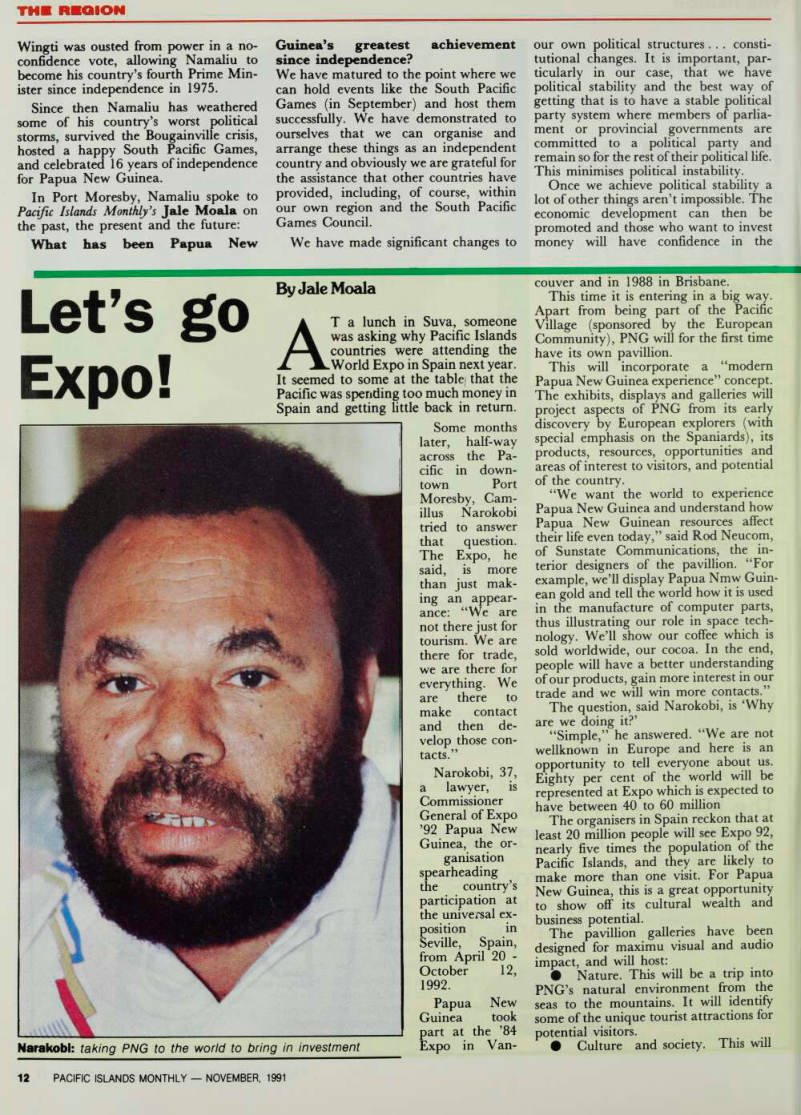
Narokobi, 37, a lawyer, is Commissioner General of Expo ’92 Papua New Guinea, the or
ganisation
spearheading
the country’s
participation at
the universal ex
position in
Seville, Spain,
from April 20 - October 12, 1992.
Papua New Guinea took part at the ’B4 Expo in Van
couver and in 1988 in Brisbane.
This time it is entering in a big way.
Apart from being part of the Pacific Village (sponsored by the European Community), PNG will for the first time have its own pavillion.
This will incorporate a “modern Papua New Guinea experience” concept.
The exhibits, displays and galleries will project aspects of PNG from its early discovery by European explorers (with
special emphasis on the Spaniards), its
products, resources, opportunities and
areas of interest to visitors, and potential of the country.
“We want the world to experience Papua New Guinea and understand how Papua New Guinean resources affect their life even today,” said Rod Neucom, of Sunstate Communications, the in terior designers of the pavillion. “For
example, we’ll display Papua Nmw Guin
ean gold and tell the world how it is used in the manufacture of computer parts, thus illustrating our role in space tech nology. We’ll show our coffee which is sold worldwide, our cocoa. In the end, people will have a better understanding of our products, gain more interest in our trade and we will win more contacts.”
The question, said Narokobi, is ‘Why are we doing it?’
“Simple,” he answered. “We are not wellknown in Europe and here is an opportunity to tell everyone about us.
Eighty per cent of the world will be represented at Expo which is expected to have between 40 to 60 million The organisers in Spain reckon that at least 20 million people will see Expo 92, nearly five times the population of the Pacific Islands, and they are likely to make more than one visit. For Papua New Guinea, this is a great opportunity to show off its cultural wealth and
business potential.
The pavillion galleries have been designed for maximu visual and audio impact, and will host: • Nature. This will be a trip into PNG’s natural environment from the seas to the mountains. It will identify some of the unique tourist attractions for
potential visitors.
• Culture and society. This will
Narakobl: taking PNG to the world to bring in investment
show the coun try’s rich and diverse culture and the peo ple. • Pot of gold will por tray Papua
New Guinea as natural resource-rich, highlighting the mineral and petroleum industry boom to attract foreign interest. • Primary products. The aim is to promote and sell primary agricultural products such as coffee, cocoa, tea, sugar, palm oil, rubber and spices. • Forestry and fisheries. Its aim will be foreign investment and markets, and publicising PNG’s tuna fishing grounds. • Exports. Promote export prod ucts to secure new overseas markets.
Narokobi is looking for K 7.2 million (US$7.6 million) to fund his Expo campaign. K 1.2 million will go towards the Pacific Village being organised in Suva by Pacific Discoveries, the com pany set up for that purpose.
Corporate sponsorship is being en couraged through a double taxation policy similar to that for the South Pacific Games. This time, however, it has been refined to only apply to 75 per cent of the assessed income of the sponsor, but regardless of whether the sponsorship is in kind or in cash.
The government proposed three levels of sponsorships: corporate partner, cor porate, and individual. Corporate part ners are the big ones and eight were being sought. By the end of September, Harbours Board and Post & Telecom munication Corporation had paid K 500,000 each, and Ok Tedi goldmine had paid K 250,000. The government paid K 500,000 to help establish the Expo ’92 office in Port Moresby.
“92 is a big year in Europe,” said Narokobi. “It’s the year of the Olympic Games in Barcelona, it’s the year when Europc~will dismantle all trade barriers, and it’s the year when Madrid will be designated the Cultural Capital of Eur ope. It is also the year when the world will see Papua New Guinea like they’ve never seen them before. □