Looking
pp. 11-14 · Read in the full issue
back, then moving on
By Jale Moala
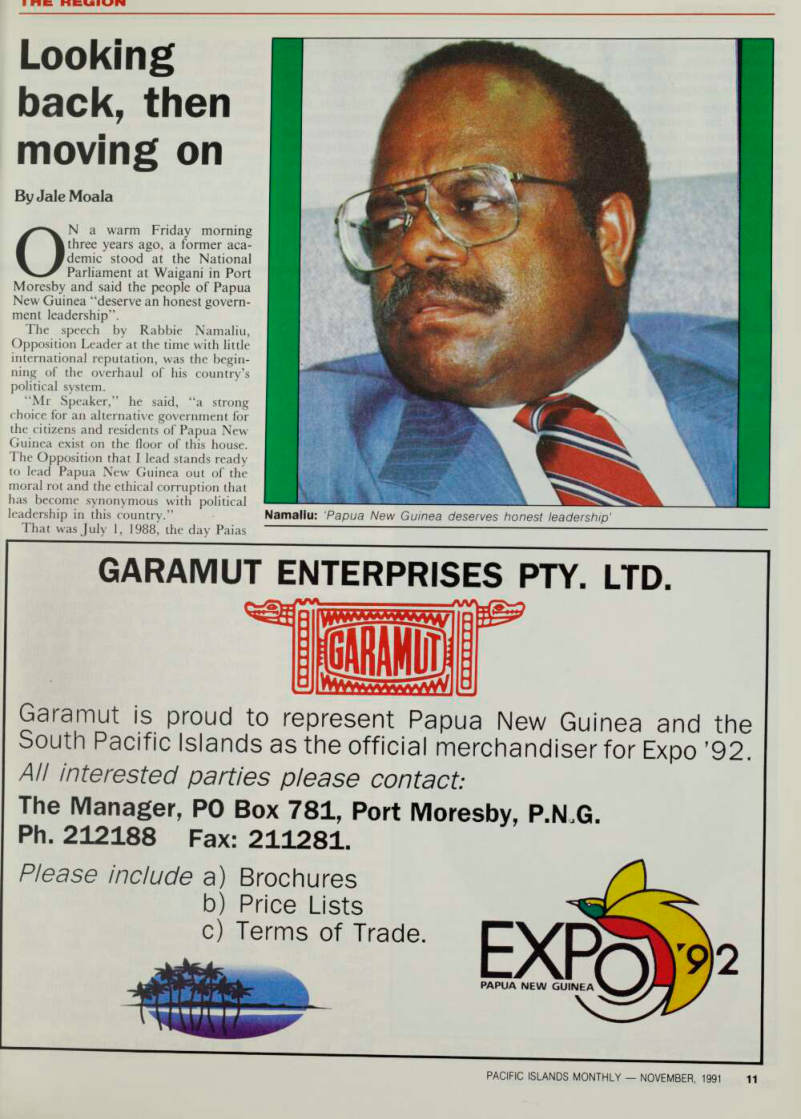
ON a warm Friday morning three years ago, a former aca demic stood at the National Parliament at Waigani in Port Moresby and said the people of Papua New Guinea “deserve an honest govern
ment leadership”.
The speech by Rabbie Namaliu, Opposition Leader at the time with little international reputation, was the begin ning of the overhaul of his country’s political system.
“Mr Speaker,” he said, “a strong choice for an alternative government for the citizens and residents of Papua New Guinea exist on the floor of this house.
The Opposition that I lead stands ready to lead Papua New Guinea out of the moral rot and the ethical corruption that has become synonymous with political leadership in this country.”
That was July 1, 1988, the day Paias
Namaliu: 'Papua New Guinea deserves honest leadership'
Wingti was ousted from power in a noconfidence vote, allowing Namaliu to become his country’s fourth Prime Minister since independence in 1975.
Since then Namaliu has weathered some of his country’s worst political storms, survived the Bougainville crisis, hosted a happy South Pacific Games, and celebrated 16 years of independence for Papua New Guinea.
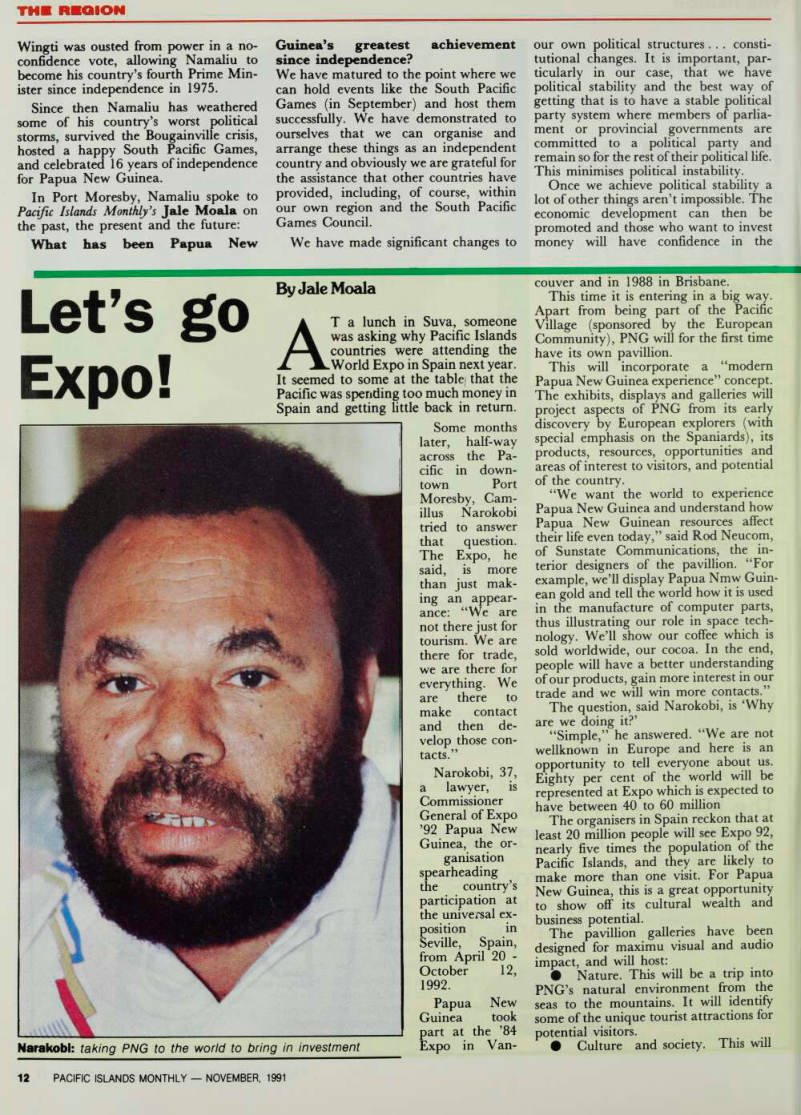
F In Port Moresby, Namaliu spoke to Pacific Islands Monthly’s Jale Moala on the past, the present and the future: What has been Papua New
Guinea’s greatest achievement
since independence?
We have matured to the point where we can hold events like the South Pacific Games (in September) and host them successfully. We have demonstrated to ourselves that we can organise and arrange these things as an independent country and obviously we are grateful for the assistance that other countries have , . , r •, • provided, including of course within our own region and the South Pacific Games Council.
We have made significant changes to
our own political structures. . . consti tutional changes. It is important, par ticularly in our case, that we have political stability and the best way of getting that is to have a stable political party system where members of parka ment or provincial governments are committed to a political party and remain so for the rest of hpr political life.
Th ‘ s mmimises pol.tica instability Once we achieve political stability a lot ofother things aren’t impossible. The economic development can then be promoted and those who want to invest money will have confidence in the
country. Our people will have more confidence in the system.
We have achieved a lot in the past 16 years. In education, although we still have about 60 per cent of the population who are illiterate, more and more people are now literate and better educated.
Unemployment is another of our bigger challenges and will remain so for the future. Fortunately we will be able to address a number of critical problems effectively in the future because of the resources that are now at our disposal.
But that will depend a lot on the political
direction of the government of the day.
What areas of development need emphasis?
Infrastructure is one. Obviously we need to build more roads, more bridges into the rural sectors to bring more people in the rural sectors into the cash economy to sell their produce.
We must put more resources into education, into health and into agricul ture, The non-mining sector will remain the key to the future of this country because that’s where the bulk of our people are and will continue to be. We have to develop the agricultural sector, get more people involved in it. The fisheries sector is undeveloped at the moment. We also need to develop the forestry sector.
One area in which we have not put much emphasis in the past is tourism.
Our country has got a lot of tourism potential which we have never realised in the past and we’d like to put some emphasis into that. All these areas have the greatest potential for job creation in the rural areas. That’s the way I’d like to see the revenue coming in from the mining sector being put in.
Would that mean elevating tourism to a more senior status in Cabinet?
That has to be the case eventually if we are to be serious about it . . . we’ll have to give it a higher status.
What has been the key to your success as a leader?
In our case, where the government is built on a coalition, it is very, very important that you consult as much as possible with your coalition partners . . . But it is always understood that where agreement is not possible then the person who is in charge makes the final decision and is accepted as long as they know that they’ve been involved in the discussions.
What about human rights?
Generally, we’ve had a relatively free society in Papua New Guinea where the constitutional rights are guaranteed and have been exercised quite freely by the people, from voting to freedom of expression to freedom of movement and a host of other things. We’ve never really had a major abuse of those rights in the sense that a government in power had either abused them or had taken steps to refuse them. We’ve succeeded a lot in making sure the constitution works.
Of course, there are blots, like the Bougainville situation. But the Bougain ville situation has got to be seen as an exceptional situation where certain things happened because of the circum stances surrounding those incidents.
Once we have found a permanent
solution to Bougainville we are prepared to establish a judicial enquiry into those abuses that were allegedly committed on both sides on the national government side and on the side of the Bougainville
Republican Army.
Did Amnesty International mis judge the events in Bougainville?
I think they made hasty conclusions without really understanding the situ ation in Papua New Guinea. People have a tendency to make all sorts of criticisms because they sound good from the point of view of their organisational objectives but really with no appreciation and understanding of the local situation.
How well has the economy re covered since the Bougainville crisis started in 1988?
The past two years, 1990 and 1989, were the toughest years for us and we have had to take some very drastic steps, particu larly in the beginning of last year. We put together an economic package of measures to assist us with the economic management. We got the help of the World Bank to introduce a major structural adjustment programme. This involved, among other things, the de valuation of the kina by 10 per cent so that we can maintain a reasonable level of foreign reserves and also make our export more competitive.
We had to cut expenditure in the public sector and we had to cut the budget by about a million kina. We had to make some drastic decisions in rationalising functions and responsibil ities in the public sector and, in the process, cut out any form of duplication.
We rationalised government investments in the private and public sectors where the government had been losing money.
We had a major privatisation pro gramme because of that.
We took drastic steps to liberalise the investment policies and trade policies.
We abolished the National Investment Development Authority and in its place we have set up the Investment Promo
tion Authority which will assist us attract investment both domestically and from overseas ... We changed the forestry legislation because of the abuse of the previous forestry legislation. We made changes in some of the commodity boards and industries like coffee. All of these were geared to making Papua New Guinea more competitive, more export oriented and efficient in terms of cost.
The lessons of Bougainville made us introduce new policies in relation to mining and petroleum. We now have landowners and provincial governments
much more closely involved in the negotiations or discussions in relations to the development of a mine or a pet roleum project. The landowners and the provincial governments are now entitled to equity. We have increased the royalty payments to landowners from 5 per cent to 20 per cent. We have specified in the agreements that the priorities, in rela tions to jobs and spinoffs, must first be given to the landowners and the people of that province before anyone else. We have provided for infrastructure develop ments that the company must fulfil as
well as the national government.
These have all helped in the past three years to see at least three major projects: • Misima, in Milne Bay. This is a gold and silver mine which is in full production; • Porgcra goldmine, in the High lands. This will be its first year of full production; • Kutubu oil project. This is under construction.
All of these are multi-billion dollar projects which . . . (have) placed us in a much stronger position in terms of the economy of the future. We had negative growth in 1989 and again last year. This year it will be reversed and will be sustained on a very good level in future years. When the Bougainville copper mine comes back into production it will be a bonus. Even without Bougainville now the country can move toward a period of sustained prosperity.
Were you saddened by Sir Michael Somare’s loss at the United Nations* presidential elections?
In a way we were very disappointed that Sir Michael’s candidature didn’t come off the way we thought it would. There were a number of countries that told us they would support us and didn’t. We are appreciative of the support we got from the South Pacific countries and ASEAN and Australia, New Zealand, Japan.
We knew the United States would be a major influence in this. And because of what happened in the Gulf War, the continuing efforts in the Middle East to resolve the Palestinian question and the outstanding issue regarding Iraq, there was a lot of pressure from the United States on the Western countries to support Saudi Arabia. And Saudi Arabia is a major country in the Arab world and in the Muslim world. They’ve got the petro dollars to also mount an effective campaign.
It is unfortunate that at a time when the United States was showing increasing interest in the South Pacific they couldn’t have offered and used this opportunity in a tangible way to demonstrate that commitment to the Pacific by supporting our candidature. We are pleased that Sir Michael got the support he received.
Forty-five is still a substantial number of countries in the United Nations system and it helped Papua New Guinea and the Pacific to be put on the map.
What are your chances like in the general elections due June next year?
Pretty good. We are pretty optimistic but in Papua New Guinea, you know, politics is quite fluid. It will be a very interesting, very challenging election for all concerned. I rate our chances as pretty good at this point. □