Sir Erl’s swanswong
p. 10 · Read in the full issue
By James Grubel
PAPUA New Guinea’s Governor- General Sir Serei Eri has had successful careers as an author, teacher and diplomat, but he is likely to be remembered for his role in PNG ’s recent constitutional crisis. Sir Serei’s
correspondence to judges and politicians
over the past month has opened a new chapter in the colourful life of a man who has seen his country grow from an
Australian colony to a fiercely indepen
dent nation.
Now he is Governor-General no more.
He resigned on October 1, only hours before the Queen was expected to rectify his sacking on the recommendation of the Prime Minister, after he refused to comply with the PNG constitution by sacking his close friend and former political ally Ted Diro. (Diro has been found guilty of 81 corruption charges.) The move has plunged PNG into its own version of The Dismissal , the consti tutional crisis in Australia in 1975 which saw the queen’s representative sack the elected Labor government. Ironically, Sir Serei was stationed in Australia as PNG’s consul general at the time of the
Whitlam sacking.
Serei Vincent Eri was born in the Gulf Province of PNG in 1936 and educated at Catholic mission schools until he was 14. After a brief stint in the workforce in 1950, Sir Serei returned to study and undertook a teacher’s training course.
From 1956 the young Eri taught part time across PNG while studying to complete tertiary qualifications.
In the early 19605, Eri travelled widely throughout the Middle East, Malaysia and Australia. He was one of the first students to enter the newly-created University of PNG in 1967 and he graduated three years later with a BA with a special interest in creative writing.
Also in 1970, Eri made history when
a short story he had written at university was published as a novel, The Crocodile.
It was the first published novel by a Papua New Guinean and it won critical acclaim throughout the Pacific. The book jacket says the story is of a man who “knows he must come to terms with the unfamiliar and often brutal ways of the Europeans”.
The plot resembles the conflict Sir Serei faced as the vice-regal head of a Westminster democracy in a country where tribal loyalties remain strong. Sir Serei’s writing skills have led to some entertaining letters over the past month.
On September 3, he wrote to his Chief
Justice Sir Buri Kidu to ask for up to half the
charges against
Diro to be drop ped. In a letter
to Leadership
Tribunal Chair man Justice Graham Ellis, after the tri bunal found Diro guilty, Sir Serei flatly re jected the find ings but thank ed the tribunal chairman for “a job well done”.
In a final let ter to Prime Minister Rab bie Namaliu on
September 30,
Sir Serei spent two pages justi fying his actions and criticising the government for causing the crisis. While ad
mitting Diro
was his friend,
Sir Serei said he would gladly sign Diro’s death warrant if the circumstances were right.
Again he displayed a sense of humour with the closing paragraph: “Sorry for this long and possibly meaningless let ter . .
In 1986 Eri was named president of Diro’s People’s Action Party and he was appointed Governor-General in January 1990, on Diro’s recommendation.
One month after taking over the vice regal role, Eri was made a Knight in the most Distinguished Order of St Michael and St George and Knight of the Order of St John in a ceremony in London.
He is married with six children. □
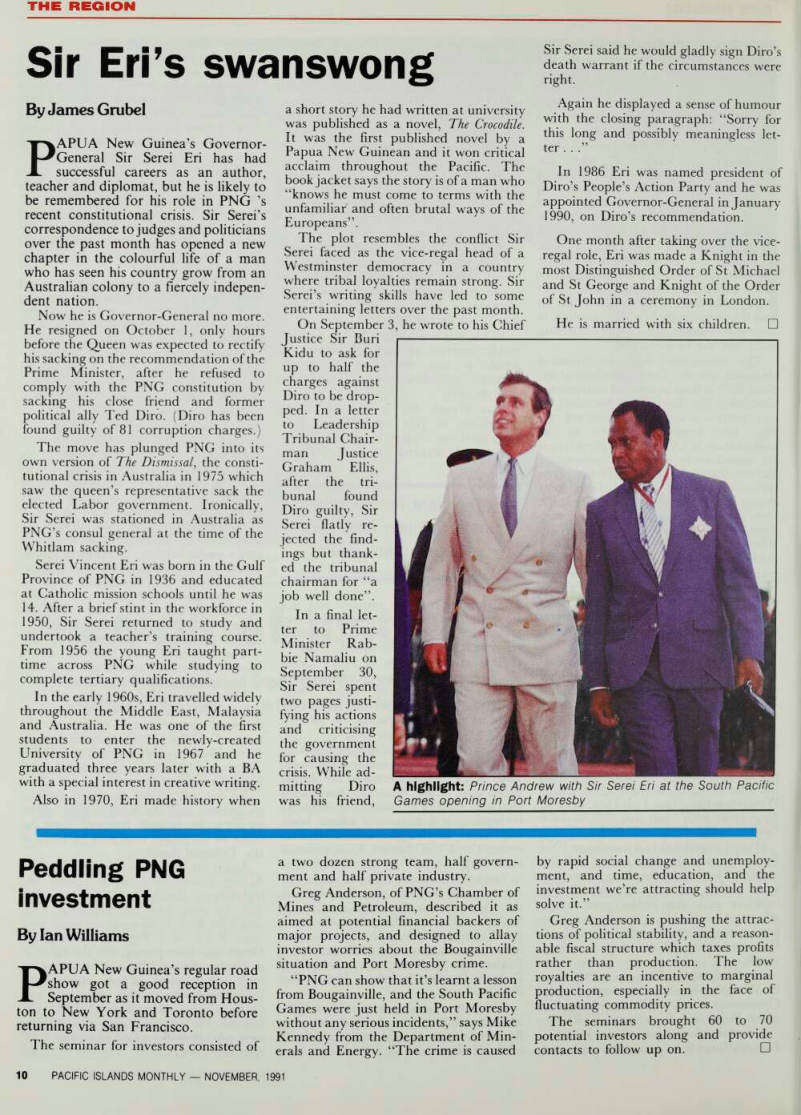
A highlight: Prince Andrew with Sir Serei Eri at the South Pacific Games opening in Port Moresby