Triumph of justice
pp. 8-9 · Read in the full issue
The Region
Ted Diro’s turbulent exit from power has been likened to a second-rate film ... with a significant theme
By Frank Kolma
THE story has been told many times. Papua New Guinea turned 16 on September 16 this year. Four of those 16 years have been taken up by Edward (Ted) Ramu Diro.
He has been a prominent figure, not just in terms of exposure and controversy, but in determining the course of Govern ments and, longer-term, for highlighting the weaknesses in the political and legal framework of the nation if by default.
The man who now heads the Oppo sition, Paias Wingti, was put in power in 1987 by Diro and dethroned in July the next year by Diro. Current Prime Minister Rabbie Namaliu gained power with Diro’s help and kept it through Diro. Laws pertaining to Commissions of inquiry, perjury (lying while under
oath), the functions and jurisdiction of the Ombudsmen Commission, and even the Constitutional provision to have the Queen as Head of State, have been questioned, reviewed and in most cases loopholees identified, and moves are afoot to plug them during the course of the now famous Barnett Commission of Inquiry into Aspects of the Timber Industry in 1987.
The same inquiry uncovered lack of Government policies for the forestry industry, rampant transfer pricing, un hindered logging of some of the world’s last reserves of tropical rainforest, and gross mismanagement and corruption, and recommended criminal charges for Diro and a number of businessmen and
public servants.
A maker of Prime Ministers, Diro himself was third in line for the post come June 1992, after Namaliu and Wingti. If such news comes as a shock to outside
watchers of PNG politics, it was an inevitable outcome in the intricate, delicate world of PNG politics.
In a nation divided by internal regionalism and held in balance by careful distribution of top jobs in Papua New Guinea, the region represented by Diro (the entire southern half of the country) has never been represented by a prime minister since independence.
The past and present Prime Ministers had come from the other three regions of PNG. Michael Somare represented the New Guinea mainland coastal area; Julius Chan represented New Guinea Islands; Paias Wingti represented New Guinea mainland Highlands Rabbie Namaliu again comes from New Guinea Islands, when really it was due the southern region of Papua. Papua had been content with the mostly ceremonial posts of Governor General and Deputy Prime Ministership in the past, mostly because Papuan MPs had petty differ ences and none had the national vision of charism to gain many supporters.
The first Commander of the PNG De
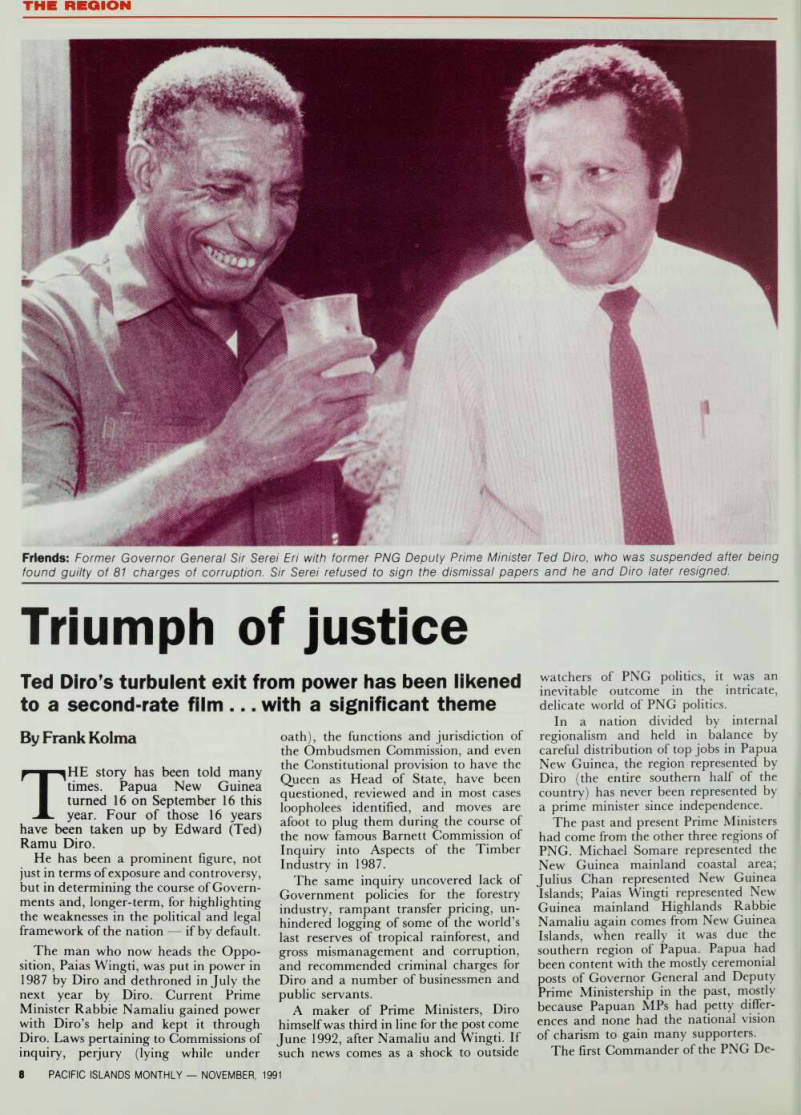
Friends: Former Governor General Sir Serei Eri with former PNG Deputy Prime Minister Ted Diro, who was suspended after being found guilty of 81 charges of corruption. Sir Serei refused to sign the dismissal papers and he and Diro later resigned.
fence Forces, Ted Diro entered national politics in 1982. He rose above the rest of Papuan leaders and, by the next elections in 1987, had formed his People’s Action Party and banded Papuan leaders under one leadership to present a formidable force in Parliament.
His aspirations disappeared at B.oBam on Friday September 27 when the National and Supreme Court judge, an Australian, pronounced Diro guilty on 81 charges of corruption, bribery and misuse of office and recommended dis missal from office for each of 71 counts.
The convictions included an attempt to prevent the course of justice, that he accepted K 140,000 in political donations from Indonesian Armed Forces Chief Benny Murdani without declaring it; and that he secretly held directorships in
several companies against the leadership
code and the Constitution.
The conviction, his recommended dismissal and the Governor General Sir Serei Eri’s refusal to sign the instruments dismissing him have been described by one observer as scenes from a second rate film. Diro supporters see it as the culmination of a sinister plot perpetrated by outsiders to destroy a prominent Papuan leader. But mostly, the tale of the turbulent passing of Ted Diro from Papua New Guinea’s political life is the story of the triumph of justice a story forgotten in all the excitement, but worth telling.
Since the Barnett Inquiry recom mended Diro and others for criminal prosecution in early 1988 many efforts have been made to pervert the course of justice, by everyone from Diro supporters to the man himself to the Governor General of Papua New Guinea.
In 1987 he was cleared on a technical ity in six counts of perjury which carries 14 years imprisonment but Diro claimed he was cleared of every thing. “It’s a victory for justice,” he said.
On March 9, 1988, when it was evident the Barnett Inquiry would table its final report, Diro supporters met and put an ultimatum to then Prime Minis
ter, Pias Wingti. Amongst other things
Wingti was told “that Tedi Diro’s case be done away with” and that this be done “within seven days, no later”.
Wingti responded in a statement: “No Prime Minister should interfere with the course of justice; he should not interfere with police matters, he should not interfere with the public prosecutor’s office and he should not interfere with the proceedings of a commission of inquiry.”
He was to lose Government for those words.
Eleven days later Diro, then a Minister in Wingti’s Government, wrote to an Opposition member offering the support
of his People’s Action Party (PAP).
His conditions, paraphrased, were: Forestry Inquiry be done away with; and
Deputy Prime Minister comes to People’s Action Party on day one of new Government.
“Whoever satisfies these demands will get PAP and (Papuan) bloc support. (People’s Democratic Movement) PDM and Wingti are now caught,” he wrote, and asked that it be passed to opposition leader Sir Michael Somare.
Mr Diro has admitted to the leader ship tribunal that he wrote the letter and claimed Parliamentary privilege. Tri bunal chairman Justice Ellis found the claim to be “misconceived”.
Justice Ellis wrote in his judgement: “Parliamentary privilege is the principle which enables Members of Parliament to speak on matters of public and national importance in Parliament without fear... of defamation.
“This was not a letter which had the public interest or national interest in mind: it was motivated by purely personal considerations and unworthy ones at that.”
Pias Wingti fell in a vote of no confidence in July 1988. Diro’s PAP supported the Opposition to gain Gov ernment. It secured the Deputy Prime
The fight for a Papuan Prime Minister has been set back many years
Ministership but the inquiry was not stopped. The final report was submitted and Prime Minister Rabbie Namaliu referred it to the fraud squad. 1989 saw a change in Police Com missioners after former Commissioner Paul Tohian’s farcical “coup”. New Commissioner Ila Geno declared there was “no case” in persuing the forestry file.
When victory seemed in sight for Diro, the Ombudsmen Commission pounced.
Early in 1991 it submitted to the Public Prosecutor, Kina Bona, to have Diro charged with 73 counts of bribery, corruption and misuse of office. Bona duplicated the charges further to 86 and wrote the Chief Justice to appoint a leadership tribunal to hear them.
The leadership tribunal was subject to delay tactics by Diro who first claimed the Ombudsmen Commission did not have jurisdiction. When that was over ruled, Diro forced a change of com missioners on grounds that chairman, Justice Arnold Amet, was a friend of Forestry Inquiry chairman, Justice Tos Barnett.
When new chairman Graham Ellis took the chair, Diro charged that the Barnett evidence should not be admitted to the Tribunal as they presumed him
guilty. That was also over-ruled.
Having exhausted legal means, more powerful friends were brought in. On September 3 Sir Serei Eri, the Governor General of PNG, long time friend of Diro and former PAP president, wrote to Chief Justice Sir Buri Kidu twice, hinting and then requesting outright that charges against Diro be dropped.
He said: “From what I hear, more than half of the charges against Mr Diro that the Ombudsman has referred to the courts for Tribunal to deal with, is based on the Barnett Report and if this is the case, then the Ombudsmen should do the right and fair thing and have them withdrawn.”
The Chief Justice wrote back: “Your first letter to me was most improper and your second letter to me is not only improper, it should not have been written at all.
“When I took my oath as Chiefjustice 13 years ago I promised to uphold the Constitution and the Law of Papua New Guinea. You did the same when I swore you in as Governor General of Papua New Guinea. Your letter on the third instant is an attempt to induce me to breach my oath of office. It is not my intention to violate my oath of office.”
If the Chiefjustice did not intend to violate his oath, Diro went ahead and broke it. On September 9 he refused to go before the tribunal and ordered his lawyer not to represent him there. He told a media briefing: “I refuse to submit myself to the jurisdiction of this Leader ship Tribunal. The Leadership Tribunal can go ahead and hear the charges against me if it wishes but I will not appear nor will my counsel appear to defend the charges against me . . ..”
The tribunal took heed of Diro’s counsel, proceeded and pronounced him guilty within a matter of weeks.
There was one last attempt to buck the system. Sir Serei refused to sign the dismissal papers and reinstated the suspended Diro to full status as Deputy Prime Minister, only fining him K 3,000.
The resulting furore ended in Sir Serei himself resigning from office.
To top off Diro’s disregard for the procedures and the legal process in the country, he himself resigned from an office he no longer occupied by effect of the Tribunal decision.
Again the law exerted itself, when the Acting Governor General signed the instruments dismissing him from office
and, by some legal interpretation, bar
ring him from contesting elections next year. Fears of a Papuan uprising for Diro’s sake have passed, but the fight for a Papuan Prime Minister has been set back many years. There appears no leader with the money, charisma and vision to keep and build on what Diro left behind. The party divided after he left, over who should replace Diro and PAP split three ways. □