Rumble of republicanism
pp. 16-17 · Read in the full issue
IN Tuvalu, the Government of Bikenibeu Paeniu emerged un scathed from their recent Parlia
mentary sitting, despite intensive
debate on domestic issues, and despite a motion of “no confidence”. But MP for Funafuti, Kamuta Latasi, surprised ob servers when he proposed a motion calling for a feasibility study into making Tuvalu a Republic.
At present it is an Independent Nation with the Queen as Head of State. Prime Minister Paeniu’s Government supports the motion, though he has publicly stated that the issue is a “very delicate” one.
Kamuta Latasi, proposer of the mo tion, is a politician of long experience.
Deeply involved in the movement for Separation from Kiribati 12 years ago, he was Tuvalu’s first High Commissioner to Fiji, and is a former Dean of the Diplomatic Corps. Broadly aligned with the ruling Paeniu Government, he is married to Naama Maheu Latasi, Min ister for Health, Education and Com munity Affairs in the present Administra tion. Here, he talks to Irene Nisbet.
Concerning your proposal for a feasibility study into the possibility of turning Tuvalu into a Republic why did you raise this motion?
Firstly, and importantly, I was given
a mandate by my constituents to raise the motion in Parliament. But it’s a thing which has been in my mind for a long time, from when we were a colony together with the Gilberts.
On Separation, there was a consti tutional committee set up to draft a new constitution for Tuvalu and I expressed my views at the time, but the majority of people took this present view (for an independent nation with the Queen as Head of State). I feel that at the time, there wasn’t enough explanation given to make the Tuvalu people understand what sort of Government they are going into. Things seemed rushed, rushed, right from the start. Because on Separ ation, we had a lot of problems in trying to become a new country, without most of the infrastructure to go along with it and the politicians went into trying to form a Government, which they felt at that time, would be suitable.
It’s 12 years now since Separation, and I’ve never had any doubt in my mind that maybe there is another alternative to the present set-up. The prime factor which has driven me into this is unity for Tuvalu.
What advantages do you see for
the people of Tuvalu in having a Republican system as opposed to the present one?
During the last 12 years, we’ve had three governments, including this present one. Our system at the moment is based on the Westminster module. Twelve Members, elected by their constituents.
This set-up at the moment! Since Separation, we’ve had five or six motions of no confidence pushed through. In December we had one, and just a few days ago, in this session, we had one.
There is a question we have to ask Why? Why is this happening?
A motion of “no confidence” is a political game. In any free society, politicians will play like this. But in a small society like ours, obviously some thing is wrong, something missing some where, when this happened.
The electoral system look at the whole thing in Tuvalu, most of the MP’s come in with less than 50 per cent of the votes. Whereas look at Kiribati when the election takes place, each candidate must achieve a certain number of votes according to the majority views of his constituents, which is a very important factor. I feel that for anyone to represent his constituents in Parliament, he must have a mandate from his island, and he must have the majority behind him.
There is another aspect - the leader ship of Government. I can assure you that out of the last three Governments, we (the members) obviously could not get a complete agreement on the choice of leader. As you know, in politics everyone aims high, and there is always a division somewhere. The question is: is the Prime Minister, or the leader, the one the people want? Because the only time the individual voter (in Tuvalu) plays his part in selecting a Government is at the ballot box. Only once, and only for his own MP.
Let’s have the leader of Government elected nationally. Then, when the leader is then elected, he feels confident with his mandate from the people, and can then select his ministers with confi dence, not on a party system. Let’s be fair let’s not be frightened of who is going to be leader. Give it to the country the country will tell you.
Do you feel you have good backing for your proposal within Govern ment, and from your constituents?
I am totally confident that we will get it. It has gone through Parliament. Of course, there is opposition to it, for whatever reason but let me tell you that after 12 years, and all the problems we’ve gone through (it might not be noticeable to the rest of the world, but it is definitely noticeable in Tuvalu), we cannot get closer to stability under the present system. Of course, I am mindful that no government is 100 per cent perfect. But we must work towards
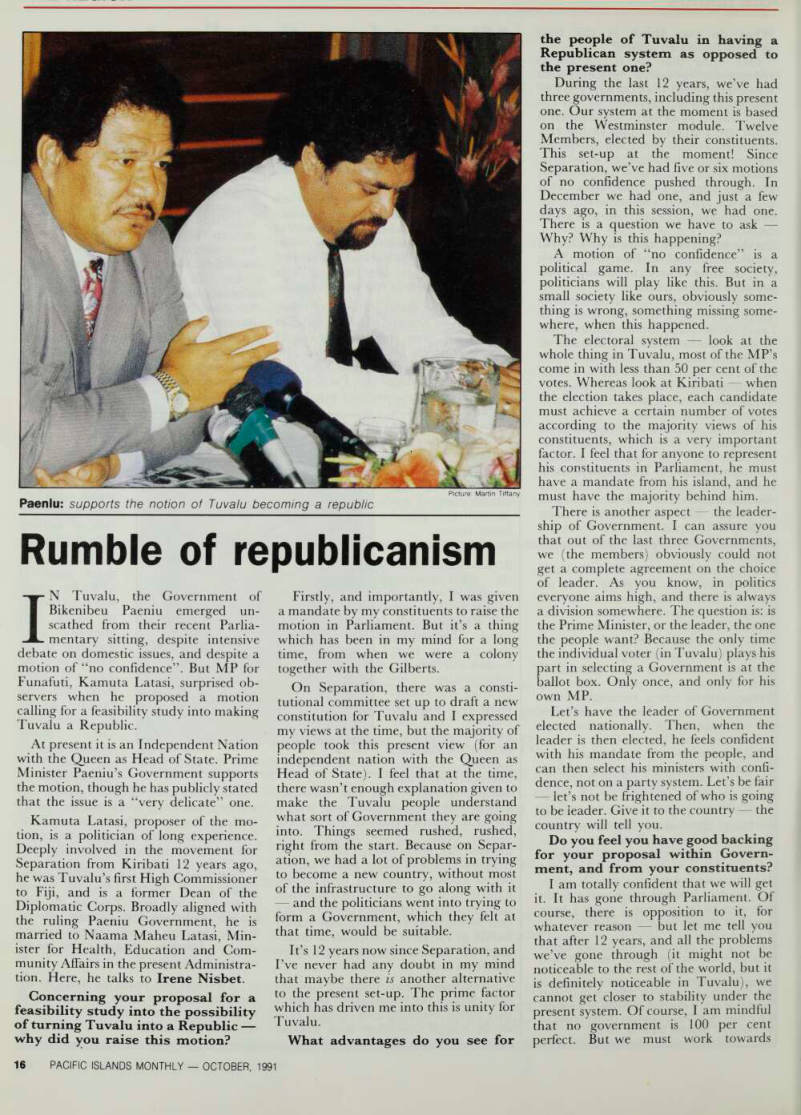
Picture: Marlin Tiffany Paenlu: supports the notion of Tuvalu becoming a republic
something that is closer, and more acceptable to the people.
If the report is ready by the next Parliamentary sitting, where do you go from there?
I hope that the Government will meet the target date. Of course I would not put the Government into an awkward position, but if it’s ready for the first sitting in 1992 and it shows that the people agree to my suggestion as ap proved by Parliament at this stage, then the plan I feel is right is that we have to endorse in Parliament that we will accept a Republican type of democracy. If that happens, obviously a new Constitution has to be written. If the people say “yes”, we will try to work the programme so that the next general elections will be based on the new Constitution. As you see from my motion, I requested that government consult as widely as possible inside and outside Tuvalu. What I have in mind is that we get some experts and consultants in so that the whole thing is properly worked out, and not rushed into. If it happens that the report is not ready by the last session, I won’t mind, provided that the chance has been given as widely as possible for the people to give their views. In my own mind, it wouldn’t require a drastic change in the consti tution. I hope the constitution would be based on something like the module in Kiribati, where candidates for the lead ership are chosen by the people.
Do you think that changing to a Republican system would alter the way in which traditional aid donors like Australia, Britain and New Zealand would view Tuvalu?
I do not think that our traditional friends, aid donors, would look at it in this way, that for us to give up the Queen as Head of State would cause them any problems. The move to a Republic is purely for the stability of the country.
Look at the Commonwealth there are 48 members, and only 16 have the Queen as Head of State. I do not want this to be misinterpreted. As everyone knows, our main aid comes from our good friends, and I hope that for us to become a Republic would not in any way be interpreted as a rejection of them. But they have to look, and understand the situation we are in.
There is another important point that is, concerning the position of the Governor-General (in Tuvaluan so ciety). Already, we are a small poor country with many problems. The financial burden of having a representa tive of the Queen the British are not prepared to pay for maintaining the Representative, and it’s costing us a great deal of money every year, which could be utilised elsewhere. Also we want to eliminate feelings of discontent maybe jealousy is too strong a word amongst the islands of Tuvalu concerning the
appointment... I don’t think that this (system) is all that workable or import ant right now. The fact is that Tuvalu is independent. If Tuvalu can handle her own internal affairs, why do we have to have a Governor-General? ... To elim inate all this, we must turn into a Republic, and change the Constitution, and the model of self-Government at which we are aiming.
Do Tuvaluans still tend to think of their island first, and national
identity second?
My personal view is that very few politicians classify national interests first, and island interest second. The trend I have seen is always island interests first.
It will take time for people to feel, “we are Tuvaluan People” instead of “We are Funafuti, or Namumanga, or Vaitupu people”. Each island has its own pride, of course and individual traditions must be preserved. But everyone must take the national interest first.
Dr Tomasi Pua Pua, Leader of the Opposition, has said that he be lieves the people of Tuvalu “prefer the kind of Democracy presently used in the Country”. How do you view his comments is he out of touch with public opinion?
Of course, I don’t speak for him, but as I said to him in Parliament, “Look, why do you object to this motion? There
is one question you have to answer are you frightened to go to the electors?” I think he may be out of touch. He’s very popular in his own constituency (Vaitupu) but a politician who’s fright ened to go to the people well, there is obviously something wrong somewhere.
Where do you see your own role and future in a newly-created Re public of Tuvalu?
At the moment, I am seriously con sidering bowing out from politics at the end of the present Parliament term, but if my constituents still want me to represent them, then I have to get over the first hurdle just like anyone else. It may be wrong, but I think I know what your question implies. Who doesn’t want to be at the top? But there are certain limits which one has to know of oneself before going into it it’s not just as simple as becoming President, you know.
You have to go through the process.
Changing to a Republic does not change much in relation to the election of members based on a democratic system . . . Even though the present sys tem is democratic, I feel that it hasn’t gone far enough to achieve what democ racy really is in our society. In Parlia ment, we must look, and make sure that the national interest is served first.
Because uppermost, at all times in my mind, is trying to get as close as possible to the wishes of the people. □