Missing from the climate map
p. 15 · Read in the full issue
By David Robie
ONE big thing was missing at
last month’s South Pacific Environments conference in New Zealand the Pacific.
When it came to the greenhouse effect, the region wasn’t on the map.
Some delegates were stunned when Professor Ann Henderson-Sellers, direc tor of the Climatic Impacts Centre at Macquarie University, Sydney, said that virtually all 30 nations represented at the conference were missing from computer models of the world climate.
None of the island states were there, nor was New Zealand. The reason? The models on even the most advanced super-computers break the world into 500-kilometre squares, missing the tiny islands and atolls of the Pacific. The crude model representations are due to
the large number of climatic variables needed for the com puter formula.
However, the roughness of the models does not dis prove the green house theory.
Professor Hen derson-Sellers said the Intergovern mental Panel on Climate Changes (IPCC) report indi cated “that emiss ions resulting from human activities are substantially in creasing the atmos pheric concen trations of the greenhouse gases carbon dioxide, methane, chloro fluorocarbons and
nitrous oxides and that these in creases will cause an additional warm ing of the Earth’s surface; that current models predict a one-degree Celsius increase in temperature above 1990 temperatures by 2025, and a three degree Celsius increase in temperature by 2100 ... we calculate with confidence that immediate reductions of over 60 per cent would achieve atmospheric stabil isation at the level of equivalent doub ling of carbon dioxide over pre industrial levels by 2100.”
Some delegates at Auckland Univer sity criticised the “doomsday” scenarios that global warming and rising oceans would engulf low-lying atoll nations
such as Kiribati and Tuvalu by early next century.
Professor Roger McLean, a New Zealand geographer attached to the Australian Defence Force Academy, believes that most Pacific islands will still be above the sea in 100 years. He stressed the coral base of atolls coral needs water to grow and, as the sea rises, so would the land. He based his argument on evidence gathered in eastern Polynesia, where many islands have survived big rises in the sea level caused by changes in ocean currents.
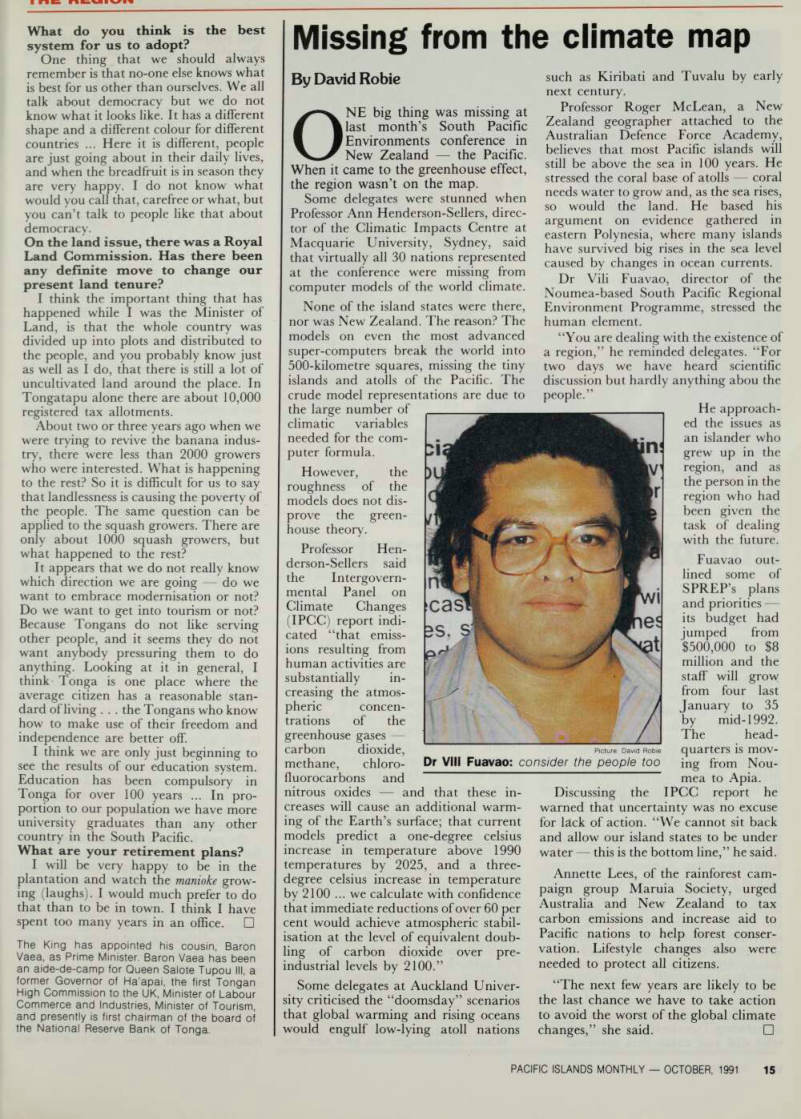
Dr Vili Fuavao, director of the Noumea-based South Pacific Regional Environment Programme, stressed the human element.
“You are dealing with the existence of a region,” he reminded delegates. “For two days we have heard scientific discussion but hardly anything abou the people.”
He approach
ed the issues as an islander who grew up in the region, and as the person in the region who had been given the task of dealing with the future.
Fuavao out lined some of SPREP’s plans
and priorities
its budget had
jumped from
5500,000 to S 8 million and the staff will grow from four last January to 35 by mid-1992.
The head quarters is mov ing from Nou mea to Apia.
Discussing the IPCC report he warned that uncertainty was no excuse for lack of action. “We cannot sit back and allow our island states to be under water this is the bottom line,” he said.
Annette Lees, of the rainforest cam paign group Maruia Society, urged Australia and New Zealand to tax carbon emissions and increase aid to Pacific nations to help forest conser vation. Lifestyle changes also were needed to protect all citizens.
“The next few years are likely to be the last chance we have to take action to avoid the worst of the global climate changes,” she said. □
Picture: David Robie Dr Vili Fuavao: consider the people too