No gold stars for the
p. 13 · Read in the full issue
The Region
No gold stars for the Prince and the nobles
“Some view him (the Crown Prince of Tonga) as too Westernised, too often away from home, and too interested in women some of whom the King does not approve.”
“Ministers travel frequently and usually first class, which entitles them to US$7OO per diem in the Unites States. Allegedly one received $200,000 in travel expenses in one year alone.”
“The Wesleyans resent the Mormons and accuse them of ‘buying members’ because of their recruitment activities.”
WHO is writing these things? A sensational supermarket tab loid? An enflamed political opponent of Tonga’s Estab lishment?
None of the above. The quotations are from a report submitted to America’s Pentagon by a highly respected US think tank, the Rand Corporation. Labeled “A Rand Note” and entitled The Kingdom of Tonga , it was written by George K.
Tanham and was, according to its preface, “sponsored by the Office of the Secretary of Defence ... (as) part of a larger study on security trends in the South Pacific.”
California-based Rand, a multi million dollar non-profit entity, was for decades the brains behind the US Air Force. It later expanded into social science and foreign relations. Its findings are taken seriously in Washington.
Tanham’s report, written in 1988 but having limited circulation until now, criticises Tonga’s government and de spairs for the nation’s future.
The report is gentle with the King, Taufau’ahau Tupou IV, who is “liked and respected. He is the country’s traditional spiritual leader and head of the Free Wesley Church, the kingdom’s official church.”
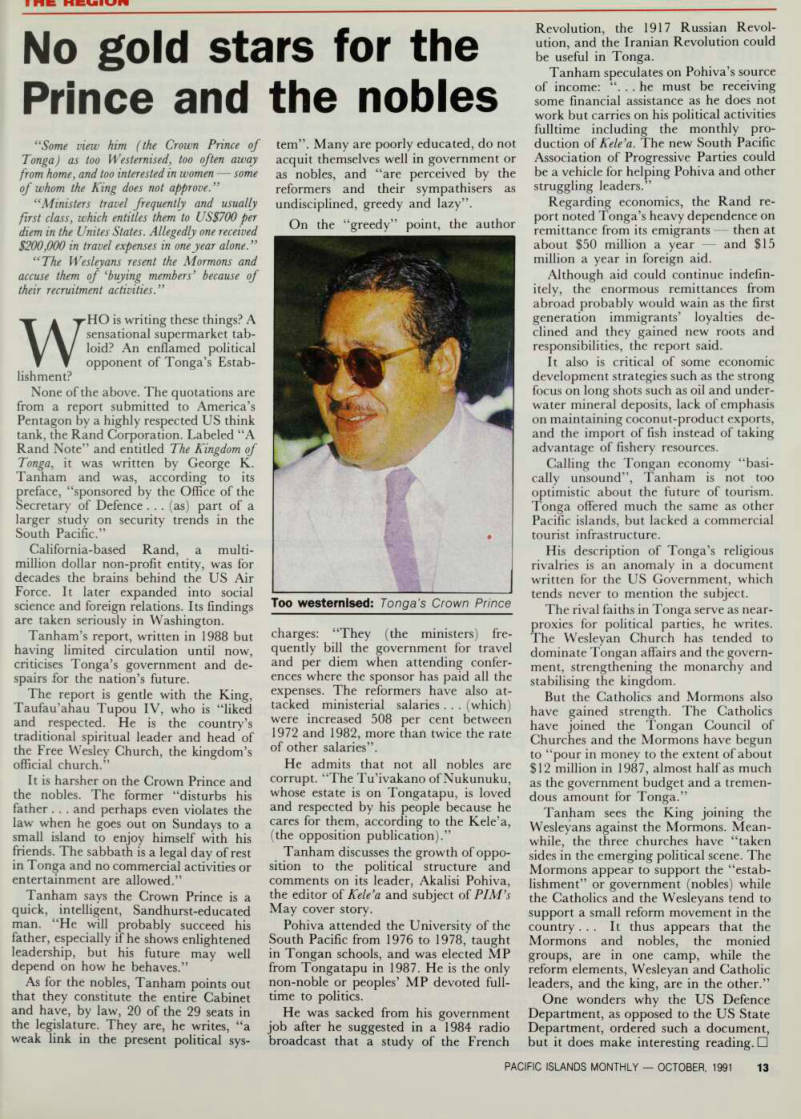
It is harsher on the Crown Prince and the nobles. The former “disturbs his father . . . and perhaps even violates the law when he goes out on Sundays to a small island to enjoy himself with his friends. The sabbath is a legal day of rest in Tonga and no commercial activities or entertainment are allowed.”
Tanham says the Crown Prince is a
quick, intelligent, Sandhurst-educated
man. “He will probably succeed his father, especially if he shows enlightened leadership, but his future may well depend on how he behaves.”
As for the nobles, Tanham points out that they constitute the entire Cabinet and have, by law, 20 of the 29 seats in the legislature. They are, he writes, “a weak link in the present political sys
tern”. Many are poorly educated, do not acquit themselves well in government or as nobles, and “are perceived by the reformers and their sympathisers as undisciplined, greedy and lazy”.
On the “greedy” point, the author
charges: “They (the ministers) fre quently bill the government for travel and per diem when attending confer ences where the sponsor has paid all the expenses. The reformers have also at tacked ministerial salaries .. . (which) were increased 508 per cent between 1972 and 1982, more than twice the rate of other salaries”.
He admits that not all nobles are corrupt. “The Tu’ivakano ofNukunuku, whose estate is on Tongatapu, is loved and respected by his people because he cares for them, according to the Kele’a, (the opposition publication).”
Tanham discusses the growth of oppo sition to the political structure and comments on its leader, Akalisi Pohiva, the editor of Kele’a and subject of PlM’s May cover story.
Pohiva attended the University of the South Pacific from 1976 to 1978, taught in Tongan schools, and was elected MP from Tongatapu in 1987. He is the only non-noble or peoples’ MP devoted full time to politics.
He was sacked from his government job after he suggested in a 1984 radio broadcast that a study of the French
Revolution, the 1917 Russian Revol ution, and the Iranian Revolution could be useful in Tonga.
Tanham speculates on Pohiva’s source of income: . . he must be receiving some financial assistance as he does not work but carries on his political activities fulltime including the monthly pro duction of Kele’a. The new South Pacific Association of Progressive Parties could be a vehicle for helping Pohiva and other struggling leaders.”
Regarding economics, the Rand re port noted Tonga’s heavy dependence on remittance from its emigrants then at about $5O million a year and $l5 million a year in foreign aid.
Although aid could continue indefin itely, the enormous remittances from abroad probably would wain as the first
generation immigrants’ loyalties de
clined and they gained new roots and responsibilities, the report said.
It also is critical of some economic development strategies such as the strong focus on long shots such as oil and under water mineral deposits, lack of emphasis on maintaining coconut-product exports, and the import of fish instead of taking advantage of fishery resources.
Calling the Tongan economy “basi cally unsound”, Tanham is not too optimistic about the future of tourism.
Tonga offered much the same as other Pacific islands, but lacked a commercial tourist infrastructure.
His description of Tonga’s religious rivalries is an anomaly in a document written for the US Government, which tends never to mention the subject.
The rival faiths in Tonga serve as near
proxies for political parties, he writes.
The Wesleyan Church has tended to dominate Tongan affairs and the govern ment, strengthening the monarchy and stabilising the kingdom.
But the Catholics and Mormons also have gained strength. The Catholics have joined the Tongan Council of Churches and the Mormons have begun to “pour in money to the extent of about $l2 million in 1987, almost half as much as the government budget and a tremen dous amount for Tonga.”
Tanham sees the King joining the Wesleyans against the Mormons. Mean while, the three churches have “taken sides in the emerging political scene. The Mormons appear to support the “estab lishment” or government (nobles) while the Catholics and the Wesleyans tend to support a small reform movement in the country... It thus appears that the Mormons and nobles, the monied groups, are in one camp, while the reform elements, Wesleyan and Catholic leaders, and the king, are in the other.”
One wonders why the US Defence Department, as opposed to the US State Department, ordered such a document, but it does make interesting reading. □
Too westernised: Tonga's Crown Prince