Over the oil barrel
pp. 11-12 · Read in the full issue
FINAPECO strikes troubled waters before its first shipment is launched. Penny Gibson reports
THE Fiji Government’s entry into the South Pacific petroleum market seems certain to raise prices for regional countries already burdened with high fuel bills and external debt.
The Fiji National Petroleum Com pany (FINAPECO) was established by Fiji’s interim government in December 1990 to be the sole importer of petroleum products into Fiji, for internal use and supply to smaller regional countries.
Fiji imports 30 per cent of the region’s fuel. The Government-owned company will buy 10,000 barrels a day of crude oil from Malaysia’s PETCO, a division of Petronas Trading Corporation itself a subsidiary of the Malaysian state-owned Petroleum Nasional Berhad. ESSO will refine it in Singapore and ship 210,000 barrels to Fiji each month. FINAPECO expects to import 2.52 million barrels a year, worth about Fslss million.
British Petroleum, Mobil and Shell believe that fuel from FINAPECO will cost them more, so they will charge buyer countries more. The price question and other problems have led them to reassess Fiji as a central depot for shipping fuel to Kiribati, Niue, Tonga, Cook Islands and Tuvalu if they shift their base, regional buyers will face a price rise to cover costs of the move.
FINAPECO has yet to prove itself on the supply question. Its first shipment into Fiji has been delayed by negotiations over the Product Supply Agreement with the oil companies. Unresolved differences include pricing formula, demurrages (costs of staying in port), security for aviation fuels, quality specifications, and some handling and shipping operations.
The Chief Executive of FINAPECO, Akuila Savu, said that when FINAPECO, the oil companies, the Reserve Bank and the Ministry of Finance finalise the price, the way should be clear to resolve other problems.
The question of whether prices will increase and by how much, both in Fiji and regional countries, is not clear.
Savu is confident. “Where costings are available and where comparisons can be made, FINAPECO can bring the prod ucts into Fiji, on an appropriate GIF (Cost, Insurance and Freight) basis, at prices equal to or lower than the oil companies,” he said.
However, the General Manager of Shell Fiji, Joe Mar, questions this.
“If it was such a good deal (from ESSO) how come we are still negotiating for a more competitive set of prices ten months later?”
Fiji’s Minister for Finance, Josevata Kamikamica, is on record as saying prices should not be higher in Fiji and if FINAPECO made a profit, it would be passed on to consumers through reduced fuel tax, currently about 50 per cent of the bowser price. PIM understands this
is unlikely in the short-term.
The regional situation is not so clear, Fiji’s Minister for Tourism, Civil Aviation and Energy David Pickering stifled debate on prices and FINAPECO at a Regional Energy Ministers’ Meeting in Hawaii earlier this year, and the Interim Prime Minister, Ratu Sir Kamisese Mara, deferred any definitive answers at the South Pacific Forum.
The leaders’ concerns led Ratu Mara to host a meeting of regional Energy Ministers on August 29/30 in Suva where papers on the history and reasoning for FINAPECO were presented.
The oil companies presented the meeting with figures, based on the latest negotiations, which indicated the oil companies would have to pay FINAPECO $3.10 per barrel more.
Mobil’s Geoff Zippel told PIM the latest negotiations with FINAPECO suggested the rise would be on the GIF (cost, insurance and freight) price, and costs borne by the oil industry because of increased financing costs through FINAPECO’s stringent credit terms, increased inventory requirements and increased demurrage (costs of staying in port).
Zippel said price rises would have to be passed on to clients. Increases would differ for trans-shipments depending on each country’s location and require ments.
Regional responses could affect the oil companies’ future plans.
The Solomon Islands Director of Energy in the Ministry of Natural Resources, Gordon Darcy, said his country would continue to buy from Singapore because the price of petroleum products would be higher from Fiji, and Kiribati’s Minister for Energy Teaiwa Tenieu said his country would wait and see if FINAPECO really was going to sell petroleum products cheaply.
But the general manager of Kiribati Oil Company, Arintetaake Aran, said Mobilnad given assurances that alterna tive sources would be sought if FINAPECO started charging higher prices than Mobil was able to offer.
BP’s Tonga manager Fuka Kitekei’aho said the Tongan Govern ment should consider inviting the oil companies in Fiji to move to Tonga. This would need support from Samoa, but it would mean more money from duties, taxes and employment, “as well as sure supply of oil products”, he said.
Tuvalu’s Prime Minister, Bikenibeu Paeniu, applauded FINAPECO as a move away from dependence on New Zealand and Australia, but even
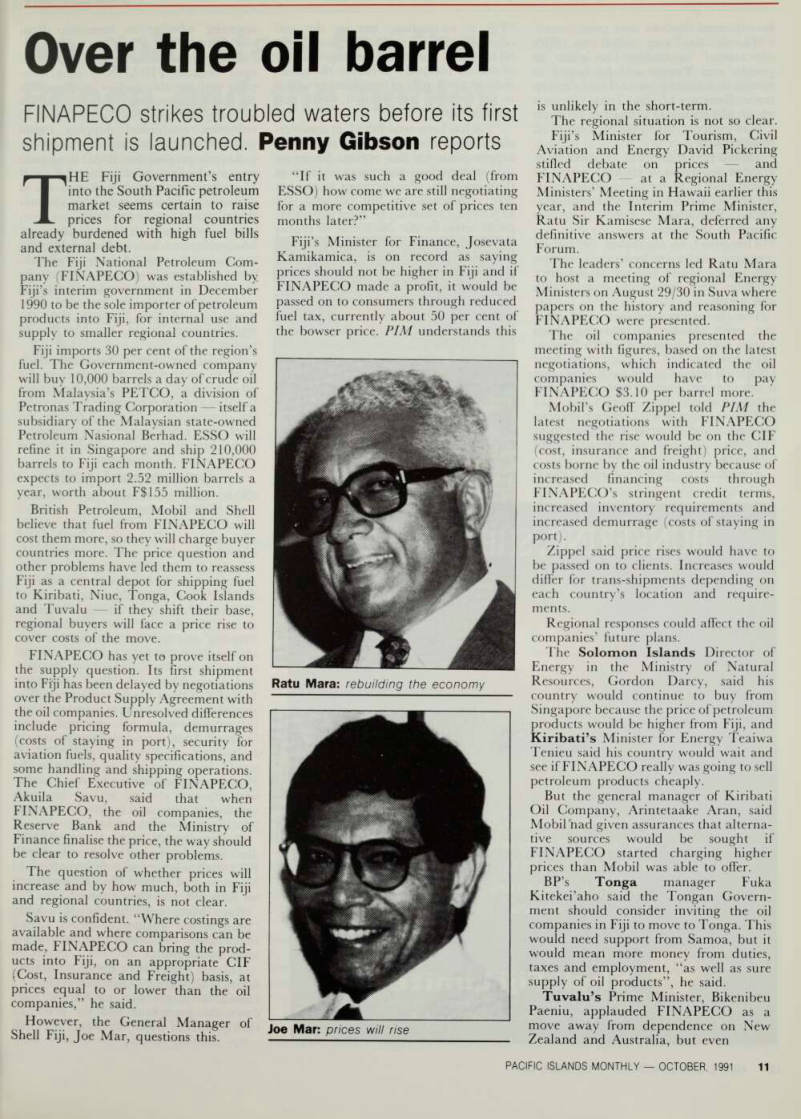
Ratu Mara: rebuilding the economy
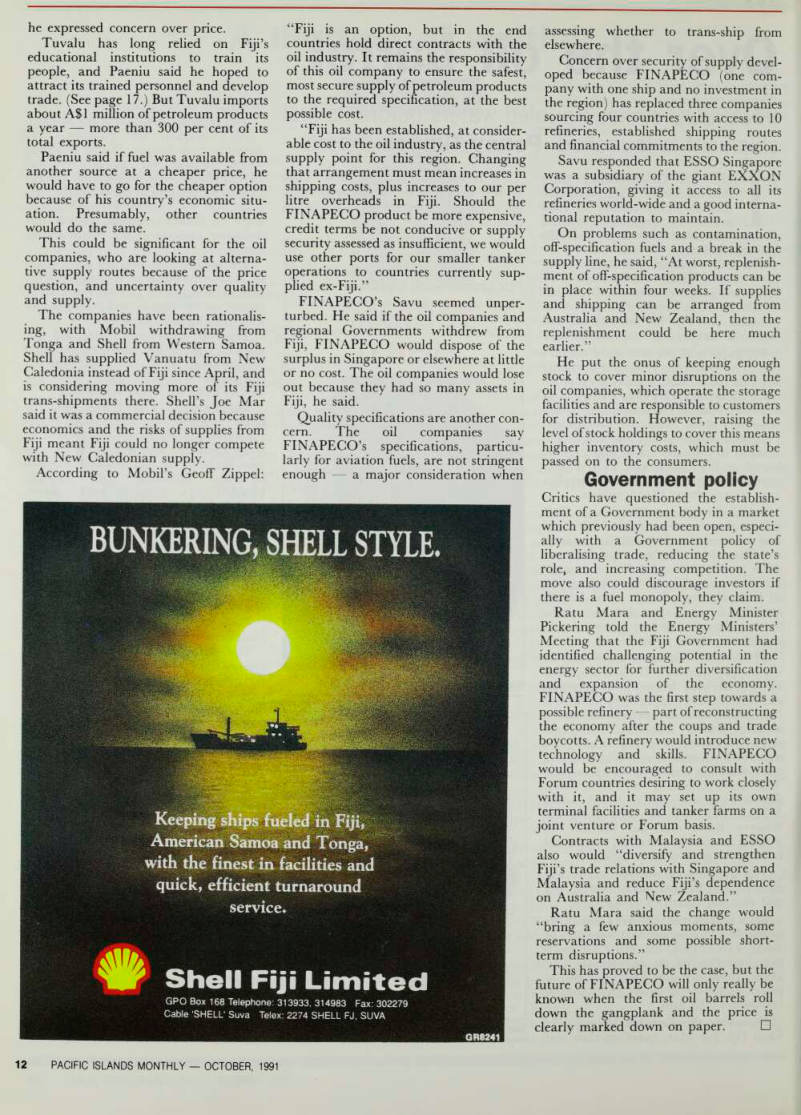
Joe Mar: prices will rise
he expressed concern over price.
Tuvalu has long relied on Fiji’s educational institutions to train its people, and Paeniu said he hoped to attract its trained personnel and develop trade. (See page 17.) But Tuvalu imports about ASI million of petroleum products a year more than 300 per cent of its total exports.
Paeniu said if fuel was available from another source at a cheaper price, he would have to go for the cheaper option because of his country’s economic situ ation. Presumably, other countries would do the same.
This could be significant for the oil companies, who are looking at alterna tive supply routes because of the price question, and uncertainty over quality
and supply.
The companies have been rationalis ing, with Mobil withdrawing from Tonga and Shell from Western Samoa.
Shell has supplied Vanuatu from New Caledonia instead of Fiji since April, and is considering moving more of its Fiji trans-shipments there. Shell’s Joe Mar said it was a commercial decision because economics and the risks of supplies from Fiji meant Fiji could no longer compete with New Caledonian supply.
According to Mobil’s Geoff Zippel:
“Fiji is an option, but in the end countries hold direct contracts with the oil industry. It remains the responsibility of this oil company to ensure the safest, most secure supply of petroleum products to the required specification, at the best
possible cost.
“Fiji has been established, at consider able cost to the oil industry, as the central
supply point for this region. Changing
that arrangement must mean increases in shipping costs, plus increases to our per litre overheads in Fiji. Should the FINAPECO product be more expensive, credit terms be not conducive or supply security assessed as insufficient, we would use other ports for our smaller tanker operations to countries currently sup
plied ex-Fiji.”
FINAPECO’s Savu seemed unper turbed. He said if the oil companies and regional Governments withdrew from Fiji, FINAPECO would dispose of the surplus in Singapore or elsewhere at little or no cost. The oil companies would lose out because they had so many assets in Fiji, he said.
Quality specifications are another con cern. The oil companies say
FINAPECO’s specifications, particu
larly for aviation fuels, are not stringent enough a major consideration when
assessing whether to trans-ship from elsewhere.
Concern over security of supply devel oped because FINAPECO (one com pany with one ship and no investment in the region) has replaced three companies sourcing four countries with access to 10 refineries, established shipping routes and financial commitments to the region.
Savu responded that ESSO Singapore was a subsidiary of the giant EXXON Corporation, giving it access to all its refineries world-wide and a good interna tional reputation to maintain.
On problems such as contamination, off-specification fuels and a break in the supply line, he said, “At worst, replenish ment of off-specification products can be in place within four weeks. If supplies and shipping can be arranged from Australia and New Zealand, then the replenishment could be here much earlier.”
He put the onus of keeping enough stock to cover minor disruptions on the oil companies, which operate the storage facilities and are responsible to customers for distribution. However, raising the level of stock holdings to cover this means higher inventory costs, which must be passed on to the consumers.
Government policy
Critics have questioned the establish ment of a Government body in a market which previously had been open, especi ally with a Government policy of liberalising trade, reducing the state’s role, and increasing competition. The move also could discourage investors if there is a fuel monopoly, they claim.
Ratu Mara and Energy Minister Pickering told the Energy Ministers’
Meeting that the Fiji Government had identified challenging potential in the energy sector for further diversification and expansion of the economy.
FINAPECO was the first step towards a possible refinery part of reconstructing the economy after the coups and trade boycotts. A refinery would introduce new technology and skills. FINAPECO would be encouraged to consult with Forum countries desiring to work closely with it, and it may set up its own terminal facilities and tanker farms on a joint venture or Forum basis.
Contracts with Malaysia and ESSO also would “diversify and strengthen Fiji’s trade relations with Singapore and Malaysia and reduce Fiji’s dependence on Australia and New Zealand.”
Ratu Mara said the change would “bring a few anxious moments, some reservations and some possible short
term disruptions.”
This has proved to be the case, but the future of FINAPECO will only really be known when the first oil barrels roll down the gangplank and the price is clearly marked down on paper. □