Cable and Wireless
pp. 47-48 · Read in the full issue
loses its contract
By Angela MacCarthy
The Cook Islands government has successfully forced Cable and Wireless out and taken control of all telecommunications systems in the country. In a shock legislation, The Government of Geoffrey Henry has terminated the contract of Cable and Wireles PLC Company four years early.
The company’s Cook Islands man ager, Mick Blackwell, said he was informed of the Bill the day before it passed into legislation, and ho is per turbed by the “indecent haste, lack of consultation and effect it will have on the investment reputation of the Cook Islands.”
Henry said the Cable and Wire less contract was terminated in or der for the devel opment of the Cook Islands inter-island tele communications system to proceed.
Cable and Wire less PLC’s con tract gave them exclusive rights to provide and oper ate an interna tional system for 15 years, renew able for further
five-year periods
by mutual con sent. It did not include the devel opment of local or inter-island sys tems.
Henry’s gov
ernment pledged
during the 1989 elections to de velop the inter island systems within the first three years of gov
ernment. They
are halfway
through their
third year and the inter-island sys tem remains out dated and un
changed.
Rarotonga has
local and interna tional telecom munications sys tems with demand for telephone con
nections outstripp
ing supply. In the
13 outer islands, which consist of under half of the Cook Islands population, only Aitutaki and Mitiaro have a local telephone exchange. Inter-island com munication is through Peacesat or the Post Office radio telephone system which breaks the voice signal so much that it is received garbled and difficult to under stand.
This is due to be changed by a new national telecommunications company, Telecom Cook Islands (TCI). TCI is to integrate the administration of the local and international systems by taking over Cable and Wireless and the Post Office.
It is to be financed by a USS 7.9 million loan granted by the Asian Development Bank (ADB) and the Export Credit Finance Organisation of Australia.
The loan has been given to upgrade facilities and communications on the outer islands. TCI say revenue from telecommunications should cover loan repayments. Other sources say that the national system can’t pay for itself that the international system is needed to subsidise it, and that is a major reason why the Cable and Wireless contract has been terminated.
TCI has been in the making for the past two years. When the Cook Islands Party became government in 1989, they discussed with Cable and Wireless the possibility of extending their services to cover national telecommunications.
Cable and Wireless presented a dis cussion document involving a joint venture with government, only to find that government had also put out a competitive tender for the task a tender that Telecom Network Interna tional (TNI) eventually won with a 40/60 joint venture bid.
TCI is the company resulting from that joint venture agreement with gov ernment. TNI, which is the international division of New Zealand Telecom, is owned by the American companies, Bell Atlantic and Americtech, and New Zealand companies, Freight ways Hold ings and Fay Richwaite. An Australian company, OTCI, which was involved with TNI in the original negotiation for Telecom Cook Islands, pulled out once they realised that Government intended to end the Cable and Wireless contract.
TNI signed a memorandum of under standing with government in 1989.
Shortly after, government asked Cable and Wireless to terminate their contract early. Cable and Wireless refused. “We told them then that we were not in the business of trading franchise but are in the business of telecommunications,” said Cable and Wireless Regional Direc tor, Peter Jackson. “We are a commer cial company so when our proposal for a national system was rejected we accepted that and we stated that we would continue to provide our service and improve it where we could.”
Prime Minister Henry said Cable and Wireless should have realised that if their tender didn’t win they would be out because the tender was for an integrated domestic and international system to be in place by 1993. Said he: “There was a clear understanding that I wanted the upgrading all finished by the end of 1993.
I wanted the outer islands to be able to watch on TV the 1992 Festival we’re
hosting.”
According to Henry, TNFs agreement was based on the condition that the Cable and Wireless franchise would end so that they could get on with the development. “They (TNI) said that if we wanted to deal with them, if we liked their terms of revenue and their tech nology then we had to take the steps
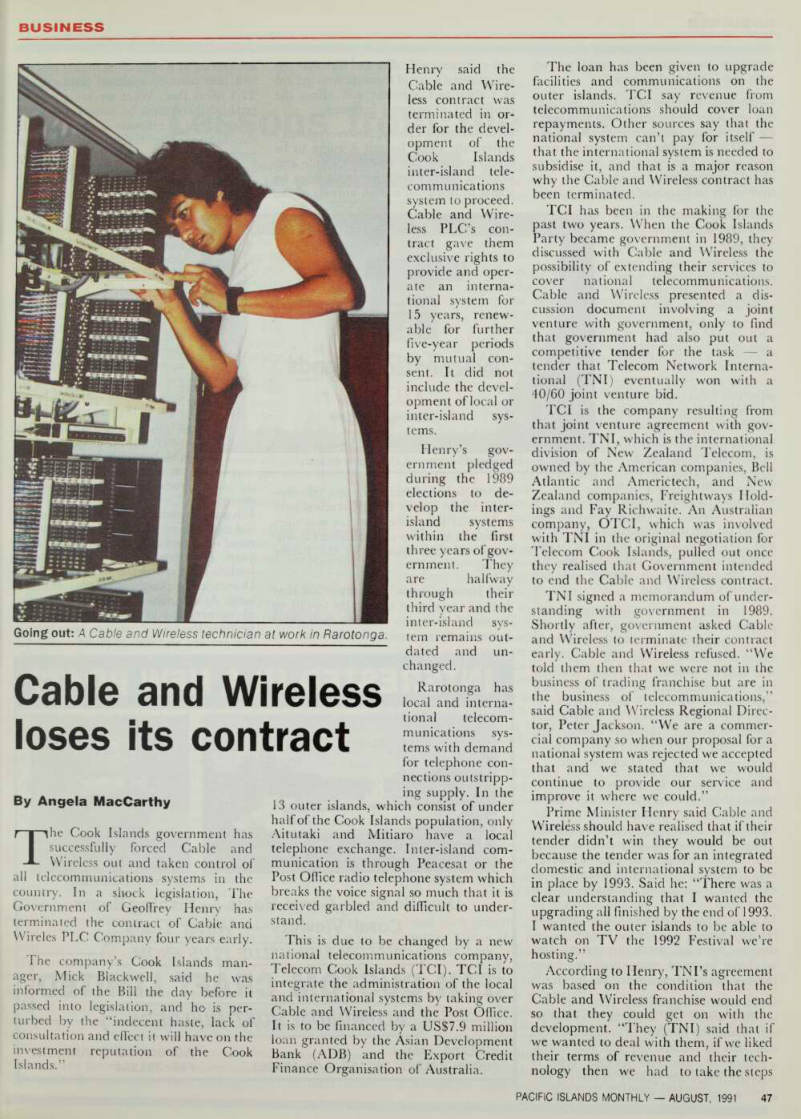
Going out: A Cable and Wireless technician at work In Rarotonga.
necessary to ensure they could get on with the job, said Henry.
Cable and Wireless said their contract did not have to be terminated in order for inter-island improvements to be done by TNI and the Post Office over the next four years. The company said interisland telecommunications were not covered by its franchise and other parties
were free to proceed in that area at any time.
The two parties have also clashed over royalty pay ments. They were orig inally set at 15 per cent with right of review every five years. Last year they were due for review and although both parties agreed on a maximum rise from 15 per cent to 22 per cent. But Government said its accountant, Arthur Anderson & Co., advised it to increase it to 75 per cent.
After lengthy debate gov ernment referred the mat
ter to arbitration. Royalties were not increased after the first five years of Cable and Wireless’s contract (1985) on the understanding that Cable and Wireless would introduce IDD (International Direct Dialling) and pro vide the necessary equipment into the local exchange. It did.
The two sides also have compensation payments to settle. The government will have to pay Cable and Wireless for their assets and loss of profits. Peter Jackson said that he believes the Prime Minister has been misinformed over the past efforts made by Cable and Wireless to help the development of inter-island communications. Jackson cannot see how Cable and Wireles’s early termin ation will benefit the Cook Islands.
“For government 1 can’t see the advan tage as they have to pay full compensatin for our loss of profits based on the significant investment we have made.
They get a business to run that needs capital, and we get our capital back,” said Jackson. “Telecommunications is expensive it is not profitable in the short term so we organise contracts of 15 20 years to ensure we receive our return which is made in the last years. To date we have not made our return, and we have invested more than we have taken so we need compensation for this.”
Government Opposition members are worried about the amount of compen sation and the expense of creating a new company to replace one that was doing; a satisfactory job. The business sector is worried about the quality of service the
new company will offer and fear that the government’s use of legislation to get rid and Wireless will affect the confldence of overseas investors.
Prime Minister Henry, however doesn’t believe the Cook Islands is going to be disadvantaged. He said that Cable and Wireless doesn’t have the technology he wants to bring his nation abreast of the
modern world outside He said telecom moaern won ° ou J He said telecommumcations for the Cook Islands should f° telephones and fax machines
an^d^TsvsteZ rlheTt ‘
j. ? d data s y stems for the Pacific re S lon * Said Henry: “I made up my mind that there is n 0 P° int in bein S able t 0 ,alk to * he world j fwe can’t talk to each other domestically or regionally. So what we
are looking at is upgrading so that we can link into planned regional connections.
TNI offers that. What we are going to establish here must be compatible with what is seen as ultimate in the region in the future. The Cable and Wireless proposal in 1989 didn’t take that into account and wouldn’t be compatible.”
“I don’t understand,” said Blackwell.
“Cable and Wireless is one of the leading telecommunica tions companies in the world. Only last year we wanted to move towards more modern transmission by introducing Intermediate Data Rate, without which the international service from here would have be come congested and de graded. Government told us they didn’t want us to bring it in. In the end we did bring it in, but government in sisted that it not be placed on the branch’s books. At the same time they say our technology isn’t good
enough?”
It is not clear why the Henry government did not adhere to the previous govern ment’s contract and wait out the last four years. The government said some Pacific leaders have sent letters of support.
Domestically people aren’t so enthusi astic. As compensation has to come out of government coffers, many wonder whether the rush is going to be worth all the anxiety and loss of money. □
Coming in: new telecom sign in the Cook Islands