making
p. 46 · Read in the full issue
Smile!
this one’s making money
By Martin Tiffany
FLASHING a broad smile at all present, Andrew Drysdale strode confi dently into the room. Looking every bit the executives’ executive, with crisp striped shirt and matching tie, the reason for the Air Pacific chiefs joy was soon to be revealed. The airline’s chairman, Gerald Barrack, followed closely on Drysdale’s heels into the company’s headquarters boardroom in Suva. He too
was smiling.
Members of the press present waiteo
expectantly.
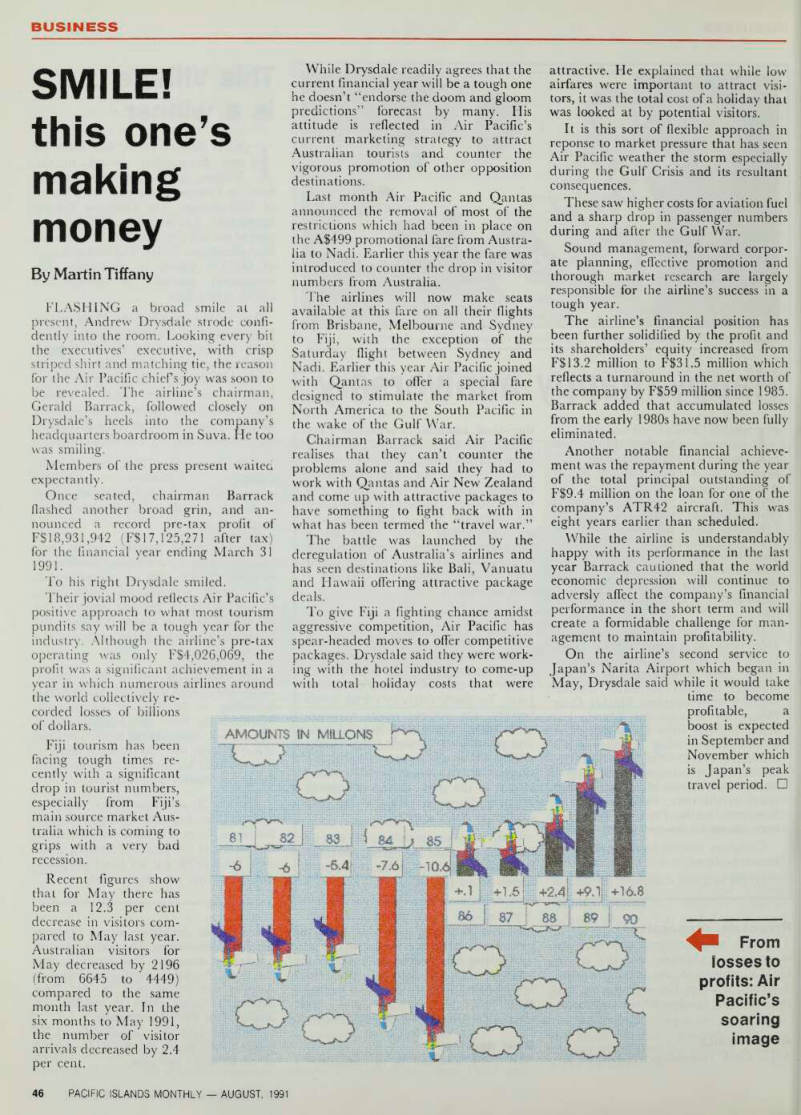
Once seated, chairman Barrack flashed another broad grin, and an nounced a record pre-tax profit of F$ 18,931,942 (F 517,125,271 after tax) for the financial year ending March 31 1991.
To his right Drysdale smiled.
Their jovial mood reflects Air Pacific’s positive approach to what most tourism pundits say will be a tough year for the industry. Although the airline’s pre-tax operating was only F 54,026,069, the profit was a significant achievement in a year in which numerous airlines around
the world collectively re corded losses of billions of dollars.
Fiji tourism has been facing tough times re cently with a significant drop in tourist numbers,
especially from Fiji’s
main source market Aus tralia which is coming to grips with a very bad recession.
Recent figures show that for May there has been a 12.3 per cent decrease in visitors com pared to May last year.
Australian visitors for
May decreased by 2196
(from 6645 to 4449) compared to the same month last year. In the six months to May 1991, the number of visitor arrivals decreased by 2.4 per cent.
While Drysdale readily agrees that the current financial year will be a tough one he doesn’t “endorse the doom and gloom predictions” forecast by many. His attitude is reflected in Air Pacific’s current marketing strategy to attract Australian tourists and counter the vigorous promotion of other opposition destinations.
Last month Air Pacific and Qantas announced the removal of most of the restrictions which had been in place on the A 5499 promotional fare from Austra lia to Nadi. Earlier this year the fare was introduced to counter the drop in visitor numbers from Australia.
The airlines will now make seats available at this fare on all their flights from Brisbane, Melbourne and Sydney to Fiji, with the exception of the Saturday flight between Sydney and Nadi. Earlier this year Air Pacific joined with Qantas to offer a special fare designed to stimulate the market from North America to the South Pacific in the wake of the Gulf W ar.
Chairman Barrack said Air Pacific realises that they can’t counter the problems alone and said they had to work with Qantas and Air New Zealand and come up with attractive packages to have something to fight back with in what has been termed the “travel war.”
The battle was launched by the deregulation of Australia’s airlines and has seen destinations like Bali, Vanuatu and Hawaii offering attractive package deals.
To give Fiji a fighting chance amidst aggressive competition, Air Pacific has spear-headed moves to offer competitive packages. Drysdale said they were work ing with the hotel industry to come-up with total holiday costs that were
attractive. He explained that while low airfares were important to attract visi tors, it was the total cost of a holiday that was looked at by potential visitors.
It is this sort of flexible approach in reponse to market pressure that has seen Air Pacific weather the storm especially during the Gulf Crisis and its resultant consequences.
These saw higher costs for aviation fuel and a sharp drop in passenger numbers during and after the Gulf War.
Sound management, forward corpor ate planning, effective promotion and thorough market research are largely responsible for the airline’s success in a tough year.
The airline’s financial position has been further solidified by the profit and its shareholders’ equity increased from F3U3.2 million to F 531.5 million which reflects a turnaround in the net worth of the company by FSS9 million since 1985.
Barrack added that accumulated losses from the early 1980 s have now been fully eliminated.
Another notable financial achieve ment was the repayment during the year of the total principal outstanding of F 59.4 million on the loan for one of the company’s ATR42 aircraft. This was eight years earlier than scheduled.
While the airline is understandably happy with its performance in the last year Barrack cautioned that the world economic depression will continue to adversly affect the company’s financial performance in the short term and will create a formidable challenge for man agement to maintain profitability.
On the airline’s second service to Japan’s Narita Airport which began in May, Drysdale said while it would take
time to become
profitable, a
boost is expected in September and November which
is Japan’s peak
travel period. □
From losses to profits: Air Pacific’s soaring image