Opening our eyes to blindness
p. 44 · Read in the full issue
Health
By Martin Tiffany
EIGHTY per cent of all blindness in the Pacific could be eliminated in the not too distant future.
Not by some miracle or a wonderful, new, expensive medical discovery but for the simple reason that 80 per cent of all blindness is preventable or curable.
The wheels are already in motion to prevent the preventable and cure the curable. In mid-May the Pacific Islands Council For Blind Persons (PIC) held its first annual general meeting in Suva, Fiji, which included a three-day planning session. Fiji, the Cook Islands, Papua New Guinea, Solomon Islands, Tonga, Vanuatu and Western Samoa and rep resentatives of the Australian South Pacific Eye Consultant Team (ASPECT) of Melbourne, the Christoffel- Blindenmission of Germany, Foresight of Australia, Hilton/Perkins International of the United States, the International Council for the Education of the Visually Handicapped regional office in Austra lia, and sponsors, Sight Savers of the
United Kingdom, took part.
Bill Winkley of Sight Savers has been in Suva for the past year working at establishing a permanent regional PIC
office there. An executive director and a training officer will be appointed for PIC soon and an office should be running by
January 1992.
PIC aims to ensure that needless blindness is prevented or corrected, and that incurably blind people receive appropriate education and rehabilitation
services. Organisational development
services, technical assistance, and staff training will be provided by PIC to government bodies and non-government organisations in member countries.
According to Winkley, they want to train locals of each country to run their own organisation and be self-sufficient under the guidance of PIC. He said in Vanuatu a non-doctor has been trained to do cataract surgery, and this was the answer for the other islands.
Winkley said that in PNG, where he spent four years, 5 per cent of the 4000 people tested had cataracts and 51 per cent of people in their 50s had them. The situation was similar in the Solomons because people took for granted that when you got old, you went blind, he said. An estimated 20 million people world-wide are made blind by cataracts, yet this kind ofblindness can be relatively
easily cured by operations.
However, education in basic hygiene and a good diet also works wonders.
In Kiribati, lack of Vitamin A has led to blindness, mainly because Kiribati was an atoll and vegetables containing Vitamin A couldn’t be grown there, he said. Vitamin A tablets are being distributed there, work will then be done to improve diet.
Another blinding disease is trachoma, associated with overcrowding and lack of hygiene and particularly clean water.
Better eye hygiene is needed.
Apart from Fiji and PNG, services for blind people in the Pacific are minimal.
PIC wants to deinstitutionalise blind ness, and break down stereotypes of the blind as useless through schemes such as teacher training for integrated educa tion. PIC wants to conduct community based rehabilitation so blind children can be taught skills appropriate to their living environment, not be taken off to some institution to learn irrelevant skills.
PlC’s aim is organisation, develop ment and training which will begin with primary eye care. Its most effective strategies will be to invest in “people power”. They help to train local people, from villagers to hospital staff, who will give a lifetime of service to their communities. A number of the council members are blind and preference will be given to blind people and/or those experienced in providing services to the blind or those at risk, when PlC’s executive director is chosen.
The new slogan for their 1991 cam paign is “Please don’t turn a blind eye.”
PIC is proving that it, at least, certainly is not doing that. □
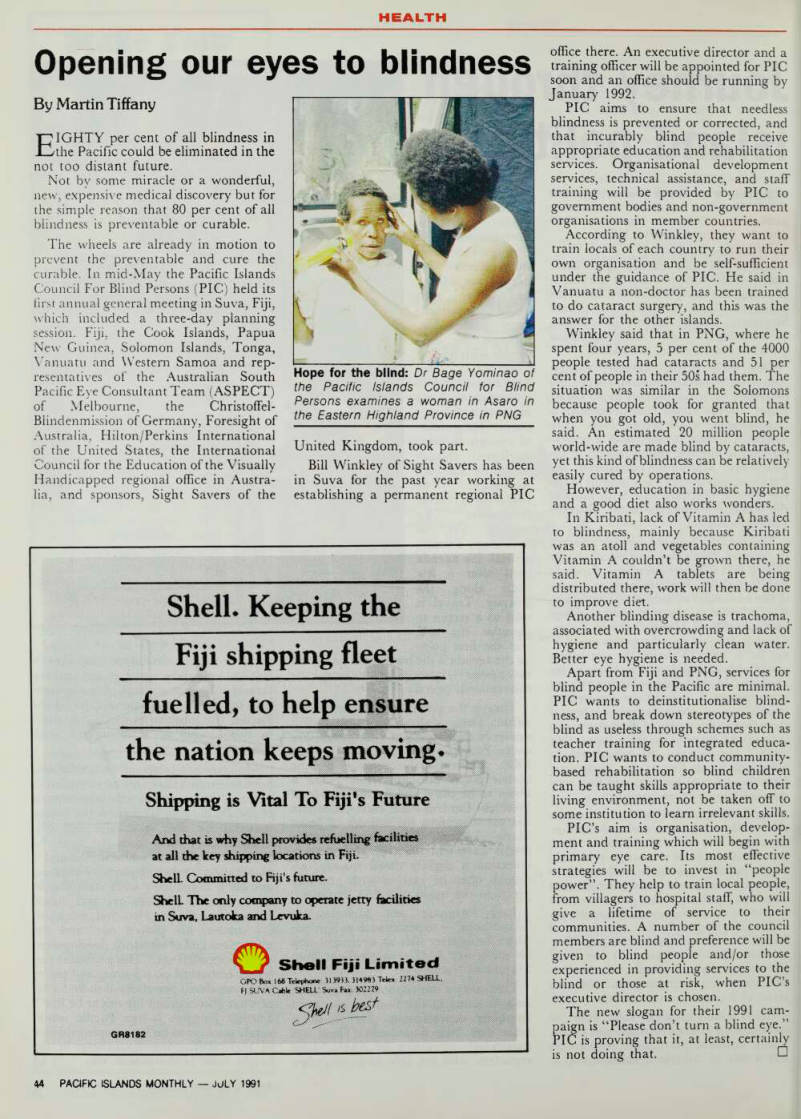
Hope for the blind: Dr Bage Yominao of the Pacific Islands Council for Blind Persons examines a woman in Asaro in the Eastern Highland Province in PNG