Journey through
p. 43 · Read in the full issue
Books
Journey through island politics
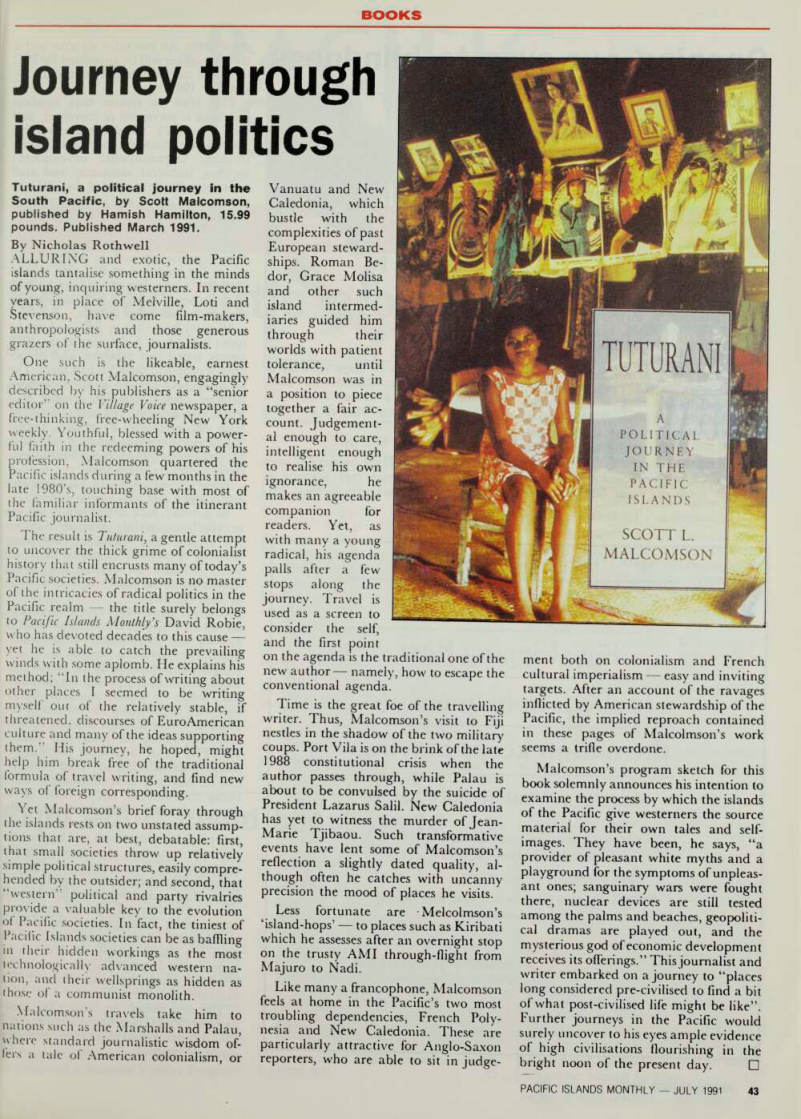
Tuturani, a political journey in the South Pacific, by Scott Malcomson, published by Hamish Hamilton, 15.99 pounds. Published March 1991.
By Nicholas Rothwell ALLURING and exotic, the Pacific islands tantalise something in the minds of young, inquiring westerners. In recent years, in place of Melville, Loti and Stevenson, have come film-makers, anthropologists and those generous grazers of the surface, journalists.
One such is the likeable, earnest American, Scott Malcomson, engagingly described by his publishers as a “senior editor’ on the Village Voice newspaper, a
free-thinking, free-wheeling New York
weekly. Youthful, blessed with a power ful faith in the redeeming powers of his profession, Malcomson quartered the Pacific islands during a few months in the late I9Bo’s, touching base with most of the familiar informants of the itinerant Pacific journalist.
The result is Tnturani , a gentle attempt to uncover the thick grime of colonialist history that still encrusts many of today’s Pacific societies. Malcomson is no master of the intricacies of radical politics in the Pacific realm the title surely belongs to Pacific Islands Monthly's David Robie, who has devoted decades to this cause yet he is able to catch the prevailing winds with some aplomb. He explains his method; “In the process of writing about other places I seemed to be writing myself our of the relatively stable, if threatened, discourses of EuroAmerican culture and many of the ideas supporting
them.’’ His journey, he hoped, might
help him break free of the traditional formula of travel writing, and find new
ways of foreign corresponding.
\ et Malcomson’s brief foray through the islands rests on two unstated assump tions that are, at best, debatable: first, that small societies throw up relatively simple political structures, easily compre hended by the outsider; and second, that “western” political and party rivalries provide a valuable key to the evolution of Pacific societies. In fact, the tiniest of Pacific Islands societies can be as baffling in their hidden workings as the most technologically advanced western na tion, and their wellsprings as hidden as those ol a communist monolith.
Malcomson’s travels take him to nations such as the Marshalls and Palau, where standard journalistic wisdom of fers a talc of American colonialism, or
Vanuatu and New Caledonia, which bustle with the complexities of past
European steward
ships. Roman Be dor, Grace Molisa and other such island intermed iaries guided him through their worlds with patient tolerance, until Malcomson was in a position to piece together a fair ac count. Judgement al enough to care, intelligent enough to realise his own
ignorance, he
makes an agreeable companion for readers. Yet, as with many a young radical, his agenda palls after a few stops along the journey. Travel is used as a screen to consider the self, and the first point
on the agenda is the traditional one of the new author — namely, how to escape the conventional agenda.
Time is the great foe of the travelling writer. Thus, Malcomson’s visit to Fiji nestles in the shadow of the two military coups. Port Vila is on the brink of the late 1988 constitutional crisis when the author passes through, while Palau is about to be convulsed by the suicide of President Lazarus Salil. New Caledonia has yet to witness the murder of Jean- Marie Tjibaou. Such transformative events have lent some of Malcomson’s reflection a slightly dated quality, al though often he catches with uncanny precision the mood of places he visits.
Less fortunate are Melcolmson’s ‘island-hops’ to places such as Kiribati which he assesses after an overnight stop on the trusty AMI through-flight from Majuro to Nadi.
Like many a francophone, Malcomson feels at home in the Pacific’s two most troubling dependencies, French Poly nesia and New Caledonia. These are particularly attractive for Anglo-Saxon reporters, who are able to sit in judge-
ment both on colonialism and French cultural imperialism easy and inviting targets. After an account of the ravages inflicted by American stewardship of the Pacific, the implied reproach contained * n these pages of Malcolmson’s work seems a trifle overdone. \ii>, , - , .
Malcomson s program sketch for this b °° k S ° le ,T nly his intention to T b >’. whlch ,be lslands
R' T' At
materlal ,h . °'™ ‘ a *f and self lmag*s - T J? e Y hav< - been, he says, a Pf ovlder Peasant white myths and a P la Yground for ,he symptoms of unplcas a"‘ ones; san g u ‘ nar y war s were fought there, nuclear devices are still tested among the palms and beaches, geopoliti- C al dramas are played out, and the mys , er ious god of economic development receivcs its offerings,” This journalist and writer embarked on a journey to “places long considered pre-civilised to find a bit of what post-civilised life might be like”, Further journeys in the Pacific would surely uncover to his eyes ample evidence of high civilisations flourishing in the bright noon of the present day. □