Safe bet on tourism
pp. 25-26 · Read in the full issue
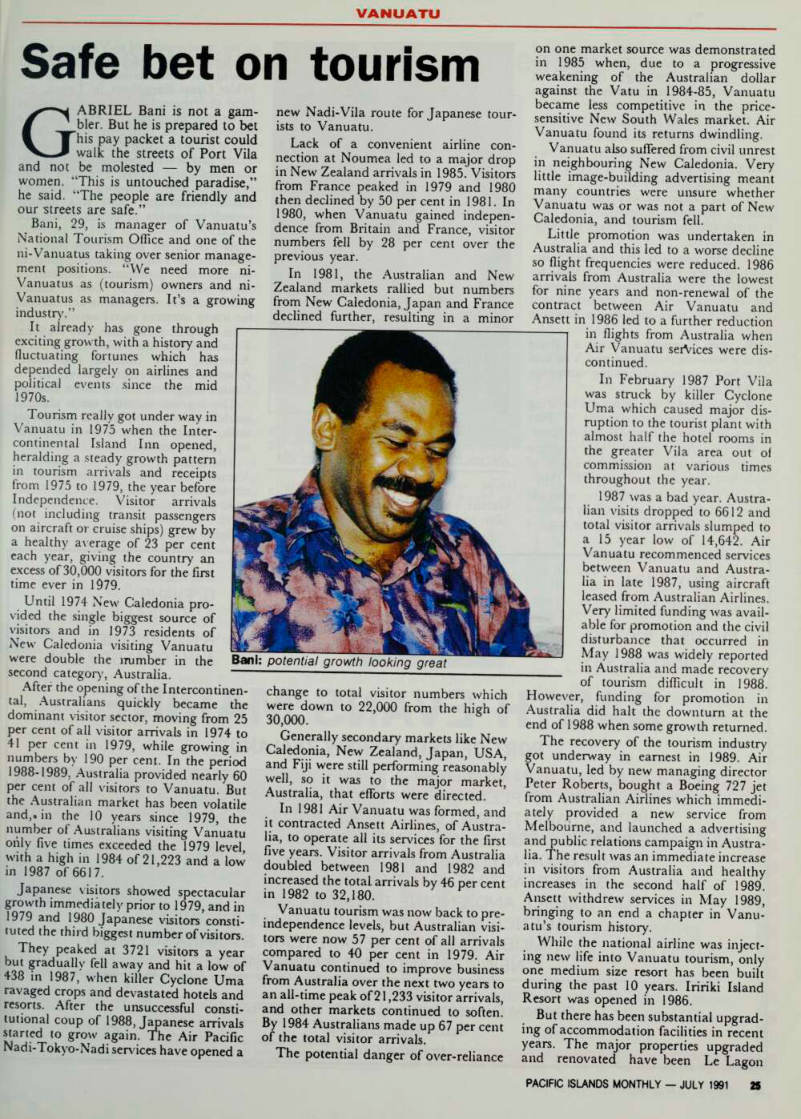
GABRIEL Bani is not a gam bler. But he is prepared to bet his pay packet a tourist could walk the streets of Port Vila and not be molested by men or women. “This is untouched paradise,” he said. “The people are friendly and our streets are safe.”
Bani, 29, is manager of Vanuatu’s National Tourism Office and one of the ni-Vanuatus taking over senior manage ment positions. “We need more ni- Vanuatus as (tourism) owners and ni- Vanuatus as managers. It’s a growing industry.”
It already has gone through exciting growth, with a history and fluctuating fortunes which has depended largely on airlines and political events since the mid 19705.
Tourism really got under way in Vanuatu in 1975 when the Inter continental Island Inn opened, heralding a steady growth pattern in tourism arrivals and receipts from 1975 to 1979, the year before Independence. Visitor arrivals (not including transit passengers on aircraft or cruise ships) grew by a healthy average of 23 per cent each year, giving the country an excess of 30,000 visitors for the first time ever in 1979.
Until 1974 New Caledonia pro vided the single biggest source of visitors and in 1973 residents of New Caledonia visiting Vanuatu were double the irumber in the second category, Australia.
After the opening of the Intercontinen tal, Australians quickly became the dominant visitor sector, moving from 25 per cent of all visitor arrivals in 1974 to 41 per cent in 1979, while growing in numbers by 190 per cent. In the period 1988-1989. Australia provided nearly 60 per cent of all visitors to Vanuatu. But the Australian market has been volatile and,, in the 10 years since 1979, the number of Australians visiting Vanuatu only five times exceeded the 1979 level with a high in 1984 of 21,223 and a low in 1987 of 6617.
Japanese visitors showed spectacular growth immediately prior to 1979, and in 1979 and 1980 Japanese visitors consti tuted the third biggest number of visitors.
They peaked at 3721 visitors a year but gradually fell away and hit a low of 438 in 1987, when killer Cyclone Uma ravaged crops and devastated hotels and resorts. After the unsuccessful consti tutional coup of 1988, Japanese arrivals started to grow again. The Air Pacific Nadi-Tokyo-Nadi sendees have opened a
new Nadi-Vila route for Japanese tour ists to Vanuatu.
Lack of a convenient airline con nection at Noumea led to a major drop in New Zealand arrivals in 1985. Visitors from France peaked in 1979 and 1980 then declined by 50 per cent in 1981. In 1980, when Vanuatu gained indepen dence from Britain and France, visitor numbers fell by 28 per cent over the previous year.
In 1981, the Australian and New Zealand markets rallied but numbers from New Caledonia, Japan and France declined further, resulting in a minor
change to total visitor numbers which were down to 22,000 from the high of 30,000. 5 Generally secondary markets like New Caledonia, New Zealand, Japan, USA, and Fiji were still performing reasonably well, so it was to the major market, Australia, that efforts were directed.
In 1981 Air Vanuatu was formed, and it contracted Ansett Airlines, of Austra lia, to operate all its sendees for the first five years. Visitor arrivals from Australia doubled between 1981 and 1982 and increased the total arrivals by 46 per cent in 1982 to 32,180.
Vanuatu tourism was now back to pre independence levels, but Australian visi tors were now 57 per cent of all arrivals compared to 40 per cent in 1979. Air Vanuatu continued to improve business from Australia over the next two years to an all-time peak 0f21,233 visitor arrivals, and other markets continued to soften.
By 1984 Australians made up 67 per cent of the total visitor arrivals.
The potential danger of over-reliance
on one market source was demonstrated in 1985 when, due to a progressive weakening of the Australian dollar against the Vatu in 1984-85, Vanuatu became less competitive in the price sensitive New South Wales market. Air Vanuatu found its returns dwindling.
Vanuatu also suffered from civil unrest in neighbouring New Caledonia. Very
little image-building advertising meant
many countries were unsure whether Vanuatu was or was not a part of New Caledonia, and tourism fell.
Little promotion was undertaken in Australia and this led to a worse decline so flight frequencies were reduced. 1986 arrivals from Australia were the lowest for nine years and non-renewal of the contract between Air Vanuatu and Ansett in 1986 led to a further reduction
in flights from Australia when Air Vanuatu services were dis continued.
In February 1987 Port Vila was struck by killer Cyclone Uma which caused major dis ruption to the tourist plant with almost half the hotel rooms in the greater Vila area out of commission at various times throughout the year. 1987 was a bad year. Austra lian visits dropped to 6612 and total visitor arrivals slumped to a 15 year low of 14,642. Air Vanuatu recommenced services between Vanuatu and Austra lia in late 1987, using aircraft leased from Australian Airlines.
Very limited funding was avail able for promotion and the civil disturbance that occurred in May 1988 was widely reported in Australia and made recovery of tourism difficult in 1988.
However, funding for promotion in Australia did halt the downturn at the end of 1988 when some growth returned.
The recovery of the tourism industry got underway in earnest in 1989. Air Vanuatu, led by new managing director Peter Roberts, bought a Boeing 727 jet from Australian Airlines which immedi ately provided a new service from Melbourne, and launched a advertising and public relations campaign in Austra lia. The result was an immediate increase in visitors from Australia and healthy increases in the second half of 1989.
Ansett withdrew services in May 1989, bringing to an end a chapter in Vanu atu’s tourism history.
While the national airline was inject ing new life into Vanuatu tourism, only one medium size resort has been built during the past 10 years. Iririki Island Resort was opened in 1986.
But there has been substantial upgrad ing of accommodation facilities in recent years. The major properties upgraded and renovated have been Le Lagon
Bani: potential growth looking great
Pacific Resort, the Solaise International Hotel, Erakor Island Resort and the Hotel Santo. The high standard of restaurants in the country has been maintained. 1989 was a year of substantial achieve ments pointing to future development; □ Air Vanuatu acquired its own aircraft and commenced a major tele vision promotion in Australia.
C Air Vanuatu put into effect a public relations campaign that has strengthened the positive image of Vanu atu overseas.
G Air Vanuatu started direct ser vices between Melbourne and Vila, re started services from Sydney and, later in the year, re-started the former Ansett operated link from Sydney via Brisbane to Vila. • Air Vanuatu started a direct service between Auckland and Vila and launched a strong advertising campaign in New Zealand. • A contract was let for the building of a new passenger terminal at Port Vila’s Bauerfield International Airport. • It was agreed to upgrade Bauerfield to facilitate the movement of wide-body jets of the Boeing 767 type. piOO 12 It was agreed to upgrade Bauerfield facilities and provide modern navigational aids including a new control rower.
□ The National Tourism Office started work on a tourism development plan to cover the next 20 years.
Significant advances have been made
in the involvement of ni-Vanuatu in the tourism sector, who now own and manage accommodation properties like White Grass Bungalows in Tanna, the local government-owned and managed Jaranmole Bungalows in Santo and the recently opened Talimoru Hotel in Vila.
There is the fledgling resort at Lokalei in Santo and several privately owned and managed guest houses. The Mele Trust manages and part-owns Hideaway Island Resort and there is a locally owned restaurant in North Efate, the
Nagar.
As part of the government policy to maximise ni-Vanuatu participation in tourism the government acquired a major shareholding in Tour Vanuatu which handles reservations and services for many overseas travel agents.
In the past three years, the National Tourism Office has established offices in Australia, New Zealand and North America. It has representatives in the United Kingdom and Western Europe.
The tourism industry needs planned guidelines for growth in pla'nt and people skills, a responsibility shared by public and private sectors.
The future of tourism development is Vanuatu is, as previously, tied to airline services and political events. “The future looks great,” said Bani. “The potential is there.”
Better still it’s safe. □
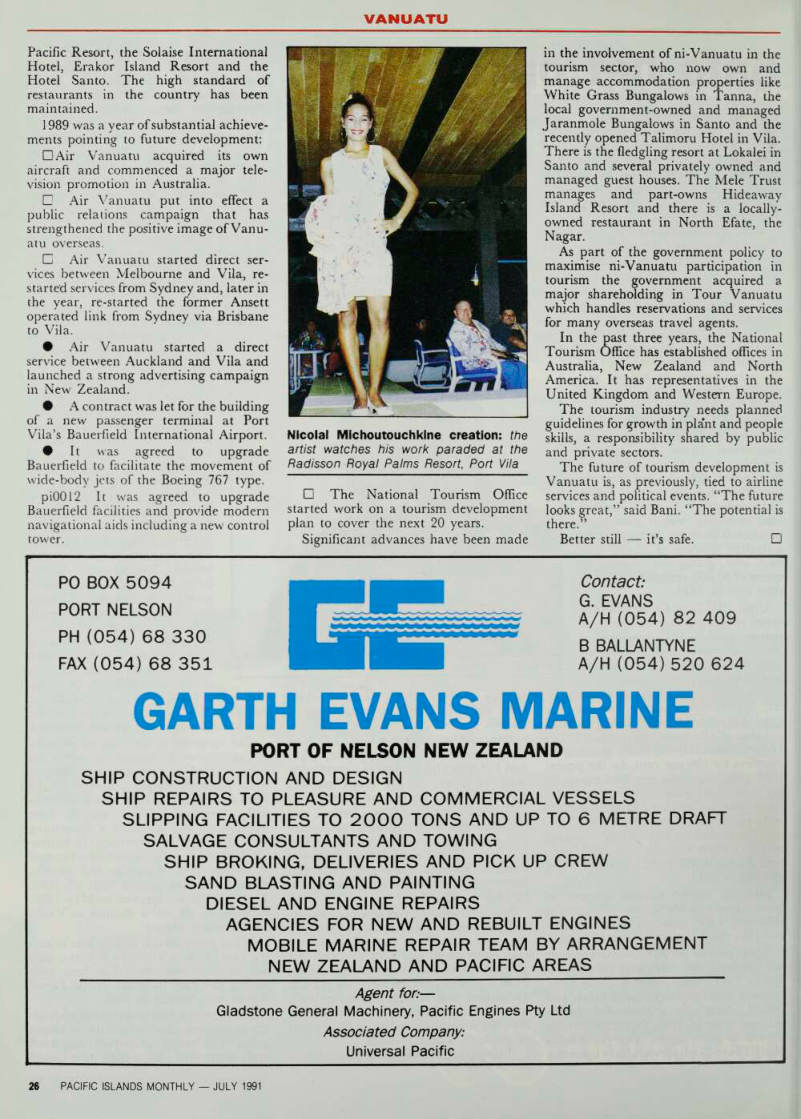
Nicolai Michoutouchkine creation: the artist watches his work paraded at the Radisson Royal Palms Resort, Port Vila