Shaping up for a showdown
pp. 18-23 · Read in the full issue
Vanuatu
After 11 years of power, Vanuatu’s ruling Vanua'aku Pali is deeply divided over the nation’s leadership. Prime Minister Walter Lini may now face his toughest hurdle.
David Robie reports.
EVER since the April congress of Vanuatu’s ruling Van ua’aku on Aneityum Island, Prime Minister Father Walter Hadye Lini has been smarting.
Even though a vote on the leadership issue had been deferred by a reasonably decisive margin, the extent of opposition and. even open lobbying against him rankled with the Prime Minister.
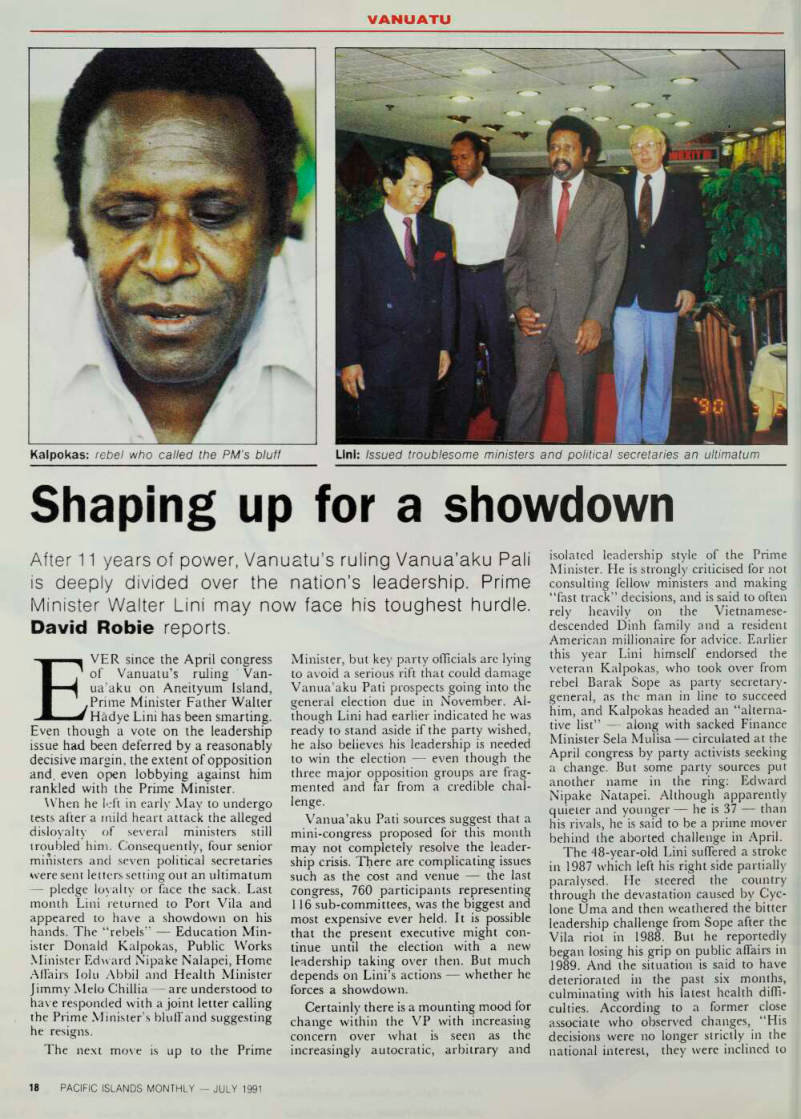
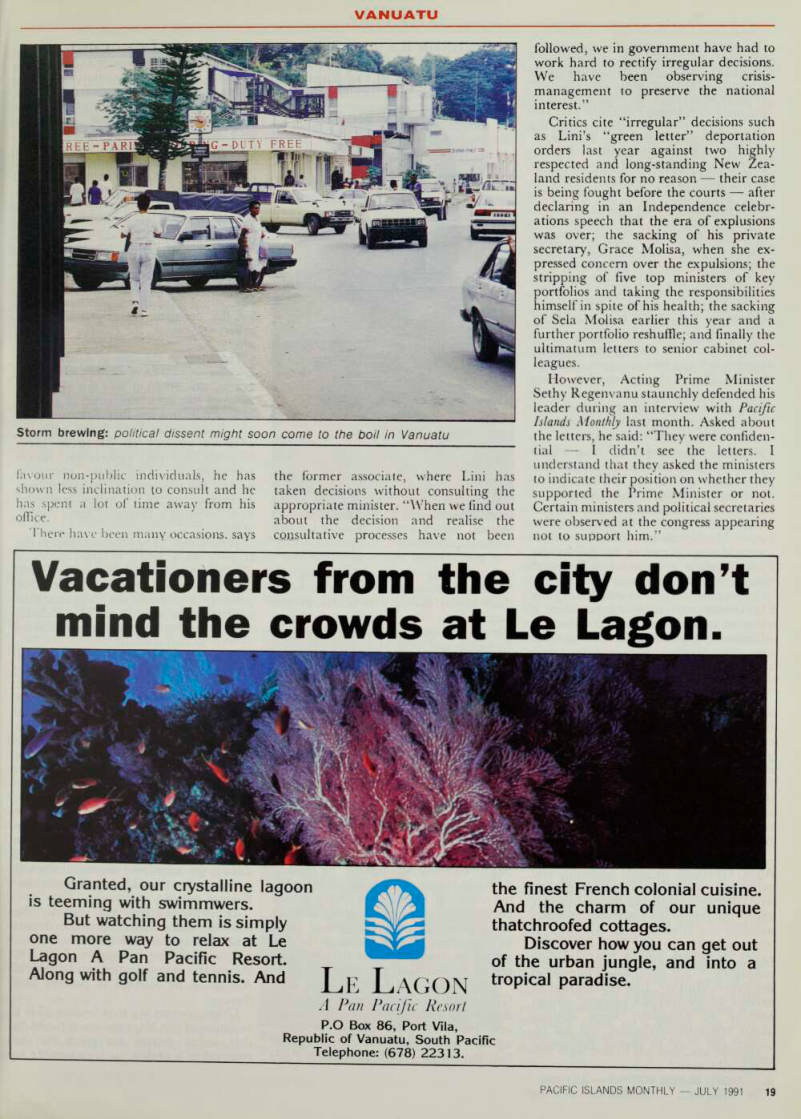
When he left in early May to undergo tests after a mild heart attack the alleged disloyalty of several ministers still troubled him. Consequently, four senior ministers and seven political secretaries were sent letters setting out an ultimatum pledge loyalty or face the sack. Last month Lini returned to Port Vila and appeared to have a showdown on his hands. The “rebels” Education Min ister Donald Kalpokas, Public Works Minister Edward Nipake Nalapei, Home Affairs loin Abbil and Health Minister jimmy Melo Chillia are understood to have responded with a joint letter calling the Prime Minister’s bluffand suggesting
he resigns.
The next move is up to the Prime
Minister, but key party officials are lying to avoid a serious rift that could damage Vanua’aku Pati prospects going into the general election due in November. Al though Lini had earlier indicated he was ready to stand aside if the party wished, he also believes his leadership is needed to win the election - even though the three major opposition groups are frag and far fr ° m a credlble chal *
lenge.
Vanua’aku Pati sources suggest that a mini-congress proposed for this month may not completely resolve the leader ship crisis. There are complicating issues such as the cost and venue the last
congress, 760 participants representing
116 sub-committees, was the biggest and most expensive ever held. It is possible that the present executive might con tinue until the election with a new leadership taking over then. But much depends on Lini’s actions whether he forces a showdown.
Certainly there is a mounting mood for change within the VP with increasing concern over what is seen as the increasingly autocratic, arbitrary and
isolated leadership style of the Prime Minister. He is strongly criticised for not consulting fellow ministers and making “fast track” decisions, and is said to often rely heavily on the Vietnamese descended Dinh family and a resident American millionaire for advice. Earlier this year Lini himself endorsed the veteran Kalpokas, who took over from rebel Barak Sope as party secretary general, as the man in line to succeed him, and Kalpokas headed an “alterna tive list” along with sacked Finance Minister Sela Mulisa circulated at the April congress by party activists seeking a change. But some party sources put another name in the ring: Edward
Nipake Natapei. Although apparently
quieter and younger he is 37 than his rivals, he is said to be a prime mover behind the aborted challenge in April.
The 48-year-old Lini suffered a stroke in 1987 which left his right side partially paralysed. He steered the country through the devastation caused by Cyc lone Uma and then weathered the bitter
leadership challenge from Sope after the
Vila riot in 1988. But he reportedly began losing his grip on public affairs in 1989. And the situation is said to have deteriorated in the past six months, culminating with his latest health diffi culties. According to a former close associate who observed changes, “His decisions were no longer strictly in the national interest, they were inclined to
Kalpokas: rebel who called the PM's bluff
Lini: Issued troublesome ministers and political secretaries an ultimatum
lav oui non-public individuals, he has shown less inclination to consult and he has spent a lot of time away from his °^ ce There have been many occasions, says
the former associate, where Lain has taken decisions without consulting the appropriate minister. “When we find out about the decision and realise the consultative processes have not been
followed, we in government have had to work hard to rectify irregular decisions.
We have been observing crisis management to preserve the national interest.”
Critics cite “irregular” decisions such as Lini’s “green letter” deportation orders last year against two highly respected and long-standing New Zea land residents for no reason their case is being fought before the courts after declaring in an Independence celebr ations speech that the era of explusions was over; the sacking of his private secretary, Grace Molisa, when she ex pressed concern over the expulsions; the stripping of five top ministers of key portfolios and taking the responsibilities himself in spite of his health; the sacking of Sela Molisa earlier this year and a further portfolio reshuffle; and finally the ultimatum letters to senior cabinet col
leagues.
However, Acting Prime Minister Sethy Regenvanu staunchly defended his leader during an interview with Pacific Islands Monthly last month. Asked about the letters, he said; “They were confiden tial I didn’t see the letters. I understand that they asked the ministers to indicate their position on whether they supported the Prime Minister or not.
Certain ministers and political secretaries were observed at the congress appearing not to support him.”
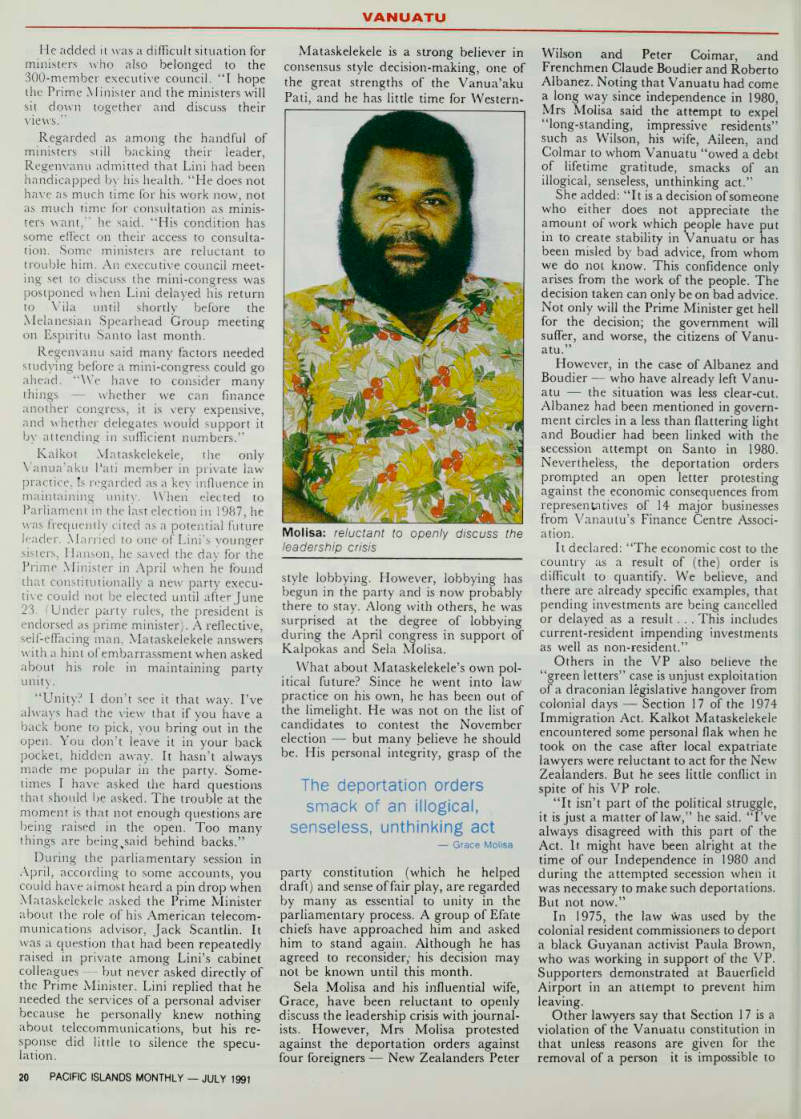
Storm brewing: political dissent might soon come to the boil in Vanuatu
He added it was a difficult situation for ministers who also belonged to the 300-member executive council. “I hope the Prime Minister and the ministers will sit down together and discuss their views.”
Regarded as among the handful of ministers still backing their leader, Regenvanu admitted that Lini had been handicapped by his health. “He does not have as much time for his work now, not as much time for consultation as minis ters want,” he said. “His condition has some effect on their access to consulta tion. Some ministers are reluctant to trouble him. An executive council meet ing set to discuss the mini-congress was postponed when Lini delayed his return to Vila until shortly before the Melanesian Spearhead Group meeting on Espiritu Santo last month.
Regenvanu said many factors needed studying before a mini-congress could go ahead. “We have to consider many things whether we can finance another congress, it is very expensive, and whether delegates would support it by attending in sufficient numbers.”
Kalkot Mataskelekele, the only Vanua’aku Pati member in private law practice, Is regarded as a key influence in maintaining unity. When elected to Parliament in the last election in 1987, he was frequently cited as a potential future leader. Married to one ofLini’s younger sisters, Hanson, he saved the day for the Prime Minister in April when he found that constitutionally a new party execu tive could not be elected until after June 23. (Under party rules, the president is endorsed as prime minister). A reflective, self-effacing man, Mataskelekele answers with a hint of embarrassment when asked about his role in maintaining party
unity.
“Unity? I don’t see it that way. I’ve always had the view that if you have a back bone to pick, you bring out in the open. You don’t leave it in your back pocket, hidden away. It hasn’t always made me popular in the party. Some times I have asked the hard questions that should be asked. The trouble at the moment is that not enough questions are being raised in the open. Too many things are being s said behind backs.”
During the parliamentary session in April, according to some accounts, you could have almost heard a pin drop when Mataskelekele asked the Prime Minister about the role of his American telecom munications advisor, Jack Scantlin. It was a question that had been repeatedly raised in private among Lini’s cabinet colleagues but never asked directly of the Prime Minister. Lini replied that he needed the services of a personal adviser because he personally knew nothing about telecommunications, but his re sponse did little to silence the specu lation.
Mataskelekele is a strong believer in consensus style decision-making, one of the great strengths of the Vanua’aku Pati, and he has little time for Western-
style lobbying. However, lobbying has begun in the party and is now probably there to stay. Along with others, he was
surprised at the degree of lobbying
during the April congress in support of Kalpokas and Sela Molisa.
What about Mataskelekele’s own pol itical future? Since he went into law practice on his own, he has been out of the limelight. He was not on the list of candidates to contest the November election but many believe he should be. His personal integrity, grasp of the The deportation orders smack of an illogical,
senseless, unthinking act
Grace Molisa party constitution (which he helped draft) and sense of fair play, are regarded by many as essential to unity in the parliamentary process. A group of Efate chiefs have approached him and asked him to stand again. Although he has agreed to reconsider,- his decision may not be known until this month.
Sela Molisa and his influential wife, Grace, have been reluctant to openly discuss the leadership crisis with journal ists. However, Mrs Molisa protested
against the deportation orders against
four foreigners New Zealanders Peter
Wilson and Peter Coimar, and Frenchmen Claude Boudier and Roberto Albanez. Noting that Vanuatu had come a long way since independence in 1980, Mrs Molisa said the attempt to expel
“long-standing, impressive residents”
such as Wilson, his wife, Aileen, and Colmar to whom Vanuatu “owed a debt of lifetime gratitude, smacks of an
illogical, senseless, unthinking act.”
She added: “It is a decision of someone who either does not appreciate the amount of work which people have put in to create stability in Vanuatu or has been misled by bad advice, from whom we do not know. This confidence only arises from the work of the people. The decision taken can only be on bad advice.
Not only will the Prime Minister get hell for the decision; the government will suffer, and worse, the citizens of Vanu atu.”
However, in the case of Albanez and Boudier who have already left Vanu atu the situation was less clear-cut.
Albanez had been mentioned in govern ment circles in a less than flattering light and Boudier had been linked with the secession attempt on Santo in 1980.
Nevertheless, the deportation orders prompted an open letter protesting against the economic consequences from representatives of 14 major businesses from Vanautu’s Finance Centre Associ ation.
It declared: “The economic cost to the country as a result of (the) order is difficult to quantify. We believe, and there are already specific examples, that pending investments are being cancelled or delayed as a result. . . This includes current-resident impending investments as well as non-resident.”
Others in the VP also believe the “green letters” case is unjust exploitation of a draconian legislative hangover from colonial days Section 17 of the 1974 Immigration Act. Kalkot Mataskelekele encountered some personal flak when he took on the case after local expatriate lawyers were reluctant to act for the New Zealanders. But he sees little conflict in spite of his VP role.
“It isn’t part of the political struggle, it is just a matter of law,” he said. “I’ve always disagreed with this part of the Act. It might have been alright at the time of our Independence in 1980 and during the attempted secession when it was necessary to make such deportations.
But not now.”
In 1975, the law was used by the colonial resident commissioners to deport a black Guyanan activist Paula Brown, who was working in support of the VP.
Supporters demonstrated at Bauerfield Airport in an attempt to prevent him
leaving.
Other lawyers say that Section 17 is a violation of the Vanuatu constitution in that unless reasons are given for the removal of a person it is impossible to
Molisa: reluctant to openly discuss the leadership crisis
be given a fair hearing, and that it prevents the, action being challenged in court contran to constitutional right.
According to leading New Zealand civil rights barrister Patrick Finnigan who is representing Colmar and Wilson. “We accept the need for an order-for-removal power. But we say it should be exercised only in circumstances and in a form which permits the deportee to know the reasons why the order-for-removal power is exercised, and be afforded a right of appeal or review. The whole thrust of administrative law these days is to take away from governments and officials the right to exercise power without being subject to review on the basis of natural justice, in terms of what is known as the Anisminic principle (named after a case in Britain) particularly when people’s rights and freedoms are at stake.”
Finnigan flew to Vanuatu at the request of Colmar, Wilson and their solicitors last October during which time.an interim restraining order was imposed by the Supreme Court on Lini as Immigration Minister, prohibiting the deportation of the two New Zealanders pending a full court hearing. Following Finnigairs return to New Zealand, he was declared persona non grata by
principal immigration officer Gordon
Haines. Airlines flying to Vanuatu were also said to have been instructed not to allow Finnigan to travel to the country without a work permit.
Asked about this, Finnigan told Pacific Islands Monthly that he had not been officially notified of this action against him. When Finnigan originally applied for a temporary permit for legal practice to assist Mataskelekele conduct the deportation case, he was turned down.
However, following submissions and a lull hearing, Acting Chief Justice Edwin Goldsborough issued a temporary prac tice certificate to Finnigan.
Peter and AHeen Wilson, now in their 50s, arrived in Vanuatu in 1971. A builder, Peter Wilson has built up a successful construction business, Wilco Modular, in partnership with another New Zealander, Roger Ovens (who is not being deported). They employ about 80 ni-Vanuatu. Peter Colmar left New Zealand for Vanuatu when he was aged 17. In two decades he has created a commercial "empire including cattle farms, abattoirs, cocoa and coffee plan tations and processing plants on Espiritu Santo. He employs about 500 ni- Vanuatu. Colmar’s ni-Vanuatu wife is Madeleine Valale and he was recently honoured with a chiefly title, Molwitamata.
The Wilsons and Peter Colmer were given “no-reasons’ deportation orders last September 24 with one month to leave the country and a threat that they could be detained and expelled after that date. An interim injuction was granted
against the order by the Supreme Court on October 26. On November 6, the Prime Minister withdrew the deport ation letter while the Attorney-General, Silas Hakwa, moved the court to revoke the interim restraint. On November 13 another “green letter” was issued this time closer to the form prescribed under the Act. Six days later, Justice Goldsborough granted a further interim restraining order.
Meanwhile, in developments in New Zealand, a protest letter was recently sent to External Affairs Minister Don It’s time we looked at government and who is in whose pocket Opposition newsletter McKinnon, saying that although an “eye for an eye” approach was not advanced, “It seems unjust that the Prime Minister of Vanuatu can seek benefits from New Zealand his children’s education, free medical check-ups for himself and aid for Vanuatu; yet behave dishonourably to wards New Zealand citizens; longstand ing residents of Vanuatu, through these no-reasons deportations.”
Lini was quoted in the now-defunct Vanuatu news magazine Pacific Islands Profile as having said it was usual practice in any Commonwealth country not to give reasons for a deportation order (a claim rejected by some Commonwealth lawyers), and that the VP had endorsed
his decisions. He reportedly said the government had the right to refuse residency permits or to deport anyone “if it considers they arc a threat to security that their continued presence in Vanuatu will create problems”.
Although no official reasons have been given, it is widely thought in Vila that the deportations could be because of a perceived business threat by Colmar and Wilson to the Dinh family. On past occasions the two New Zealanders have found themselves competing with the Dinhs in business, tendering for land and business opportunities. Said one lawyer, “The associations of Prime Minister Lini with the Dinhs are not difficult to observe; the strong feeling is that Lini may have been influenced by the Viet namese family. This seems the only logical reason for the issue of the deportation letters.”
A recent issue of Fridom Mo Jastis (Freedom and Justice), newsletter of Barak Sope’s opposition Melanesian
Prokresif Pati, published a three-page
critique of the Vanua’aku Pad’s perform ance over the past decade. It made
allegations of bribery and corruption in
the Lini government and declared it was time to end this. It was also critical of Dinh Van Than, Rene Ah Pow and other influential businessmen. “It’s time we looked into government affairs and see who is in whose pocket.”
According to a former government advisor, Father Lini used to be highly regarded as a leader of integrity and example. “But now things have changed.
He stands head and shoulders above the other cabinet ministers in his under standing of the relationship between political power and business. He is probably a man ahead of his time; he discovered ways to fast track decisions and cut the red tape he can get things done quickly, whereas most of the other cabinet ministers are tied down by the
heavy machinery of bureaucratic
decision-making that we inherited from the British and French colonial system.
Barak Sope was another minister with a fine appreciation of this power relation
ship.
“I’m not saying this is how things should be done. Once everything used to be decided with full consultation with the grassroots. Now that is no longer the case. But the positive side is that important things can be done quickly.”
Examples of such “fast track” action are said to be Air Vanuatu and Vanautu T elecommunications.
Many officers believe Lini relies too heavily on the influence of his business advisers, some of whom are said to be underwriting his continued hold on the
prime ministership. The opposition will
probably move as a group this time.
They realise the mistakes of the past: Barak Sope moved too soon, the Molisas were sacrificed and the Prime Minister
Boulekone: ombudsman needed to make government accountable
is too powerful unless the opposition move together.
The consensus processes of the past have been steadily eroded in the past three years. The change started with Barak Sope when he sent some of his supporters to Libya for training without endorsement from the party executive.
Neither the party nor the cabinet challenged him then and the door was opened to doing things without party endorsement. “In the old days, the Prime Minister hardly did anything without consulting his colleagues and the grassroots,” said a party official. “Now there is hardly ever any consultation.”
Opposition Leader Vincent Boulekone is scathing about the “undemocratic” government but he is also under no illusions about other opposition pardes.
“I’d like to see Walter Lini step down,” he told Pacific Islands Monthly . “But I don’t think he will ever resign, unless his illness forces him to. The leadership problem is here in Vila alone. People in many of the islands still want him to lead in Tanna, Malekula and practically Pentecost.” (Like the Prime Minister Boulekone comes from Pentecost).
“But if there is a change, I don’t worry about who the next leader is. The only right man is whoever will accept to cooperate with us and understand our
policy.
“With six seats, the opposition Tan Union is dwarfed by the Vanua’aku Pad’s 40 seats. They gained the seats in byelections in 1988 after 18 Union Moderate Parties members and Sope with four other VP rebels boycotted Parliament for three successive sittings.
Yet Boulakone believes that his party could be in an even stronger posidon after the election, possibly holding the balance of power.
He has a deep distrust of Sope and the MPP. “I’m under no illusions in the unlikely event that they ever get into power they wouldn’t have any more respect for democracy or freedom of the
press than the present government. As MP and secretary-general of the VP, Barak Sope sacked me from Parliament in a gross denial of democratic rights.
Sope and Jimmy Simon signed a motion to expel me from Parliament in 1986 after I’d twice failed to seek leave when I had been ill for some time. I still quesdon the leadership of the MPP about democracy. I question the VP. I don’t want the Union of Moderate Parties to follow the same line.”
Boulekone, a year younger than Lini, is vice-chairperson of the constitutional review committee established last year.
But, admits Boulekone, he is less con cerned with changing the constitution than changing its application. The constitution provides for an ombudsman,
It won't matter much, in the end we will still be the government — Sethy Regenvanu
yet the government has never appointed one.
“Why? Because the government is afraid of an ombudsman. An ombudsman’s duty is to put things right, to make government accountable and to deliver justice to ordinary people.”
Boulekone believes that if an ombudsman was in office now, some of what he regards as the more blatant abuses of power would end. Among other feedback that has emerged from submis sions heard by the commission: • “No genuine land reform. After independence, Parliament approved na tional land reforms. But until now they have not been fully carried out the custom owner has no rights on his own land. • “The constitution needs to include legal recognition of customary rights and
organisations, such as the Malfatumauri (National Council of Chiefs). They need to be recognised as the authentic power recognised and defended by the constitution, Parliament, judiciary and the people. Since 1980 this hasn’t happened. I want to see this in law. We need to recognise the justice system in our custom this is custom, this is our culture.”
Boulekone is also critical of the lopsided composition of the commission two thirds of the 31 members are Vanua’aku Pati members. Acting Prime Minister Sethy Regenvanu disagrees. He considers the composition a wide rep resentation of chiefs, churches, women and the parties. Some of the changes he anticipates are that the head of state, largely ceremonial at present, would like more executive power, the parliamentary term should be extended from four to five years; and women need a more visible place in the political structure. Another idea is to expand Parliament from 46 members to 56 an increase easily absorbed in the impressive new red roofbd Parliament Buildings under con struction on a hill overlooking Port Vila harbour. (The old chamber was so cramped that some MPs had to sit in the visitors’ seats.) The UMP has kept a fairly low profile.
A recent 21-point manifesto adopted by the party provoked an incredulous re sponse from critics when one clause advocated opening the country to a foreign military base. Even with their allies, Sope’s MPP, they are not regarded as a serious challenge by the VP.
“Certainly not, if we had an election this month we’d win,” said Regenvanu.
“There is no reason for it to change later in the year. The MP are working really hard to make an impact in the elections.
They are determined to win some seals.
I don’t know where and in what constituencies, but in the end it won’t make much difference. We will still be the government.” □