Ecotourism
pp. 19-20 · Read in the full issue
on the horizon
THE introduction of an environ mental , aspect to the 1991 Fiji Tourism Convention reflects this year’s theme, The New Horizon.
Tourism bodies are being asked to adjust the extent of their vision; to look beyond short-term considerations and
plan ahead to protect natural resources for the future.
The director of the Tourism Council of the South Pacific, Malakai Gucake, said one of the key speakers at this year’s convention would be vice-president of Science and Education for The Cousteau Society, Dr Richard C. Murphy.
The invitation to Dr Murphy was a move by the convention committee to lift the profile of environmental consider ations in tourism.
Gucake said the industry had to develop an understanding of how protec
tion of the environment now was protec tion of a long-term tourism industry.
Fiji was renowned for its natural attractions, and the demand for these was increasing, he said. But many locals still did not seem to be aware of the need to protect the environment, and many investors did not seem to understand the importance of it.
“It is crucial to a long-term industry.
If we do not take care of our environ ment, our natural attractions, then we simply will not have an industry. If we want a future in tourism it is the respon-
sibility of each and every one of us to protect the environment,” Gucake said.
The tourism industry needed to con sider the impact of developments and activities such as diving, but locals also needed to change their thinking.
“We live in these islands, we are brought up in these islands, and we ought to know how to look after them.
Yet we may well be the biggest offenders at the moment when it comes to pollution on land and sea.”
Gucake said tourism development eventually would become
environmentally sensitive.
“The Lands Department is starting to move that way already. But that is not enough, we need to make everyone aware of the importance of the environ ment so they can plan ahead,” he said.
Some of Fiji’s geographic character istics and the country’s attitude to
development could help avoid problems
faced by some other countries.
“We do not have too much industrial development, and having no urgent need for immediate development is certainly an advantage,” Gucake said.
“It is also an advantage that, although we do not have regulations regarding the height of buildings, there has been an unwritten law that no (tourism) struc ture will be higher than the tallest coconut tree. Investors are brought to understand through the Native Land Trust Board that nothing else will be accepted.”
The size of Fiji is also an advantage.
“As small as we are (compared to
larger countries), we should be able to look after our fragile environment and ensure it survives,” Gucake said.
The marketing director for The Fiji Visitors Bureau, Bill Whiting, said the industry was catching on to the notion pf “ecotourism” which is popular overseas.
“Fiji has a heritage to protect here which is a valuable tourism asset. This is important particularly when people come from areas that have been very badly polluted and they’re expecting an
unspoiled place,” he said.
“People here are becoming very con scious of that, but we need to develop a wide perspective on the issue. It goes beyond being aware of the sea, land and air to introducing practices such as protection of rainforest.
“We also need to make sure our streets are clean and tidy. We need to make sure that buses, for example, aren’t belching black fumes on the street little things can really count as well.” □
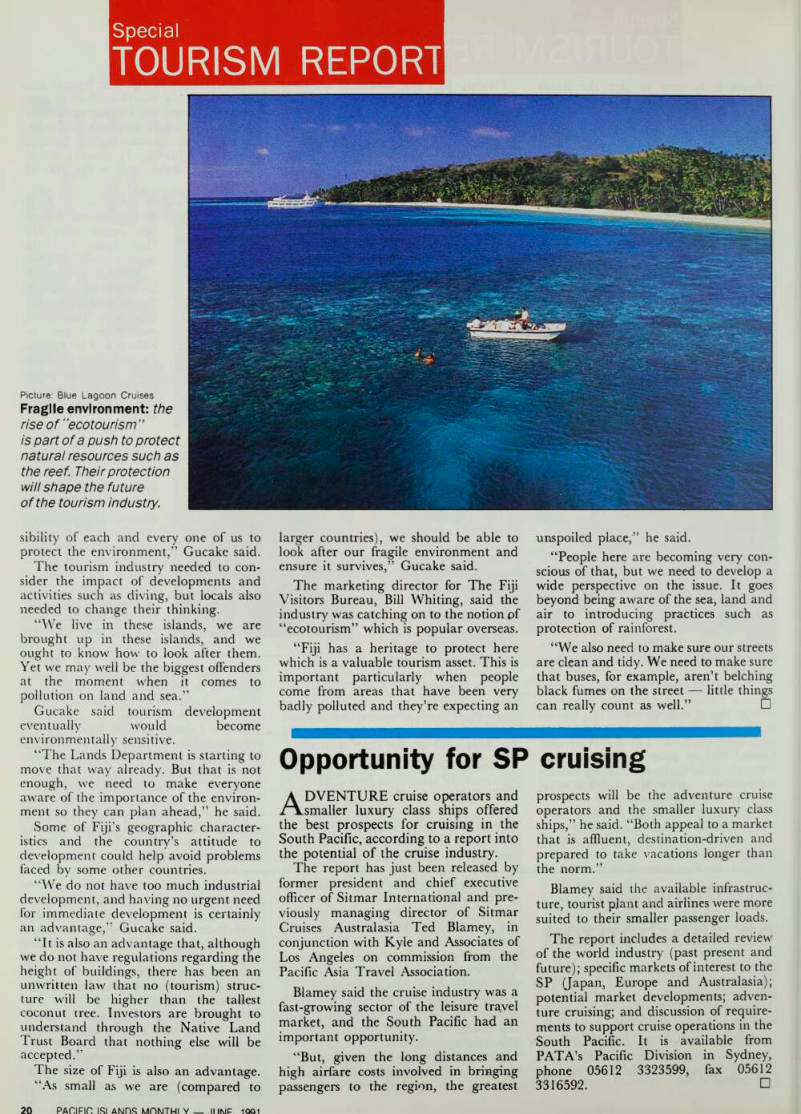
Picture: Blue Lagoon Cruises Fragile environment: the rise of “ecotourism” is part of a push to protect natural resources such as the reef. Their protection will shape the future of the tourism industry.