Deal
pp. 18-19 · Read in the full issue

Special
Tourism Report
The year of the Big Deal
By Beryl Cook
THE South Pacific must start wheeling and dealing hard in the high-flying world of tourism, to keep hold of the wings of tourism. The econ
omic downturn in major source countries for Pacific tourism and agggressive price cutting overseas has forced us to accept that this year will be, without question, The Year of the Big Deal.
Fiji hotels (widely accepted as tourism leaders for the South Pacific) are already feeling the pinch, with occupancy rates as low as 18 per cent in recent months.
Fiji Hotels Association (FHA) chief executive Kevin Mutton made it clear the worst is yet to come, when he advised the Government at the May Economic Summit that the association had revised its earlier 5 per cent estimate for the 1991 downturn, to 30 per cent.
“The message is quite clear: ‘We have to get off our bums and do something urgently or we will really be in trouble’,”
Mutton told Pacific Islands Monthly.
Individual hotels started dabbling in deals such as “Pay six nights and stay seven” months ago, and Air Pacific launched special fares such as SlO per year of age for accompanying children flying from Australia. The special airfares brought hotel occupancy rates up during March, but they plunged once the fares stopped. The hotels have been keen to blame airfares, while Air Pacific has diplomatically declined from point ing out that our range of accommodation and meal prices are higher than competi tors in Asia, Bali and Hawaii. Help from airlines throughout the region may be
limited they have all been hard hit (see article on page 23) and Air Pacific has been granted fare rises of up to 15 per cent from May 15 on most international destinations to cover expected rising costs. (Australian and New Zealand fares were not expected to be affected.) For now, a joint strategy has been adopted following an emergency meeting of Fiji’s hoteliers, airline officials, the Society of Fiji Tavel Agents and the Tourism Council of the South Pacific (TCSP) in Suva on May 15. Air Pacific has introduced a return airfare of 5499 from Australia (undercutting standard low-season economy fares by up to 5343), which is effective from June 7 until December (excluding school holidays ex- Sydney and Melbourne but not Bris bane) and available only with accommo dation packages. Hotels have added “Pay five days stay seven” and “Pay 10 days, stay 14” to make up packages they say could save an Australian couple about 44 per cent. Whether this will be enough remains to be seen.
The region has the natural attractions and reputation, and key players such as the TCSP will be marketing this aggressively. According to TCSP direc tor and chairman of the Fiji Tourism Convention Planning Committee, Malakai Gucake: “Emphasis will be on increasing the South Pacific’s awareness of new markets, and adding emphasis to traditional markets.”
Trade shows in the United States, Australia and London will be targeted.
Organisers of the Tourism Convention at the Sheraton from June 13-15 also have added marketing heavies to the list of speakers, including European tourism industry economist and marketing con sultant Esmond Devas, and Wilf Barker Australian Marketing Man of the Year 1985, former marketing director for Australia’s Nine and TEN networks, and former chairman of the Federation of Australian Television Stations, the Aus tralian Media Council, and the Advertis ing Industry Association.
Sales and Marketing Director for The Fiji Visitors Bureau, Bill Whiting, also
Cost-cutting competition: tourists want more than pretty smiles and swaying palms
believes it is time to face the harsh realities of the challenges ahead.
No-one was likely to be lulled by the record results for 1990, he said. (The number of visitors reached a record 278,996 an 11 per cent increase from 1989 to 1990; and gross earnings from tourism had been estimated provisionally at a record 5335.9 million compared with 5295.5 million in 1989).
Whiting said the biggest challenge for
Fiji (and therefore the region) would be the Australian market.
“The situation there right now is the most competitive, the most difficult that we’ve faced for many many years. The recession is tough, the competition is tough,” Whiting said. “We’ve got a good product and they’re still interested in it.
But everybody there is asking ‘What’s the deal to Fiji? What’s the fare?’, because the whole market is being motivated by deals. Whether you want to go to Melbourne or London and return, it’s all got a special deal attached to it. The whole market is deal-orientated and we have to be conscious of that.”
Whiting said overall performance for the next 12 months would be affected by the Australian crisis, and “how long we l*, , ; O see this crazy pricing going on”
Airline deals could be crucial.
“Some of those airlines must be really hurting, having to live with higher fuel prices, but they are offering incredible deals. I think we can compete with what is being offered in Australia, but a lot depends on how the airlines handle their fare structures,” Whiting said.
The South Pacific is facing the re cession in Australia, increased domestic competition in Australia through de regulation of internal airlines, and com petitive pricing by Australian resorts.
“On top of that, in terms of (Austra lian) outbound tourists, we have an excess of capacity on the Australia/ United States route,” Whiting said.
A ou have the northwest coming on soon with another four to five flights a week, so there is stiff competition.
“Similarly, Bali in the last year or 18 months have added about 8000 hotel rooms and you have competitive price
marketing there.”
Hawaii, Bali and Thailand are cost cutting e.g. Hawaii offered return fare and five nights accommodation for 5799.
Whiting said Fiji depended on Austra
lia for about 36 per cent of its visitors, but Australians stay longer so they represent about 47 per cent of Fiji’s tourisiti income.
“If we have a problem in Australia,
Fiji tourism has a prob lem,” he said. “We have to be competitive, we have to be able to hang in there, we have to accept that for some months we may have to live with lower yields from that market until it recovers, and until we decrease our dependence on that mar ket. What deals we can offer will directly affect how well we do.”
Other markets Whiting said the Bureau would look at new mar kets and expanding exist ing ones, while ensuring not too much ground was lost with Australia.
The US market held up better last year than the Bureau expected, and enormous potential had been identified in the United Kingdom and
Europe.
“Our UK/Europe ar rivals last year were in excess 0f40,000. We have to work on developing
those markets. We haven’t done much on them in the past and one of our targets from the Bureau’s point of view is to put more effort into increasing the business there, and decreasing our dependence on the short haul market from Australia.”
New Zealand: The Bureau is expect ing about the same from New Zealand as 1990, despite a tough economic climate.
Canada: Despite the fact Canadian Airlines is no longer senicing the route, the Bureau views the airline’s seat share arrangement with Qantas as evidence of
its commitment to Fiji. The Bureau also is finalising a 12 month-marketing pro gram with them, and has just opened an office there. Despite economic problems, (Canada was introducing a General Sales Tax on January 1), Canada should perform reasonably well in the next 12 months.
United States: Americans have
slowly started travel ling again after the Gulf crisis, but the impact is hard to read.
Australia in particu lar is pitching hard in North America, so the Bureau is maximising marketing there by
linking Fiji to Austra
lia and New Zealand with a campaign theme: ‘On his way to Australia, God created
Fiji.’
“If we can market Fiji as an essential part of a visit to the South Pacific we stand to
grow,” Whiting said.
Europe: * Con sidered extremely promising. The unifi cation of Germany in creased the potential market for three or four years time.
Scandinavia and the United Kingdom are sources, and Switzer land and Italy are growing. The Bureau
would like air links improved, but the potential is promising. Joint marketing with Australia and New Zealand is being used, and the Bureau is also using Tourism Council of the South Pacific representatives in London and Munich for Europe and the United Kingdom.
Between them they cover all of Europe.
Japan; Air Pacific started its second service on April 25, and the Bureau is expecting significant growth despite a slow start. Whiting said possible air links with Taiwan and South Korea rep resented medium-term potential. □
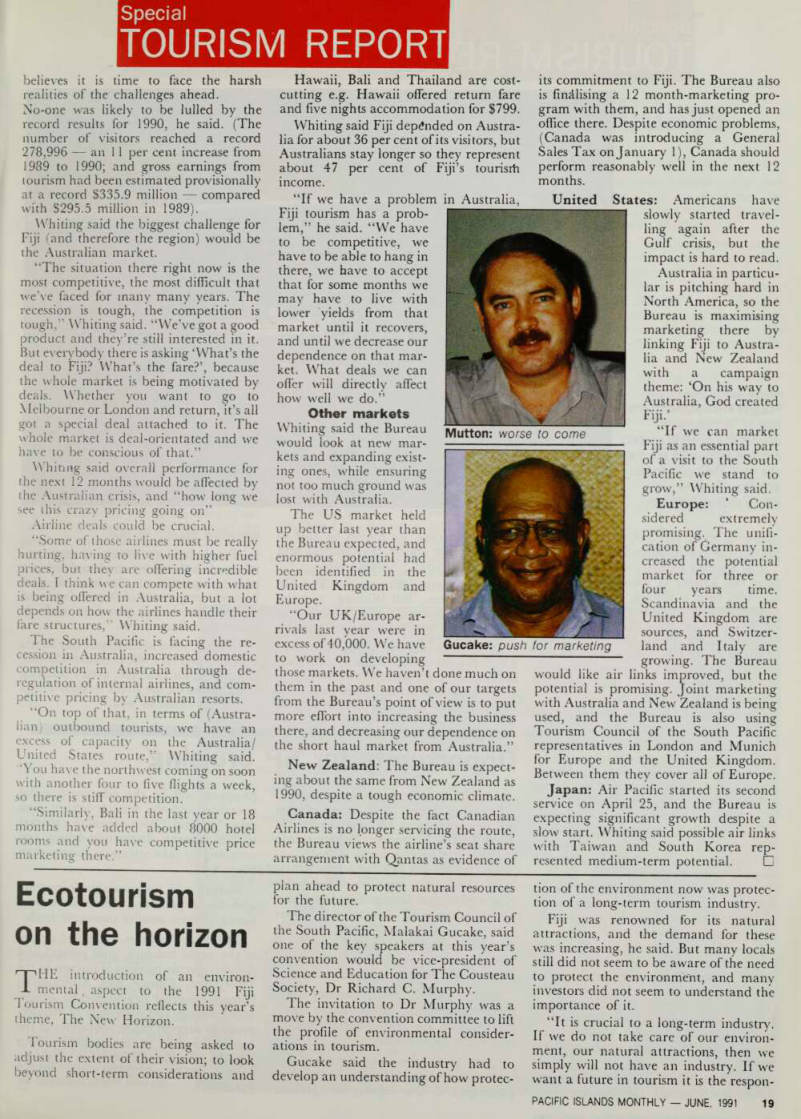
Mutton: worse to come
Gucake: push for marketing