The Bishop
pp. 53-54 · Read in the full issue
Interview
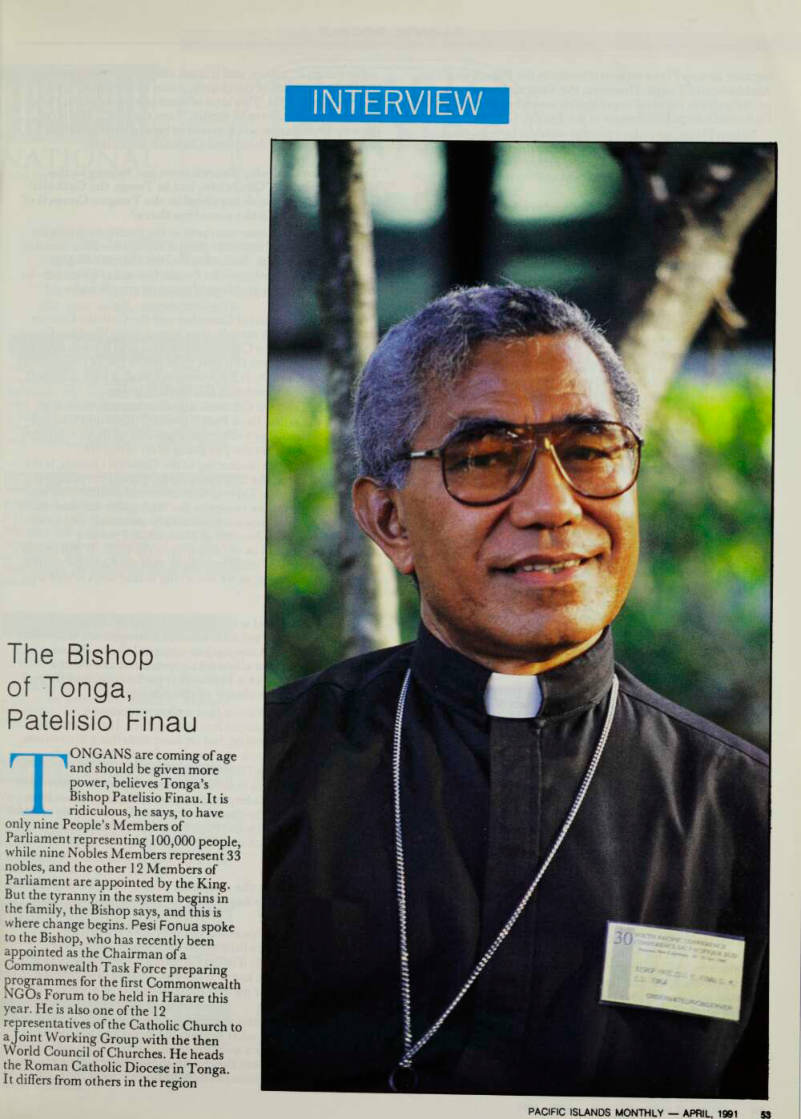
The Bishop of Tonga, Patelisio Finau
TONGANS are coming of age and should be given more power, believes Tonga’s Bishop Patelisio Finau. It is ridiculous, he says, to have only nine People’s Members of Parliament representing 100,000 people, while nine Nobles Members represent 33 nobles, and the other 12 Members of Parliament are appointed by the King.
But the tyranny in the system begins in the family, the Bishop says, and this is where change begins. Pesi Fonua spoke to the Bishop, who has recently been appointed as the Chairman of a Commonwealth Task Force preparing programmes for the first Commonwealth NGOs Forum to be held in Harare this year. He is also one of the 12 representatives of the Catholic Church to a Joint Working Group with the then World Council of Churches. He heads the Roman Catholic Diocese in Tonga.
It differs from others in the region
because Bishop Finau reports directly to the Pope who is the Archbishop of Tonga. However, the Tongan Diocese also participates in regional organisation and is represented at the Catholic Bishops Conference of the Pacific, CEPAC.
Bishop Finau, an ardent pacifist who has been outspoken about injustices he sees in Tonga, has clashed with King Tauga’ahau Tupou IV and Crown Prince Tupouto’a, who have accused him of being a marxist and an agent of the Pope.
Last April a group of New Zealanders were in Tonga, predicting that a coup would take place. They said they were inspired to come here after reading a comment you made in New Zealand about how Tonga was on the verge of a civil uprising, unless a drastic political change takes place. Did you make such a remark?
No, I do not think I gave people a cause to fear that there will be a revolution in Tonga. I think our people are very patient, and Christianity has something to do with it, Revolution in the heart, yes please, we want that; but as for violence, I do not believe in it. I never advocate it. In my honest opinion, I do not see physical violence. I suppose because I am a pacifist. If I am told to go to war, I won’t go. I think it is a certain attitude you reach after following the Lord.
You have publicly expressed concern about the well being of the poor and the oppressed. Do you notice any change in the attitude of the people in power toward these less fortunate members of the community?
I am sorry, but for me some of those in power are using their power unwisely, just to show off that they have the power. I would say though that the people are better informed on what is going on; I think it is their right to know. But then letting out this kind of information means there is a danger of physical violence. However, that is not a good reason either for people not to be informed or to keep them in ignorance.
On the other hand the churches should step up their teaching of non-violence. I know some theologians believe in violence, but that is were we part company. I see it as something like this: say in our family unit, are we going to give young people responsibility or are they going to be physically adults but only infants as far as exercising any power? He will do what he is told, he has no contribution in decision making.
Our people are coming of age and they should be given more power. Our system now with nine Members of Parliament, representing 100,000 people, and nine Nobles Representatives representing 33 nobles, and 12 MPs appointed by the King is just ridiculous. One day our grandchildren will laugh at how foolish we are. I mean, I just laugh at us now. If our King and nobles were palamgis we would not let this happen, we have been fooled by the fact that they are Tongans, our own people.
The King has labelled you as a Marxist. What do you think sparked off such a remark?
It could be that he was wrongly informed, but I am surprised that he believed it. He took a cheap type of approach. It has been done in so many countries and once a church person speaks out against the government they say, that he is a communist but, of course, today it does not work because communism is finished. It is like what a South American Bishop said, that when he gives food to the poor they call him a saint but when he asks the hungry why are they poor, they call him a communist. We have to be concerned about the root causes of the problems, not just bandaging wounds ... I consider myself a person who is very loyal to the people of Tonga and its King.
I think we can have a very beautiful system, if they work for service, but when they use their power not to serve the people but to get all the good things of life then that is wrong.
Is there a particular area in our culture where you see the Tongan culture and the teaching of Christ clash?
For example, power, and it is not only in government, but it is in the structure of the church, down to the village level, and the family level. This kind of domineering attitude, there is no consultation, even in family, T am the boss’. This is not the way Christian power is meant to be and there is a clash between our cultural way and Christian leadership.
The Roman Catholic Church does not belong to the World Council of Churches, but in Tonga the Catholic Church is very much involved in the Tongan Council of Churches. What is the situation there?
In Tonga and in most countries in the Pacific each diocese is a member of local national groups. We are always a member of any of these groups. In the Pacific, the Catholic Bishop Conference is a member of the Pacific Council of Churches. So in the Pacific we are members of national groups and a
provincial group.
The World Council of Churches and the Catholic Church work together. For example, they have a Joint Working Group, 12 members from the Catholic Church and 12 from the WCC, and I have been asked this year to be one of the 12 representing the Catholic Church. It is a seven-year term. I have accepted it and I will be a member of this working group.
The WCC and the CC work together, but still there is a technical difficulty. Pope Paul VI visited the World Council of Churches in Geneva some years ago and while he was there he asked, “And what are you going to do with Peter?”
Because the Pope, according to the Catholic Church, is the successor of Peter, the first aposde who was in charge of the church after Christ. There is an ecumenical difficulty because other churches do not recognise the Pope as the successor of Peter. The other thing is a question of numbers, if we join the Pacific Council of Churches as Dioceses and not as a Conference, we will be the majority in the PCC. It will be too overwhelming, and some may think that the Catholic church is trying to take over, so we are trying to find ways where we can work together...
You were involved with the First Pacific Regional Seminar of the World Methodist Evangelism Institute, January 8-18. Is it not rather unusual that a Roman Catholic Bishop is allowed to speak not once but a number of times in a Methodist gathering, and do you see this as a drive closer to church unity?
I interpreted it to mean that we have a common understanding, we do not fear one another. 11 does not mean that we share everything, but we have something in common, the gospel. The Bible is our treasure. It is sad that other churches do not want to work together.
Some people think that they can have a perfect church here on Earth, and that is impossible, only in heaven will we have a perfect church. The church on earth suffered because of sinful members whether it is the Pope or members, but that does not mean that the church is wrong, it is people that make false witness.
Do you think that the majority of the Tongan population over the years are beginning to understand the bible better?
They read the bible more, but they are very private Christians, with very little social conscience. We are very backward on that, as if being Christian is something between me and God, for me to get to heaven. Instead of something which is relevant for me and the community as a whole, the
people of Tonga.
The popular quotation which has been wrongly interpreted is, to give to Caesar what belongs to Caesar and to God what belongs to God. It is a question of paying tax. Now, what they are trying to say is that the church should have nothing to do with politics. It is a funny interpretation. □