Paradise found in the paintings
pp. 50-52 · Read in the full issue
Art
Paradise found in the paintings of a Mexican old movie buff
By Ed Rampell
IN style and subject, artist Keoni
Montes is to Hawaiiana painting what Norman Rockwell is to Americana art.
“He’s got that Polynesian look in all his portraits,” insists Sharon Nihipali, a Windward Oahu Hawaiian woman who commissioned Keoni to paint a portrait of her 14-year-old daughter. “Keoni’s picture looks exactly like Leilani. With other painters, you’ve got to look hard at the picture to see who it is. But Keoni’s canvas is so lifelike ... Leilani looks like
she’s looking right back at you.”
Patrick Doell, director of the Ko’olau Gallery, says “There’s a lot of interest in Keoni’s art because of the local subject matter. He captures Hawaiians real well.” Doell states that many Islanders enter the Windward Mall atelier, where Keoni is displaying the first major
exhibition of his oils, and “recognise models for the portraits. They say, T know that dancer’ or ‘canoe paddler!’ ”
What inspired this artist’s realistic techniques and oceanic obsession with Pacific Islanders? Although many, like gallery director Doell, at first mistake him for a Hawaiian, John “Keoni”
Montes originally hails from Guadala jara, Mexico. He was steeped in the rich Mexican creative tradition since his days as a small child. Both of his parents were ceramicists.
“My mother used to paint the poetry my father made,” Keoni confides. “The family had an angora cat that hated everyone except mama. That cat never came near me. Anyway, every now and then, when mom needed new art supplies, I’d see the cat run around with patches of hair missing. Then I’d see mom’s new brushes!”
Keoni was and remains to this day a big film buff. The Mexican went to the cinema to watch cowboy movies and he’d “always root for the Indians”. It was through the silver screen that the muchacho from south of the border first learned to love the South Seas. “I saw all of the Dorothy Lamour, Jon Hall sarong movies,” the film fan confesses.
Motion picture posters, as well as the old radio show Hawaii Calls piqued Keoni’s interest in the South Pacific. He began to haunt libraries for books about the Islands.
When he was still a youngster, the Monteses emigrated to El Norte, and Keoni spent his adolescence near moviedom’s capital, Hollywood. But even back then, despite his fascination with South Seas cinema, Keoni couldn’t help but notice that non-aboriginal
actors often portrayed Polynesians.
“They were usually Italians or Hispanics,” Keoni says.
One of them, Maria Montez, had a similar last name. The Mexican movie fan became increasingly aware that “Haole-wood” was manufacturing a
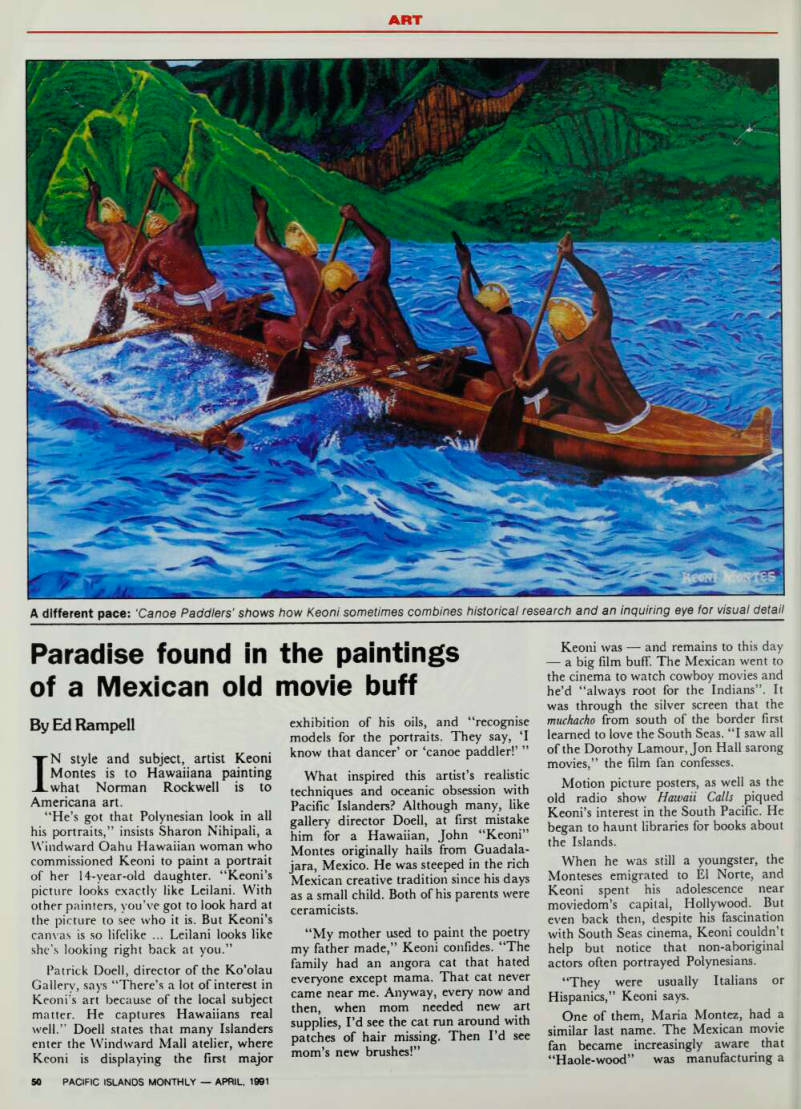
A different pace: 'Canoe Peddlers’ shows how Keoni sometimes combines historical research and an inquiring eye for visual detail
preconceived image of paradise.
So, in 1969, Keoni decided to behold what he had imagined for so long and embarked on a South Seas sojourn that changed his life forever.
Desiring to see for himself, he went on vacation to the Hawaiian Islands and the rest, as they say, is history. Like many before and after him, a holiday turned into a lifetime, and Keoni consummated his love affair with what Mark Twain called “The Isles of the blessed.”
“Hawaii was the home I w r as looking for all my life. I married the epitome of the Polynesian princess a Native Hawaiian and then a Samoan. That old brown magic got me,” Keoni says with a laugh.
Hooked on Hawaii, ever the art aficionado, Keoni wanted to buy auth entic Polynesian art, “but I couldn’t find it. The Island art then was a whitewash.”
Keoni goes on to say: “I feel Polynesians
are not being depicted authentically
enough. When I started painting in the mid-seventies, I couldn’t find faithful renditions of indigenous Islanders. Other ethnic groups were passed off as ‘Natives.’ I felt it was time to get back to basics, and like Captain Cook’s illustrator, John Webber to paint the real, true Polynesians.”
So, Keoni became a different kind of Mexican “bull” fighter, embarking on a quixotic creative Kanaka crusade. Un able to encounter what he considered to be realistic portrayals of contemporary Polynesians, he decided to create it. “I started to photograph every beautiful wahine I saw,” he says.
Keoni’s artistry flourished. By the early eighties, he created a fashion line of aboriginal apparel, calendars, silk screens, and more, featuring indigenous Islanders. The models for Keoni’s parens (sarongs), Aloha shirts, mumus, and T-shirts were always real-life Hawaiians,
Tahitians, Samoans and Tongans.
For about a year, Keoni operated the
Faces of Polynesia boutique featuring his
fashions, located at Puck’s Alley, near the University of Hawaii. His photos caught on, too. An accomplished photographer, Keoni’s pictures appeared on the cover of Hawaii publications and in Aloha Maga zine photo essays. The painter’s natural ism, which verges on photorealism, is a direct outgrowth of Keoni’s clean, crisp photographic vision. He brings the same insight-filled orb for detail and unerring eye for beauty to his canvases.
Keoni turned seriously to oils in the mid-eighties. Doell, of the Ko’olau Gal lery, describes a- Montes original as “real vibrant with bold colors. His paintings have a strong graphic style, with a lot of drawing. They’re so colourful they stand out.”
Keoni’s palette expresses the clear tropical light of the Islands. For collec tors and admirers, this colourful quality is an essential element in the paintings they love so well. But some aesthetes beg to differ. Dai Truong, a Vietnamese painter and owner of the shortlived Gauguin’s Art Gallery, exhibited a couple of Keoni’s canvases at Haleiwa.
“I call this “straight-out-of-the-tube’ painting. Keoni doesn’t mix his oil
paints,” Truong laments.
But the Montes formula can be summed up as “local color.” In form and
content, the artist brings alive the Polynesian way of life. The resonant hues embody, embrace, and express his South Seas subjects. Like Van Gogh before him, who sought the pure light of the tropics in the longed for Studio of the South, Keoni s canvases glow, imbued with what Gauguin called “the gold of their skins.” His realism transcends reality; the artist’s third eye probes the inner being of his modern models, to reveal and revel in their Islander essence. Stripped of civilisation and its discontents, within the confines of a Keoni canvas, the dancers, keikis (children), paddlers, and languid beauties become Oceanic Adams and
Eves in their Island Edens before the fall.
With a naturalistic technique, Keoni subtly conjures up Hawaii Nei, before the coming of Captain Cook.
The naturalist works in the tradition of those outsider artists who encountered the Pacific realm. Keoni is like John Webber, sketching and painting the Polynesian Wonderland from the prow of Cook’s HMS Endeavor. He is also the spritual heir of Parisian Post- Impressionist Paul Gauguin and Ameri can black velvet innovator Edgar Leeteg, who immortalised Tahid. Like the
Japanese sculptor and water colorist Hijikata and
French printmaker
Paul Jacoulet, who captured the quin tessence of Micro nesia, Keoni lives, breathes, and cre ates an authentic Island image.
But because of his representado nal style and depic tion of a particular life style, oddly enough, the artist Keoni bears most comparison to is one who painted North America, not Polynesia. He is Norman Rock well, that New York City slicker who moved to New England and ren dered immortal the culture of small town USA. It is his sensibility, the pre occupation with a way of life and a naturalistic mode to express it, that is Keoni’s hallmark.
The artist is probably best known for his sen
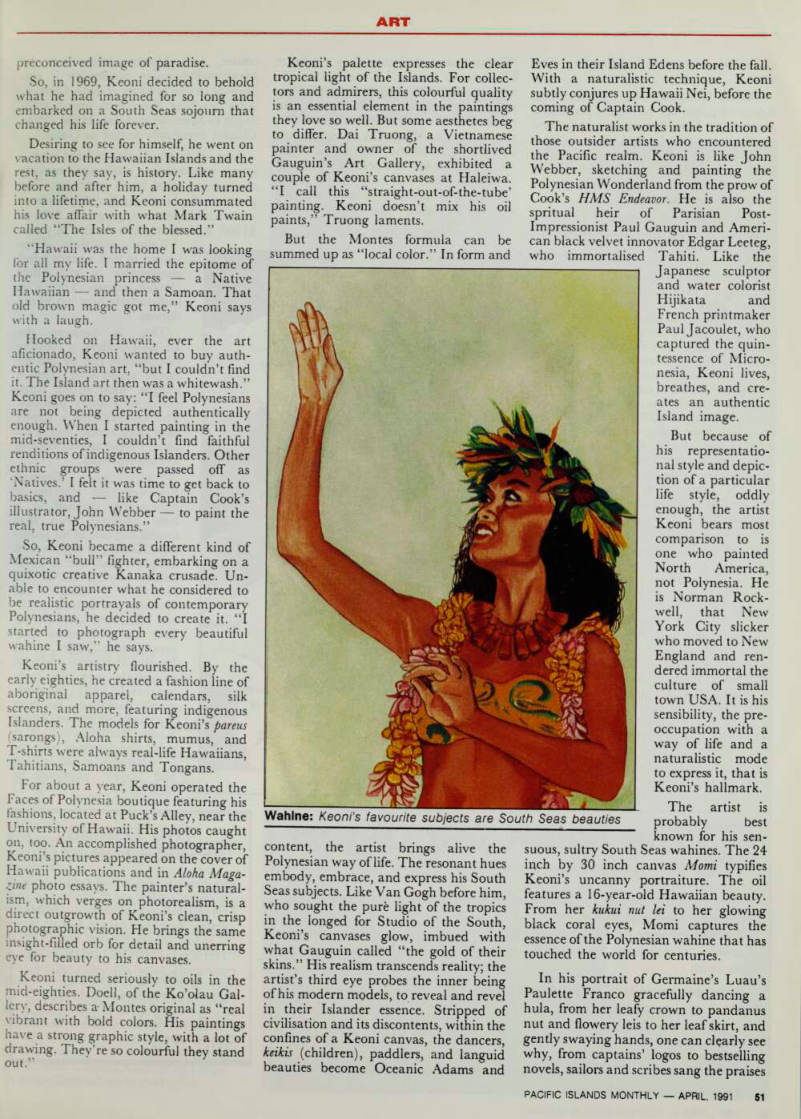
suous, sultry South Seas wahines. The 24 inch by 30 inch canvas Momi typifies Keoni’s uncanny portraiture. The oil features a 16-year-old Hawaiian beauty, From her kukui nut lei to her glowing black coral eyes, Momi captures the essence of the Polynesian wahine that has touched the world for centuries, In Bis portrait of Germaine’s Luau’s Paulette Franco gracefully dancing a hula, from her leafy crown to pandanus nut and flowery leis to her leaf skirt, and gently swaying hands, one can clearly see why, from captains’ logos to bestselling novels, sailors and scribes sang the praises
Wahine: Keoni’s favourite subjects are South Seas beauties
of Pacific womanhood throughout the ages.
Sharon Nihipali, who commissioned Keoni to paint her teenager, proclaims guests to her home “are in awe when they see the portrait”. In it, Leilani who performs in a Hawaiian hula halau (school) and met Keoni at a Tahitian dance competition is scantily clad in a bewitching pareu.
One of Montes’ models is Leimomi Bacalso, the former Miss Hawaiian
Islands and Miss Hawaii (for the Miss USA contest). How ever, although lovely wahines are Keoni’s calling card, one doesn’t have to be a beauty pageant winner to pose for the artist. In Canoe Paddlers , a 30 inch by 40 inch koa framed oil, Keoni combines historical re search with his inquiring eye for visual details. Keoni accu rately depicts six ancient kane (male) Hawaiians paddling an outrigger down Oahu’s Wind ward Coast. From the pad dler’s helmets to their males (loin cloths) to the sennit lash ing the canoe hull, Keoni realistically recreates tra ditional Pacific navigation.
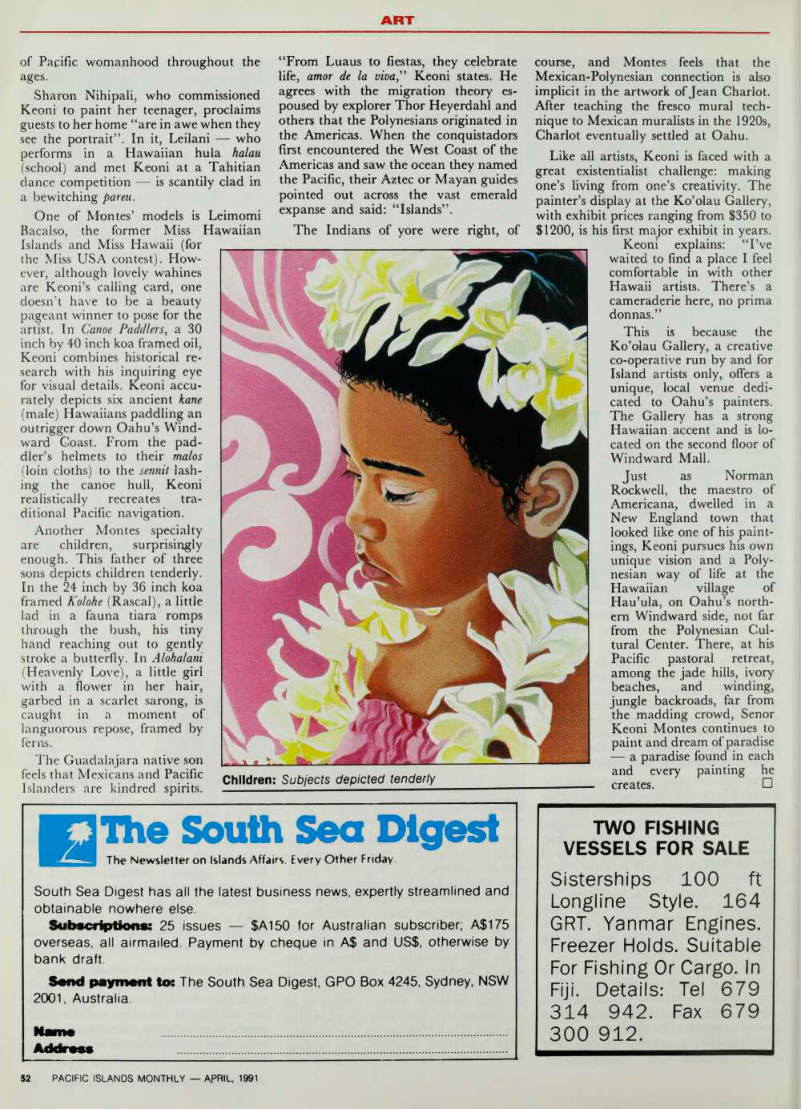
Another Montes specialty are children, surprisingly enough. This father of three
sons depicts children tenderly.
In the 24 inch by 36 inch koa framed Kolohe (Rascal), a little lad in a fauna tiara romps through the bush, his tiny hand reaching out to gently stroke a butterfly. In Alohalani (Heavenly Love), a little girl with a flower in her hair, garbed in a scarlet sarong, is caught in a moment of languorous repose, framed by ferns.
The Guadalajara native son feels that Mexicans and Pacific Islanders are kindred spirits.
“From Luaus to fiestas, they celebrate life, amor de la viva” Keoni states. He agrees with the migration theory es
poused by explorer Thor Heyerdahl and
others that the Polynesians originated in the Americas. When the conquistadors first encountered the West Coast of the Americas and saw the ocean they named the Pacific, their Aztec or Mayan guides pointed out across the vast emerald expanse and said: “Islands”.
The Indians of yore were right, of
course, and Montes feels that the Mexican-Polynesian connection is also implicit in the artwork of Jean Chariot.
After teaching the fresco mural tech nique to Mexican moralists in the 19205, Chariot eventually settled at Oahu.
Like all artists, Keoni is faced with a great existentialist challenge: making one’s living from one’s creativity. The painter’s display at the Ko’olau Gallery, with exhibit prices ranging from $350 to $l2OO, is his first major exhibit in years.
Keoni explains: “I’ve waited to find a place I feel comfortable in with other Hawaii artists. There’s a cameraderie here, no prima donnas.”
This is because the Ko’olau Gallery, a creative co-operative run by and for Island artists only, offers a unique, local venue dedi cated to Oahu’s painters.
The Gallery has a strong Hawaiian accent and is lo cated on the second floor of Windward Mall.
Just as Norman Rockwell, the maestro of Americana, dwelled in a New England town that looked like one of his paint ings, Keoni pursues his own unique vision and a Poly nesian way of life at the Hawaiian village of Hau’ula, on Oahu’s north ern Windward side, not far from the Polynesian Cul tural Center. There, at his Pacific pastoral retreat, among the jade hills, ivory beaches, and winding, jungle backroads, far from the madding crowd, Senor Keoni Montes continues to paint and dream of paradise a paradise found in each and every painting he creates. □
Children: Subjects depicted tenderly