Putting a pricetag
p. 32 · Read in the full issue
pricetag on development
By David North
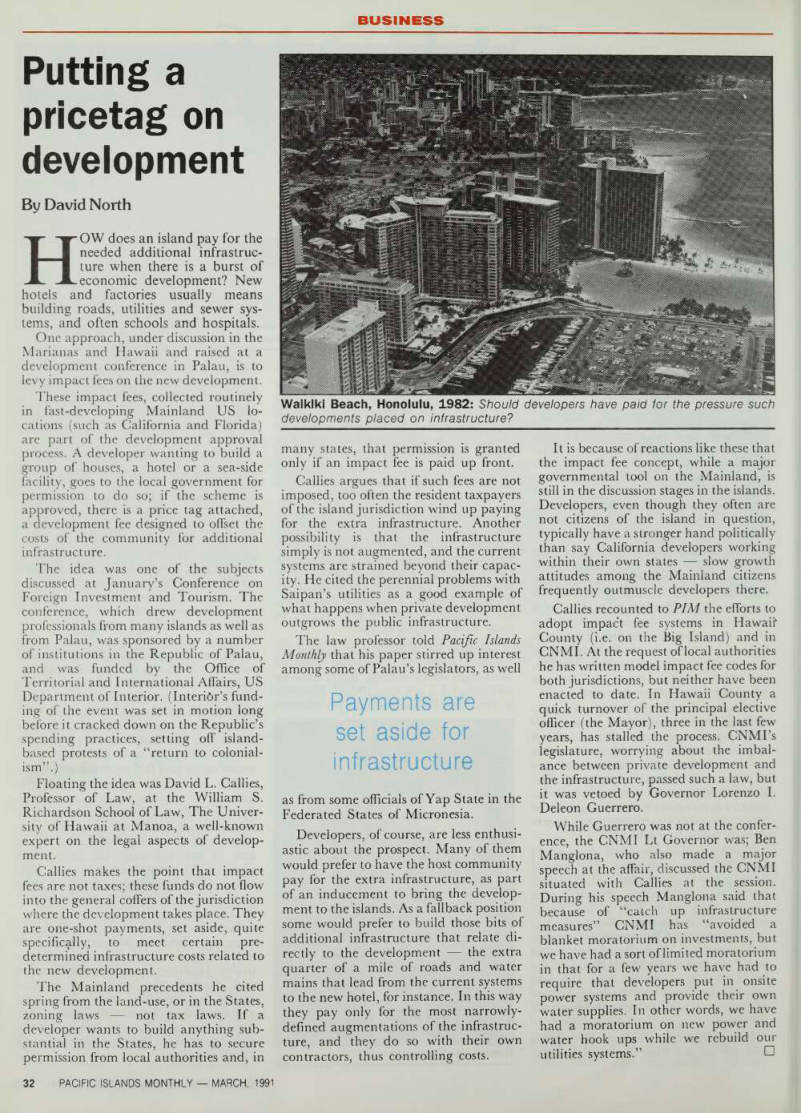
HOW does an island pay for the needed additional infrastruc ture when there is a burst of economic development? New hotels and factories usually means building roads, utilities and sewer sys tems, and often schools and hospitals.
One approach, under discussion in the Marianas and Hawaii and raised at a development conference in Palau, is to levy impact fees on the new development.
These impact fees, collected routinely in fast-developing Mainland US lo cations (such as California and Florida) are part of the development approval process. A developer wanting to build a group of houses, a hotel or a sea-side facility, goes to the local government for permission to do so; if the scheme is approved, there is a price tag attached, a development fee designed to offset the costs of the community for additional infrastructure.
The idea was one of the subjects discussed at January’s Conference on Foreign Investment and Tourism. The conference, which drew development professionals from many islands as well as from Palau, was sponsored by a number of institutions in the Republic of Palau, and was funded by the Office of Territorial and International Affairs, US Department of Interior. (Interior’s fund ing of the event was set in motion long before it cracked down on the Republic’s spending practices, setting off island based protests of a “return to colonial ism”.) Floating the idea was David L. Callies, Professor of Law, at the William S.
Richardson School of Law, The Univer sity of Hawaii at Manoa, a well-known expert on the legal aspects of develop ment.
Callies makes the point that impact fees are not taxes; these funds do not flow into the general coffers of the jurisdiction
where the development takes place. They
are one-shot payments, set aside, quite specifically, to meet certain pre determined infrastructure costs related to the new development.
The Mainland precedents he cited spring from the land-use, or in the States, zoning laws not tax laws. If a developer wants to build anything sub stantial in the States, he has to secure permission from local authorities and, in
many states, that permission is granted only if an impact fee is paid up front.
Callies argues that if such fees are not imposed, too often the resident taxpayers of the island jurisdiction wind up paying for the extra infrastructure. Another possibility is that the infrastructure simply is not augmented, and the current systems are strained beyond their capac ity. He cited the perennial problems with Saipan’s utilities as a good example of what happens when private development outgrows the public infrastructure.
The law professor told Pacific Islands Monthly that his paper stirred up interest among some of Palau’s legislators, as well
Payments are set aside for infrastructure
as from some officials of Yap State in the Federated States of Micronesia.
Developers, of course, are less enthusi astic about the prospect. Many of them would prefer to have the host community pay for the extra infrastructure, as part of an inducement to bring the develop ment to the islands. As a fallback position some would prefer to build those bits of additional infrastructure that relate di rectly to the development the extra quarter of a mile of roads and water mains that lead from the current systems to the new hotel, for instance. In this way they pay only for the most narrowly defined augmentations of the infrastruc ture, and they do so with their own contractors, thus controlling costs.
It is because of reactions like these that the impact fee concept, while a major governmental tool on the Mainland, is still in the discussion stages in the islands.
Developers, even though they often are not citizens of the island in question, typically have a stronger hand politically than say California developers working within their own states slow growth attitudes among the Mainland citizens
frequently outmuscle developers there.
Callies recounted to PIM the efforts to adopt impact fee systems in County (i.e. on the Big Island) and in CNMI. At the request of local authorities he has written model impact fee codes for both jurisdictions, but neither have been enacted to date. In Hawaii County a quick turnover of the principal elective officer (the Mayor), three in the last few years, has stalled the process. CNMI’s legislature, worrying about the imbal ance between private development and the infrastructure, passed such a law, but it was vetoed by Governor Lorenzo I.
Deleon Guerrero.
While Guerrero was not at the confer ence, the CNMI Lt Governor was; Ben Manglona, who also made a major speech at the affair, discussed the CNMI situated with Callies at the session.
During his speech Manglona said that because of “catch up infrastructure measures” CNMI has “avoided a blanket moratorium on investments, but we have had a sort of limited moratorium in that for a few years we have had to require that developers put in onsite power systems and provide their own water supplies. In other words, we have had a moratorium on new power and water hook ups while we rebuild our utilities systems.” D
Waikiki Beach, Honolulu, 1982: Should developers have paid for the pressure such developments placed on infrastructure?